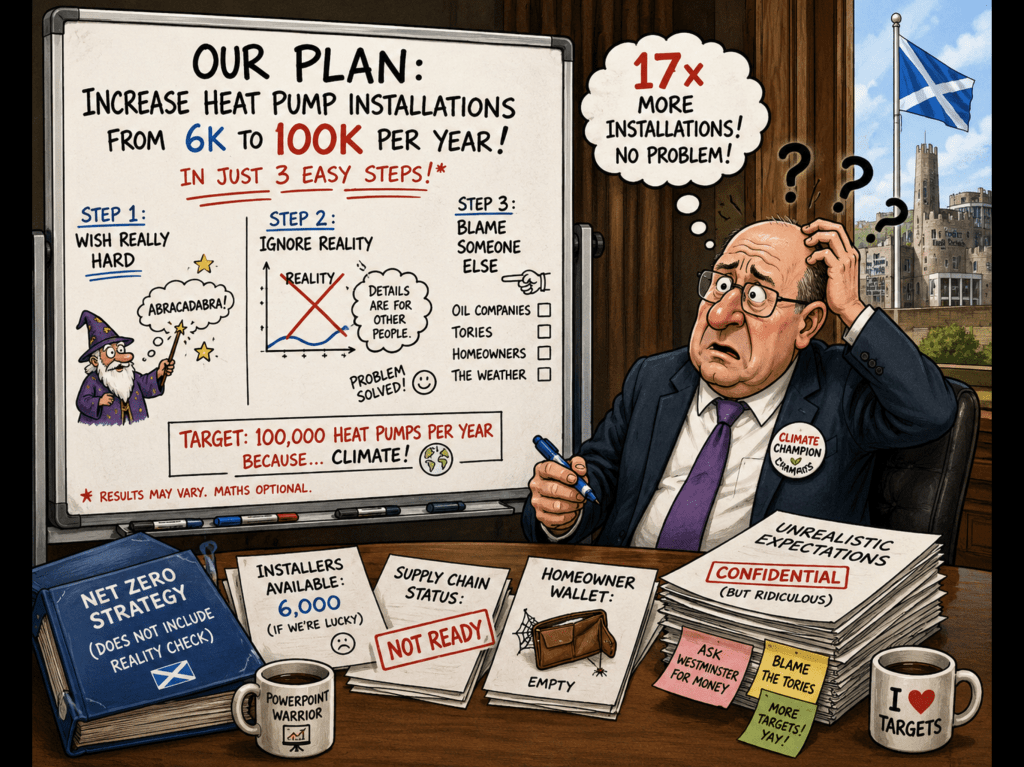
The Scottish Government says it wants to ramp up heat pump installations from around 6,000 a year to 100,000 a year. Which sounds less like a policy target and more like someone accidentally leaning on the calculator after three espressos and a motivational TED Talk. ☕📈
Because let’s be honest: multiplying installations by 17 isn’t just “ambitious.” It’s the political equivalent of announcing Dundee United will win the Champions League by Thursday.
❄️ “Just Replace Your Heating System” — Says People Not Paying the Bill 💸
The problem isn’t that people hate cleaner technology. Most homeowners aren’t anti-heat-pump zealots hiding in candlelit boiler bunkers whispering sweet nothings to their gas combis.
The problem is cost. Timing. Practicality. And trust.
A huge number of homeowners only replace heating systems when:
- the boiler dies dramatically in January 💀
- repair costs become ridiculous 🔧
- warranties expire 📜
- or energy savings actually make financial sense 💷
Nobody wakes up on a Tuesday morning and says:
“Honey, shall we spend £15,000 ripping up perfectly functional heating because a minister made a PowerPoint?” 😭
And then comes the awkward political maths.
Council housing upgrades can be centrally funded, bulk contracted, and spread over public borrowing. Fair enough. But private homeowners? That’s where the fantasy collides with reality like a £40,000 EV hitting a pothole outside Falkirk.
Many ordinary households are already squeezed by:
- mortgages 🏦
- food inflation 🛒
- energy bills ⚡
- insurance hikes 📈
- and the general thrill ride known as “modern Britain”
So when governments imply private owners should effectively absorb huge transition costs while public housing gets subsidised upgrades, resentment is inevitable.
🛠️ The Real Bottleneck Nobody Wants to Admit
Even if demand magically appeared overnight… who’s fitting 100,000 systems annually?
You’d need:
- a massive increase in trained installers 👷
- upgraded electrical infrastructure ⚡
- supply chain expansion 🚚
- consumer confidence 🤝
- planning reform 🏗️
- and pricing low enough that normal people don’t feel financially mugged
Right now, many households still hear:
“Heat pumps work brilliantly… provided your house is insulated like a Scandinavian laboratory and you own shares in an electricity company.” 🥶
That perception may not always be fair — modern systems can work well — but perception matters politically.
😂 Net Zero by Wishful Thinking™
Too much climate policy is announced backwards:
- Announce giant headline target 🎤
- Clap loudly 👏
- Hope reality catches up later 🤞
But people aren’t spreadsheets. You can’t centrally plan millions of individual financial decisions and expect zero pushback.
If governments want mass adoption, the route is obvious:
- make systems genuinely cheaper
- make installation painless
- reduce electricity costs
- improve grants
- prove reliability long term
- and stop talking to homeowners like they’re obstacles instead of taxpayers
Because right now, many Scots hear “green transition” and translate it as:
“Congratulations! You’ve been selected to finance infrastructure the state can’t afford.” 💸🔥
🔥Challenges🔥
Can the Scottish Government realistically hit 100,000 heat pump installs a year — or is this another target designed for headlines rather than reality?
Would you replace a working boiler voluntarily?
Should taxpayers subsidise private homeowners?
Or should governments stop announcing massive targets before the workforce and infrastructure exist?
Drop your thoughts in the blog comments. The best takes, rants, and reality checks might feature in the next magazine issue. 💬⚡
👇 Like, comment, and share if you’re tired of political targets that sound like they were invented during a late-night strategy meeting and a biscuit shortage. 🍪
The sharpest comments will be featured in the magazine. 📝🔥
Chameleon News


Leave a Reply