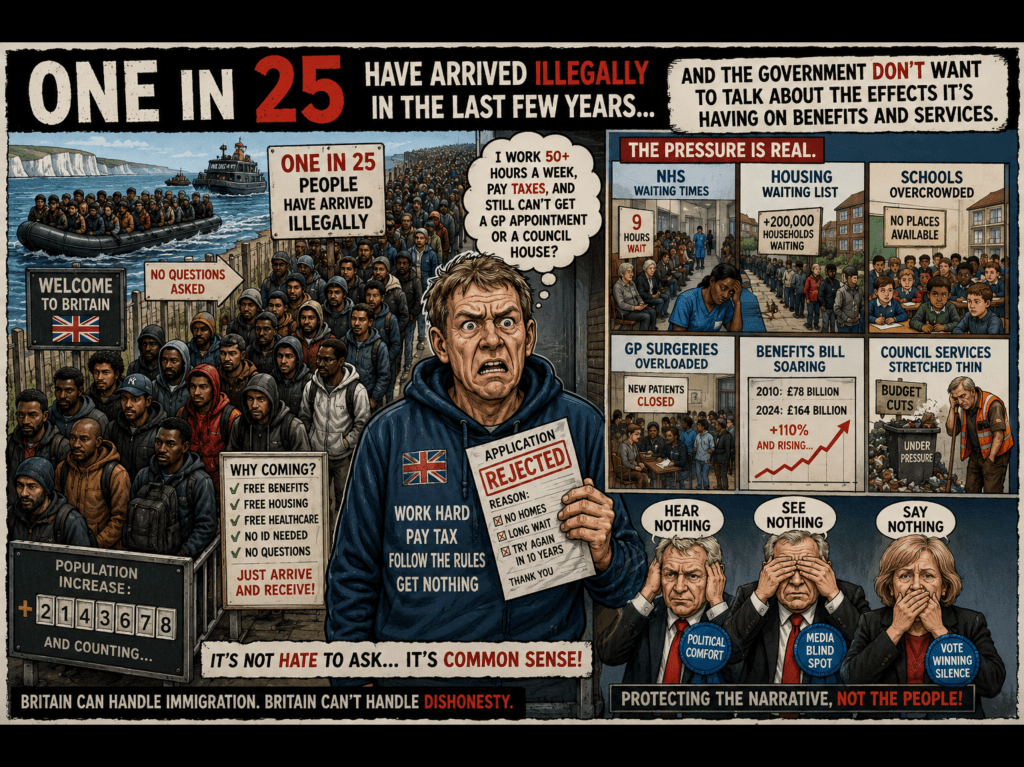
Britain can apparently debate the temperature of a sausage roll for three weeks straight… but mention the pressure mass migration places on housing, schools, GP surgeries, benefits, or infrastructure and suddenly Westminster develops selective mutism. 🎭📉
For millions of ordinary people, the frustration isn’t simply about borders anymore. It’s about a growing feeling that the political class refuses to acknowledge what people can visibly see happening around them every single day.
Overcrowded GP surgeries.
Longer NHS waits.
Housing shortages.
School places stretched thin.
Rents spiralling.
Councils buckling financially.
Public services creaking like an old shopping trolley with one broken wheel. 🛒💥
And yet whenever concerns are raised, the conversation instantly gets wrapped in political landmines instead of practical reality.
🚪 “Don’t Notice What You’re Clearly Noticing”
That’s the part driving public anger into overdrive.
People are repeatedly told:
- “There’s no link.”
- “The pressure is exaggerated.”
- “The numbers are manageable.”
- “You shouldn’t discuss it that way.”
Meanwhile the average citizen is sitting in A&E for nine hours wondering if they hallucinated the collapse happening around them. 🏥⌛
The issue becomes explosive because many voters no longer believe the political establishment is being fully honest about scale, impact, or long-term planning.
And once trust disappears, suspicion fills the vacuum.
Because this isn’t only about immigration itself — it’s about whether infrastructure, housing, welfare systems, and public services were ever prepared for rapid population growth in the first place.
That’s the question politicians increasingly seem terrified to answer directly. 🤐🔥
🏚️ The Pressure Cooker Britain Created
The public frustration grows sharper when ordinary working people are told there’s:
- “No money.”
- “No housing.”
- “No capacity.”
- “No resources.”
Yet somehow the population keeps rising while infrastructure expansion moves at the speed of a man assembling IKEA furniture with no instructions and two missing screws. 🪛📦
And politically, the optics become brutal.
Citizens struggling with rents, waiting lists, and taxes hear leaders celebrate “economic growth” while their actual lived experience feels more like managed decline with nicer slogans attached.
That disconnect is where resentment festers.
Not everybody raising concerns is motivated by hatred or hostility.
Many are simply asking:
- Can services cope?
- Who pays?
- What is the long-term plan?
- Why does honest debate feel censored?
And governments ignoring those questions usually doesn’t make tensions disappear.
It makes them worse. ⚠️
🔥Challenges🔥
Should governments be far more transparent about the real impact migration has on housing, benefits, healthcare, and public services? Or has honest debate become politically impossible in modern Britain? 🇬🇧💬
Drop your thoughts directly into the blog comments — not just social media outrage farming. We want solutions, fury, facts, sarcasm, and debate. 🔥📝
👇 Comment, like, and share if you think Britain deserves an honest conversation about population pressure and public services.
The sharpest comments and strongest arguments will be featured in the next issue of the magazine. 🎯
Chameleon News


Leave a comment