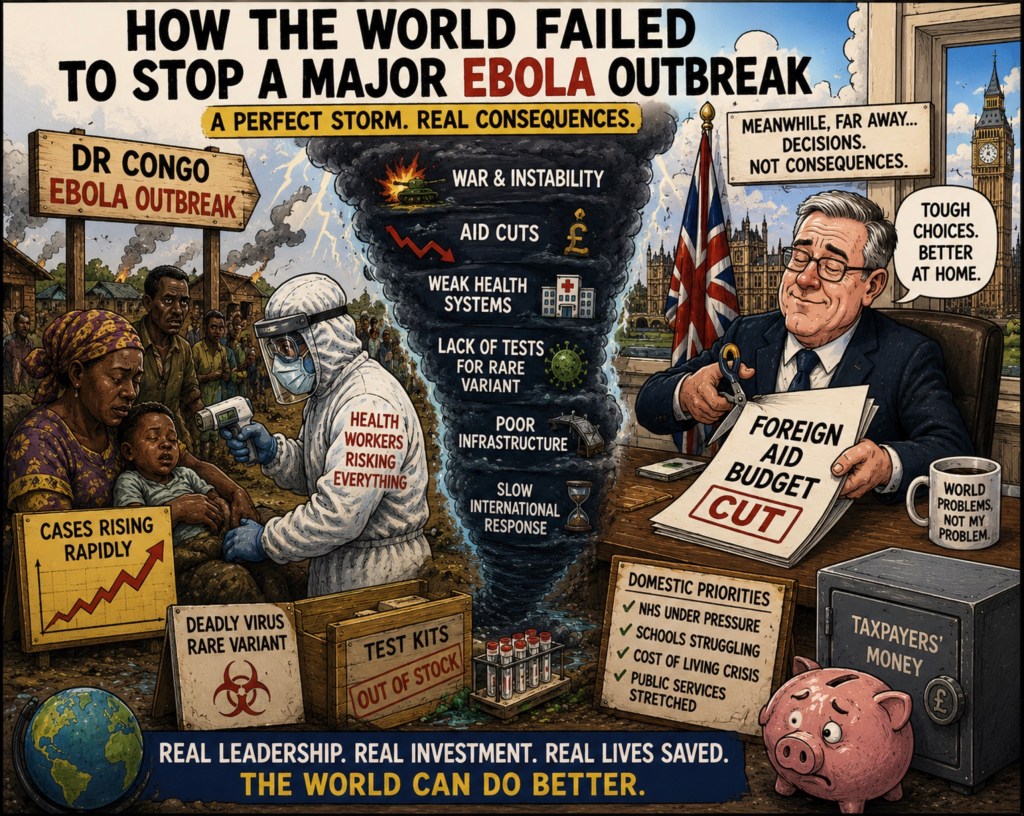
🌍💸🤦A major Ebola outbreak in Congo is now being linked to war, collapsing healthcare systems, aid disruption, and failures in disease detection. Yet somehow, as predictably as rain at Wimbledon, the moral finger-wagging machine has already shifted toward Britain and foreign aid cuts.
Because apparently, in modern politics, British taxpayers are now personally responsible for every crisis on Earth. 🇬🇧💀
The Global Guilt Subscription Service
💳🌎There’s a serious humanitarian crisis unfolding in Congo. Ebola is terrifying, deadly, and devastating for affected communities.
But what increasingly frustrates many ordinary people in Britain is the automatic political reflex that follows every international disaster:
“Why didn’t UK taxpayers spend more money?”
Not:
- Why is there chronic instability in the region?
- Why has corruption plagued aid distribution for decades?
- Why are international systems repeatedly failing?
- Why do local conflicts keep destroying infrastructure?
No — somehow the answer always circles back to:
“Britain must pay more.” 💸
Meanwhile, back home:
- Families struggle with energy bills
- Public services are stretched
- Housing shortages worsen
- Millions are spent managing migration pressures
- Tax burdens keep rising
And ordinary workers are constantly told there’s “no money” for them — unless it involves another overseas commitment accompanied by emotional blackmail and solemn BBC music.
Compassion Fatigue Is Real
⚖️Most people are compassionate.
Most people don’t want suffering anywhere.
But compassion becomes harder to sustain when governments appear more emotionally invested in global image management than fixing problems at home.
Many taxpayers increasingly feel they are being treated less like citizens and more like an endless ATM for international crises they neither caused nor control.
And that resentment grows every time legitimate questions are dismissed as “selfish” or “uncaring.”
Because people notice the contradiction:
Britain is told to cut services, raise taxes, and tighten belts domestically…
while simultaneously being lectured that reducing foreign aid makes us morally responsible for epidemics thousands of miles away.
That argument doesn’t persuade struggling households.
It alienates them.
The Bigger Question Nobody Wants to Ask
🌍🔥At what point does a nation prioritise its own stability first?
That’s the uncomfortable debate increasingly bubbling beneath the surface of British politics:
- How much should Britain spend abroad while domestic pressures mount?
- Can endless aid spending actually solve deeply rooted regional instability?
- And why are ordinary taxpayers always expected to absorb both the financial burden and the moral guilt?
These are legitimate political questions — even if parts of the establishment hate hearing them.
🔥Challenges🔥
Should Britain prioritise fixing problems at home before increasing overseas aid commitments? Or does cutting foreign aid create even bigger global consequences later on?
💬 Drop your thoughts in the blog comments.
💸 Where should taxpayers’ money go first?
📢 Like, share, and join the debate.
The sharpest comments and strongest arguments will feature in the next issue of the magazine. 📝🔥


Leave a comment