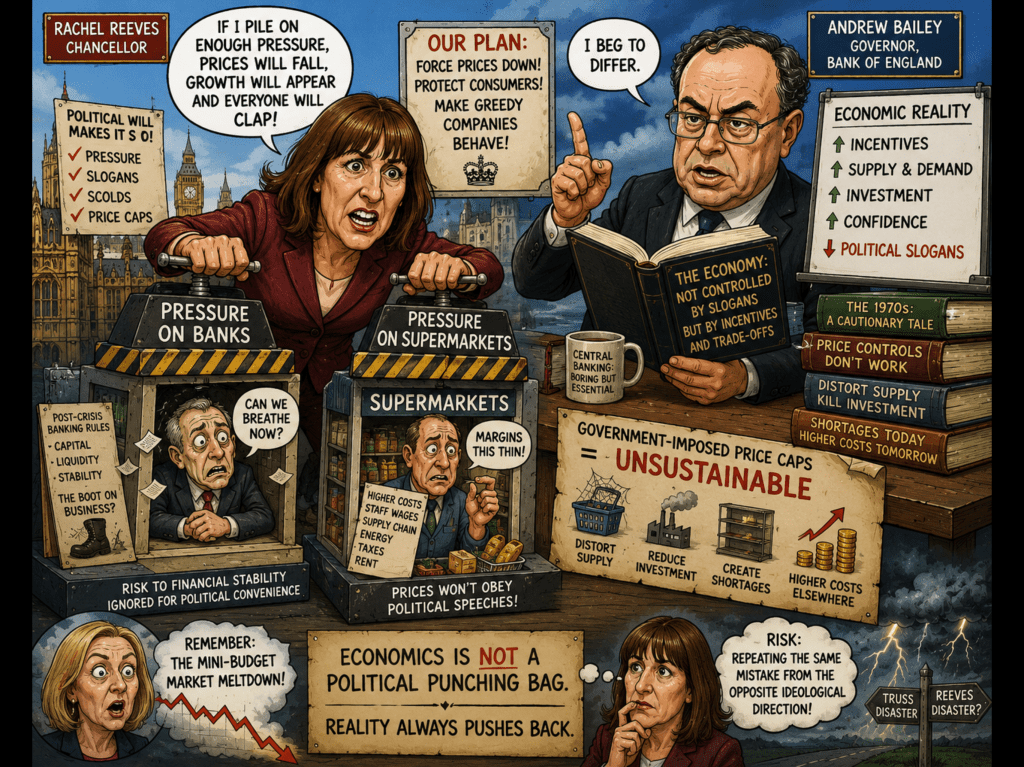
💷🧱Rachel Reeves appears increasingly convinced that economics is basically politics with better stationery. If she pressures enough banks, scolds enough supermarkets, and delivers enough carefully rehearsed slogans from a podium, then surely inflation will politely sit down, prices will behave, and growth will burst through the floorboards like a West End musical finale. 🎭📈
Unfortunately for Westminster fantasy economics, Andrew Bailey — the permanently exhausted-looking governor of the Bank of England — keeps wandering into the room holding spreadsheets and ruining the mood. 📊😐
Because while politicians like to believe economies obey speeches, economics has this deeply irritating habit of responding to incentives, confidence, risk, supply, demand, and other boring realities ministers can’t simply hashtag away. 🏦⚙️
🏛️ Westminster vs The Laws of Economics
Bailey’s warnings about price controls weren’t subtle. He practically dragged the ghost of the 1970s into the room by the collar and pointed at it like a traumatised history teacher. 📚👻
Price caps always sound wonderful in political speeches:
“Force prices down!”
“Protect consumers!”
“Make greedy companies behave!”
Fantastic. Until shelves empty, investment collapses, suppliers vanish, and suddenly the government is discovering that supermarkets are not magical public utilities fuelled by moral outrage and ministerial finger-pointing. 🛒🔥
The problem with Reeves’ approach is that it assumes markets behave like civil servants — obediently responding to memos and pressure from above. But markets behave more like cats: unpredictable, self-interested, and likely to claw your face off if handled badly. 🐈💥
And Andrew Bailey knows this because he’s already survived one economic psychodrama. Liz Truss treated markets like they were optional. The result was the financial equivalent of driving a shopping trolley through a fireworks factory while yelling “growth plan!” 🎆🛒
Now Reeves risks making the mirror-image mistake from the opposite political direction — believing government can simply will economic outcomes into existence through pressure campaigns, speeches, and performative toughness.
But economics isn’t Twitter. You cannot ratio inflation. 📱💸
And there’s something darkly hilarious about politicians repeatedly acting shocked that businesses respond to costs, regulation, taxation, and uncertainty rather than motivational speeches from the Treasury bench. It’s like watching someone scream at a kettle because boiling water refuses to become champagne. ☕🍾
Meanwhile Bailey increasingly resembles Britain’s exhausted financial babysitter — standing in the corner muttering:
“Please stop pressing buttons you don’t understand.” 😩🔘
🔥Challenges🔥
Can governments genuinely steer markets through political pressure, or are Reeves and others repeating the same dangerous fantasy that reality bends to ministerial messaging? Have politicians learned anything from Truss… or are they simply trying a different flavour of economic wishful thinking? 💬⚡
Drop your thoughts in the blog comments. Is Bailey the last adult in the room — or just another technocrat standing between politicians and their economic experiments? 📉👀
👇 Comment, like, and share if you think economics eventually punishes everybody who mistakes slogans for strategy.
The sharpest takes and best burns will be featured in the next issue of the magazine. 🎯📝
Chameleon News


Leave a comment