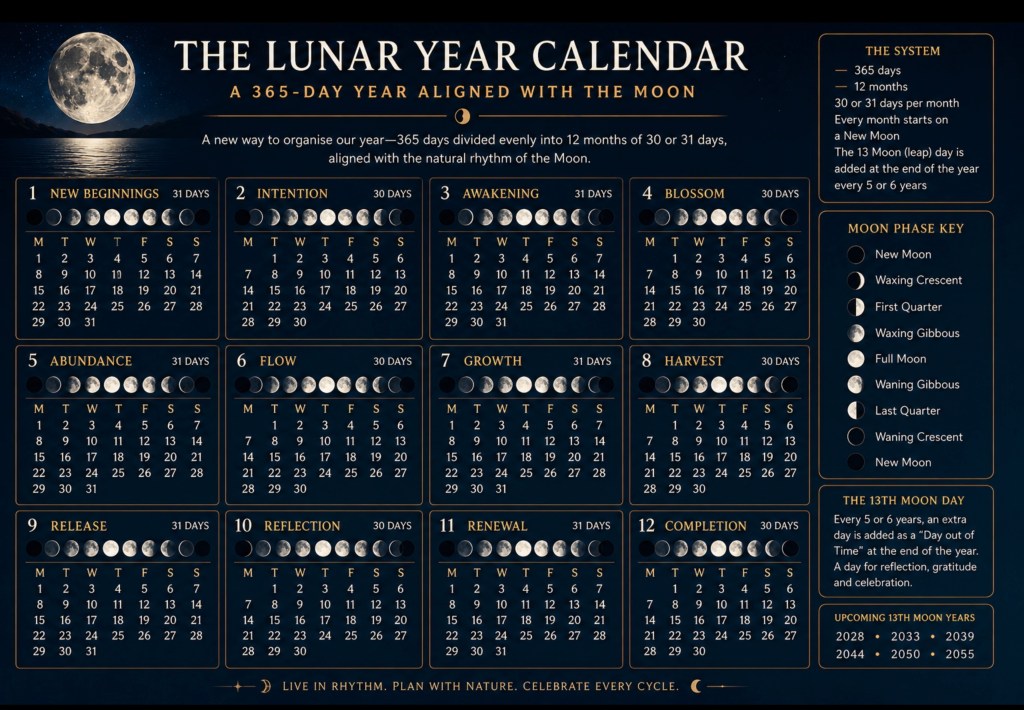
What started as a simple conversation about calendars quickly turned into something far more interesting.
Like most people, I had always accepted the modern calendar without really questioning it. Twelve uneven months. Strange historical names. Leap years awkwardly inserted to repair drift. A system built from layers of Roman politics, religious reforms, and centuries of adjustments.
But then a simple question was asked:
What if we redesigned the calendar from scratch?
Not as a gimmick. Not as fantasy. But as a cleaner, more natural way of organising time.
That question led to a fascinating collaboration with ChatGPT, where together we explored the possibility of building a completely new 365-day calendar aligned not with emperors or ancient politics, but with natural cycles — particularly the Moon.
The result became something called “The Lunar Year Calendar.”
A Calendar Built Around Rhythm
The first thing we noticed was how disconnected the modern calendar feels from nature itself.
Months vary unpredictably between 28, 30, and 31 days. Their names no longer carry meaning. Weeks drift through the months with no symmetry. The system works, but it feels mechanical rather than alive.
The Lunar Year Calendar approached time differently.
Instead of focusing purely on administration, the design focused on rhythm.
Each month was given symbolic names connected to stages of growth, emotion, reflection, and renewal:
New Beginnings
Intention
Awakening
Blossom
Abundance
Flow
Growth
Harvest
Release
Reflection
Renewal
Completion
Suddenly the year no longer felt like a list of disconnected dates. It felt like a journey.
The months themselves became psychological markers rather than arbitrary labels inherited from long-dead rulers.
Why the Idea Works So Well
What surprised me most was how quickly the system began to feel intuitive.
Humans naturally think in cycles:
sleep and waking,
seasons,
tides,
growth and decay,
beginnings and endings.
The Moon has guided agriculture, navigation, spirituality, and ritual for thousands of years, yet modern society almost completely ignores it when organising time.
The AI recognised something interesting almost immediately:
people respond emotionally to rhythm.
By aligning months visually with lunar phases, the calendar became more than a scheduling tool. It became reflective. The passage of time felt visible.
Even the concept of a “13th Moon Day” emerged naturally from the discussion — an occasional extra day outside the normal structure, treated not as an accounting correction, but as a symbolic pause in time dedicated to gratitude, reflection, and reset.
That single idea alone feels more human than the awkward leap-year logic we currently use.
The Unexpected Part: AI as a Creative Partner
What made the experience genuinely fascinating was not simply the final calendar itself, but how the ideas developed.
ChatGPT was not just answering questions. It was actively helping shape concepts, aesthetics, structure, symbolism, and logic simultaneously.
Within minutes the AI was:
• designing visual calendar systems,
• suggesting symbolic month names,
• integrating lunar cycles,
• balancing mathematics with psychology,
• and presenting the entire idea as a coherent civilisation-level redesign.
It felt less like using software and more like brainstorming with an endlessly patient conceptual designer.
That may be one of the most important glimpses into the future of AI.
Not replacing human imagination —
but accelerating it.
The Bigger Question
The Lunar Year Calendar may never replace the Gregorian system. Governments, finance, and global infrastructure are deeply tied to the current calendar.
But that almost misses the point.
The exercise revealed something important:
many of the systems we live by are inherited, not perfected.
AI allows us to revisit assumptions humans stopped questioning centuries ago.
Why do months have these names?
Why are they uneven?
Why is time structured this way?
Could it feel better?
Could it feel more meaningful?
Those are powerful questions.
And strangely enough, it took a conversation with artificial intelligence to start asking them again.
Perhaps the real value of AI is not that it gives us answers.
Perhaps it is that it encourages us to reimagine the things we thought could never change.


Leave a Reply