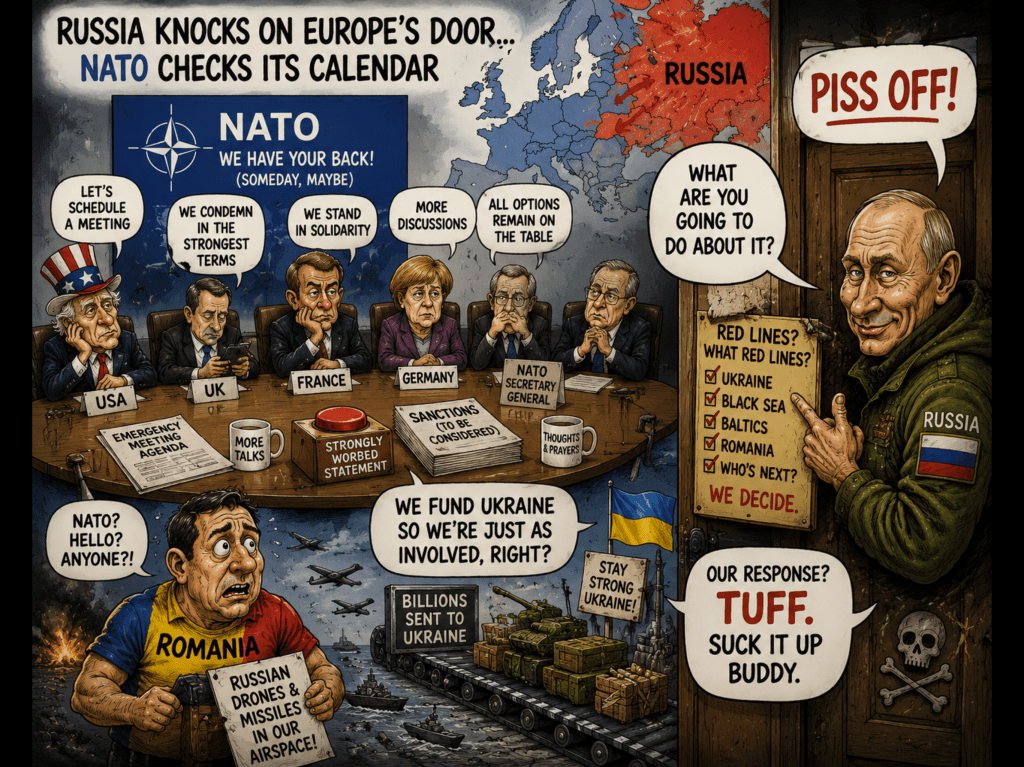
As Romania increasingly feels the pressure from Russian aggression around the Black Sea region, many ordinary citizens are asking an uncomfortable question:
At what point does NATO stop issuing statements and start demonstrating why it exists?
For years, Western governments have poured billions into supporting Ukraine, insisting the conflict is vital to European security. Yet every time Russia pushes the boundaries, the response often seems to consist of another emergency meeting, another strongly worded statement, and another promise that “all options remain on the table.”
🎪 The World’s Most Expensive Neighbourhood Watch
Russia’s message appears simple:
“You’re funding Ukraine. We know you’re funding Ukraine. We don’t like it. What are you going to do about it?”
And the uncomfortable reality is that nobody wants to discover where the actual red line lies.
NATO possesses some of the most powerful militaries on Earth. It has aircraft carriers, stealth fighters, nuclear deterrents, intelligence networks, and defence budgets that dwarf those of its rivals.
Yet from the public’s perspective, every new provocation seems to be met with a familiar cycle:
Russia acts. 🚀
Politicians condemn. 🎤
Experts analyse. 📺
Nothing much changes. 🤷
The result is growing scepticism among voters who wonder whether NATO’s greatest weapon is military power or PowerPoint presentations.
Nobody wants a wider war. Sensible people understand that direct confrontation between nuclear powers would be catastrophic.
But deterrence only works when the other side believes there are consequences.
And if every warning is followed by another warning, people inevitably start asking whether the threats carry any weight at all.
🔥 Challenges 🔥
Has NATO successfully deterred a wider conflict, or has caution started to look like weakness?
Where should the line be drawn between avoiding escalation and demonstrating strength?
Drop your thoughts in the blog comments. Is NATO playing a careful strategic game, or are ordinary Europeans losing confidence in the alliance’s willingness to act? 💬🔥
👇 Hit Comment, 👍 Hit Like, 🔄 Hit Share.
The best comments and hottest takes will be featured in the next issue of the magazine. 🎯📝


Leave a Reply