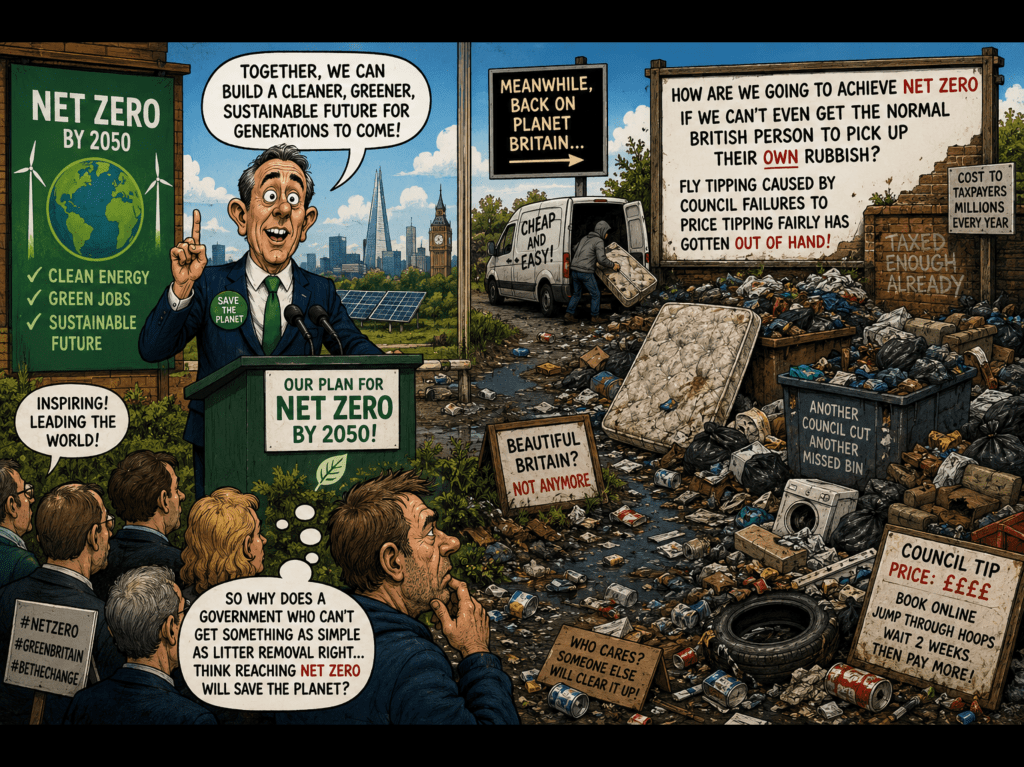
Britain has set itself the colossal task of achieving Net Zero emissions, transforming the economy, overhauling transport, changing how we heat our homes, and fundamentally altering the way we live.
Yet many people look around their towns and cities and ask a simple question: if we can’t solve the rubbish piling up on our own streets, how exactly are we supposed to save the planet?
🗑️ The Great British Fly-Tipping Strategy
Every year, local authorities spend millions clearing illegally dumped waste from roadsides, country lanes, and urban estates. Mattresses appear in hedgerows. Sofas materialise in lay-bys. Fridges seem to migrate into fields under the cover of darkness.
And while some responsibility undoubtedly lies with the individuals doing the dumping, councils have hardly helped themselves.
When disposing of waste legally becomes expensive, inconvenient, or involves navigating a booking system that feels more complicated than applying for a mortgage, some people inevitably look for shortcuts. The result? Mountains of rubbish scattered across the countryside while taxpayers foot the clean-up bill.
The irony is painful. We’re being told to calculate our carbon footprints while walking past an actual footprint made from discarded tyres and abandoned washing machines.
🌱 Saving the Planet Starts with the Basics
The Net Zero debate isn’t really about whether cleaner energy is desirable. Most people support cleaner air, cleaner rivers, and less pollution.
The frustration comes from priorities.
Governments often talk about grand global ambitions while appearing unable to manage local realities. Residents are told to switch boilers, buy electric vehicles, and monitor their energy consumption, yet many can’t get litter removed from their street or fly-tipping cleared from nearby beauty spots.
People naturally begin to wonder whether those setting these ambitious targets understand the practical challenges facing ordinary communities.
After all, public confidence isn’t built through speeches at climate summits. It’s built by proving government can deliver results people can actually see.
Fix the roads.
Empty the bins.
Clear the fly-tipping.
Keep communities clean.
Then perhaps people might have greater faith in larger environmental promises.
Because if we’re struggling to organise rubbish collection in 2026, convincing the public that we can completely transform the nation’s economy and energy infrastructure becomes a much harder sell. 🤔
🔥 Challenges 🔥
Is the public wrong to question Net Zero ambitions when basic local services often appear to be failing?
Should councils make waste disposal cheaper and easier to reduce fly-tipping, or is the real problem personal responsibility?
Drop your views in the blog comments. Are Britain’s environmental priorities in the right order—or are politicians trying to build a green future on top of an increasingly untidy present? 💬👇
👍 Like, 🔄 Share, and 🗣️ Comment below.
The best comments will be featured in the next issue of the magazine. 🏆📝


Leave a Reply