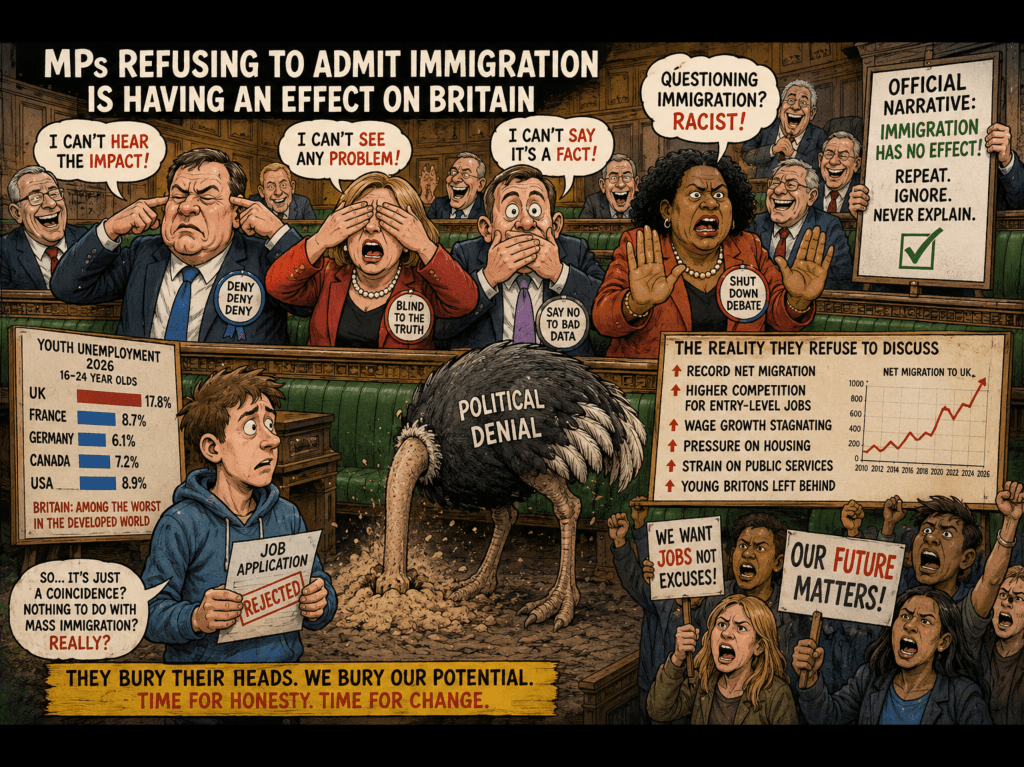
Britain’s youth unemployment problem didn’t appear overnight, and immigration isn’t the sole cause. Automation, outsourcing, underinvestment in training, rising living costs, and economic uncertainty have all played their part.
But here’s the question many politicians seem determined to avoid:
If hundreds of thousands of working-age people are struggling to find secure employment, why are we afraid to discuss the impact of record levels of migration on the labour market? 🤔
Ignoring the question doesn’t make it disappear.
🚪 More Workers, Fewer Opportunities?
For years, young Britons were told to study hard, gain qualifications, and opportunity would follow.
Instead, many find themselves trapped in temporary contracts, part-time work, unpaid internships, or living at home well into adulthood because wages simply don’t stretch far enough.
Meanwhile, employers often have access to an ever-growing labour pool. Basic economics tells us that when the supply of workers increases dramatically, competition for jobs intensifies.
Does that mean every migrant takes a job from a British worker?
No.
Does it mean immigration has no effect whatsoever on employment, wages, housing demand, and public services?
That seems increasingly difficult to argue.
Yet the moment anyone raises the issue, the discussion often descends into accusations rather than analysis.
🎭 The Politics of Pretending
The real scandal isn’t immigration itself.
The real scandal is Britain’s refusal to plan.
Successive governments have welcomed population growth while failing to build enough homes, expand infrastructure, increase training opportunities, or create enough skilled jobs for the people already here.
The result?
Young people competing harder than ever for employment while watching rents soar and public services strain under growing demand.
Then politicians express shock when frustration follows.
It’s like inviting more passengers onto a bus without buying another bus. Eventually somebody is standing in the aisle wondering why the journey has become so uncomfortable. 🚌
📊 Numbers Matter, Feelings Don’t Change Facts
A serious country should be capable of examining employment figures, migration levels, wage growth, productivity, and workforce participation without turning every discussion into a cultural battlefield.
Questions are not prejudice.
Statistics are not hatred.
Analysis is not extremism.
If immigration contributes positively in some areas, say so.
If it creates pressures elsewhere, say that too.
The public deserves facts, not slogans.
🎯 Britain’s Real Challenge
The debate should never be about blaming individuals who come to Britain seeking opportunity.
The challenge is whether policymakers can balance immigration with housing, infrastructure, education, healthcare, and job creation.
Because if they cannot, it is young people who pay the price.
And they’re already paying it.
Through higher rents.
Lower wage growth.
Greater competition.
And a future that feels increasingly out of reach.
🔥 Challenges 🔥
Are politicians avoiding an honest conversation about youth unemployment and migration? Has Britain failed to match population growth with economic planning? Or are there bigger factors driving the crisis?
Tell us what you think in the blog comments. Bring evidence, bring experience, bring disagreement—but bring solutions too. 💬🔥
👇 Like, comment and share if you believe difficult conversations should be met with facts rather than slogans.
The most insightful comments will be featured in the next issue of the magazine. 🎯📝


 Chameleon Magazine
Leave a comment