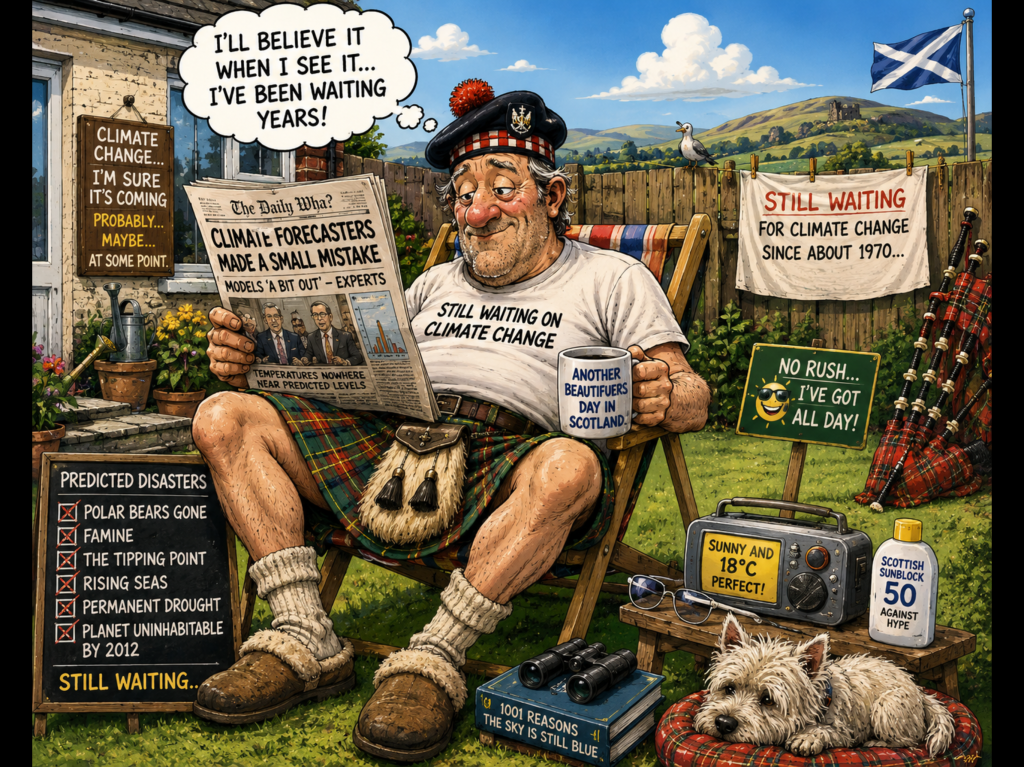
📉🔮For years, the public was told to trust the models, trust the projections, trust the experts, and most importantly—don’t ask too many awkward questions. Yet as real-world observations continue to collide with some of the more dramatic predictions, a growing number of people are wondering whether certain climate forecasts were science, speculation, or simply worst-case scenarios presented as inevitable destiny. 🤔🌡️
The result? Some of the loudest climate campaigners now seem to be quietly updating the narrative faster than politicians deleting old tweets. 📱💨
🔥 From Apocalypse Now to Apocalypse Pending™
Remember when every heatwave, snowstorm, flood, drought, cold snap, rainy day, sunny day, and mildly inconvenient Tuesday was apparently proof that civilisation was three minutes from collapse? ☄️😱
The public was bombarded with terrifying graphs, countdown clocks, and headlines so dramatic they made disaster movies look understated.
But reality has a nasty habit of refusing to follow political marketing campaigns.
When predictions fail to materialise on schedule, the deadline often gets moved.
When models diverge from observations, the models somehow remain perfect.
When critics ask questions, they’re accused of heresy against the Church of Carbon. ⛪🌍
That’s not to say climate change isn’t real or that environmental challenges don’t exist. They clearly do. The problem arises when scientific uncertainty gets replaced by absolute certainty and complex issues get squeezed into simplistic slogans.
Because science is supposed to test theories against evidence—not demand evidence conform to theories. 🧪📊
Many people are now less interested in dramatic warnings and more interested in honest discussion, transparent data, and predictions that can actually survive contact with reality.
A shocking concept, apparently. 😏
⚡ Challenges ⚡
Have climate campaigners overstated their case to drive political action?
Are sceptics unfairly dismissed instead of debated?
And should major predictions be publicly reviewed against real-world outcomes so the public can judge their accuracy for themselves?
Drop your thoughts in the blog comments. Whether you’re a climate activist, a sceptic, or somewhere in between, we want to hear your view. 💬🔥
👇 Like, comment, and share if you believe evidence should always matter more than ideology.
🏆 The best comments, sharpest observations, and strongest arguments will be featured in the next issue of the magazine.
Chameleon News


Leave a Reply