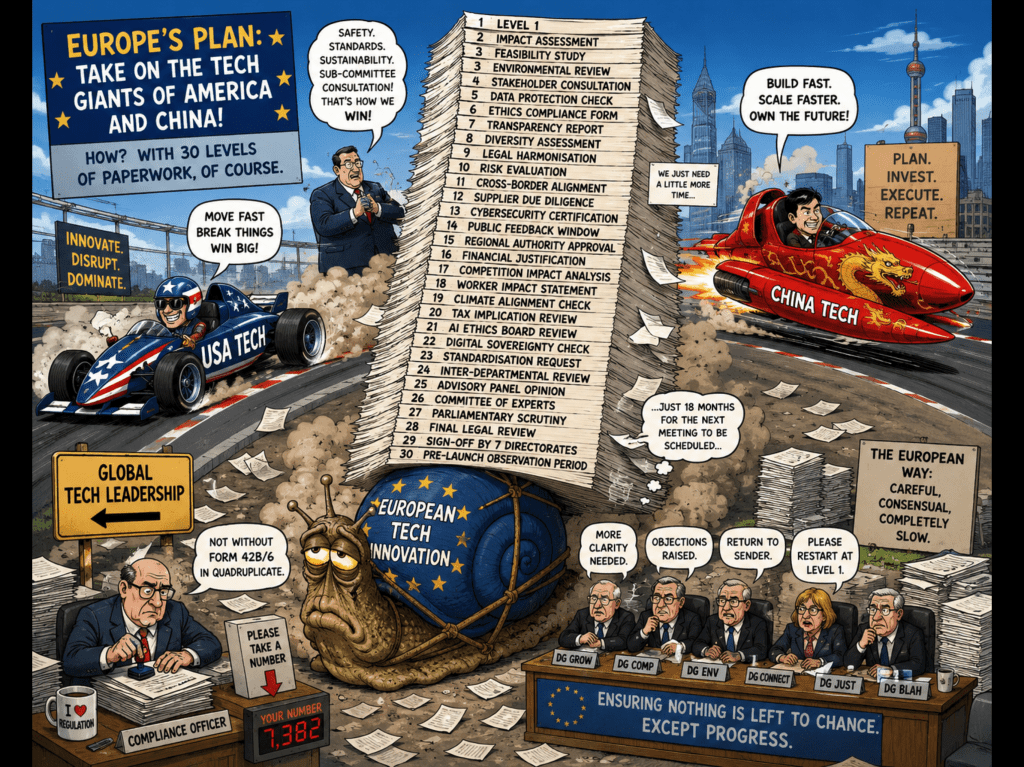
Europe has finally decided it’s tired of being technologically dependent on American giants and Chinese manufacturing powerhouses. The ambition is understandable: build homegrown AI, semiconductors, cloud infrastructure, and digital platforms that can compete on the world stage. The problem? Europe often approaches innovation the way a medieval castle approached visitors—by building another gate, another guard post, and another stack of paperwork.
🚧 The Bureaucratic Startup Accelerator (Without the Acceleration)
Europe’s strategy sometimes feels like this:
“Let’s create the next global tech champion!”
“Excellent idea. First, complete these 147 compliance forms, conduct six environmental assessments, obtain approval from twelve committees, and wait eighteen months for a review panel to schedule a preliminary discussion about forming a working group.”
Meanwhile, somewhere in California, a startup has launched, raised £500 million, changed its business model twice, and is already selling globally.
And in China, state-backed firms are building entire industrial ecosystems before the European consultation document has reached page 300.
To be fair, Europe isn’t wrong about the risks. Many American tech giants have become extraordinarily powerful, and dependence on foreign technology creates strategic vulnerabilities. Europe wants digital sovereignty, stronger privacy protections, and domestic industrial capacity. Those are legitimate goals.
The challenge is that innovation thrives on speed, risk-taking, and occasional failure. Bureaucracy thrives on ensuring nobody makes a mistake. Those objectives don’t always get along.
🏛️ Death by Committee
Europe has world-class universities, brilliant engineers, strong industrial companies, and enormous financial resources.
What it often lacks is the ability to say:
“Here’s the money. Build it. We’ll sort out the paperwork later.”
Instead, projects can become trapped in an endless loop of regulations designed to protect citizens, competitors, consumers, workers, the environment, local authorities, regional authorities, national authorities, and authorities responsible for overseeing other authorities.
The result? By the time approval arrives, the technology may already be obsolete.
It’s rather difficult to win a Formula One race when your competitors are driving cars and you’re still conducting a consultation on tyre specifications. 🏎️💨
Can Europe genuinely create tech champions capable of challenging America and China while maintaining its regulatory culture? Or does every new initiative risk drowning under the very bureaucracy designed to support it?
We want to hear your take. Is regulation Europe’s strength, preventing the excesses seen elsewhere? Or is it the anchor dragging behind every attempt to innovate and compete globally? 💬🤔
👇 Comment, like, and share. Tell us whether Europe is building the future—or just building another department to discuss building the future.
The best comments will be featured in the next issue of the magazine. 📝🏆


 Chameleon Magazine
Leave a comment