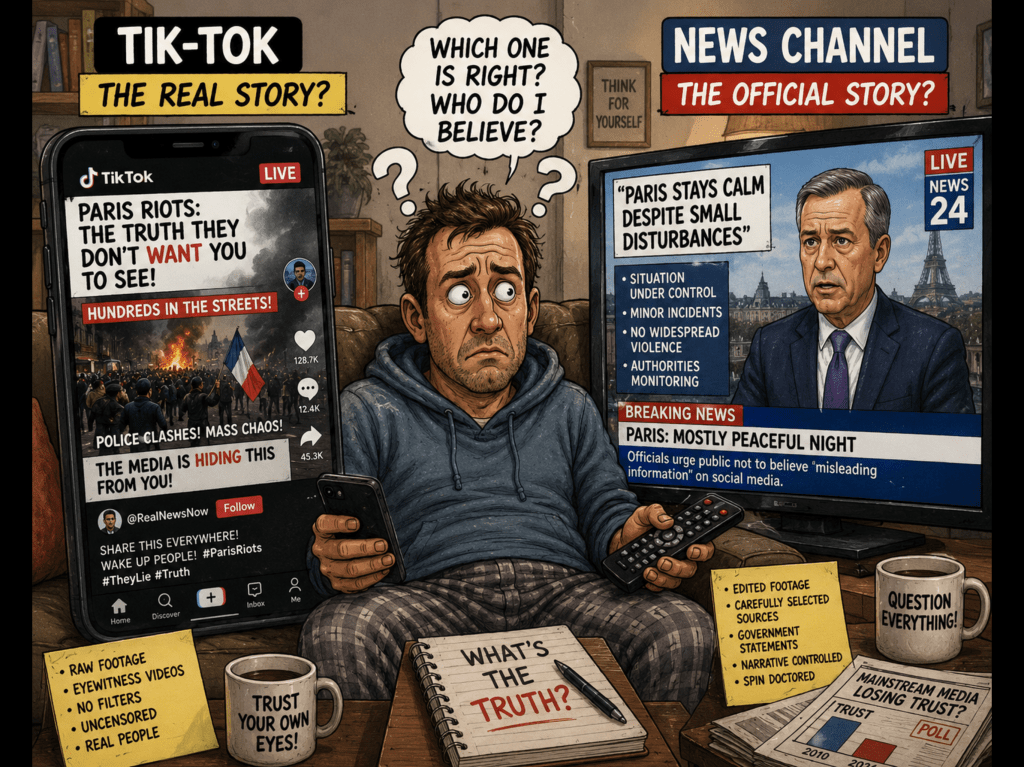
Today, growing numbers of people switch it off believing they’re only getting part of it.
And that’s a problem.
Not because everyone agrees on politics.
But because trust, once lost, is incredibly difficult to rebuild.
📡 The Great Credibility Crisis
For many people, the question is no longer:
“Is this story true?”
It’s:
“What aren’t they telling us?”
Across social media, millions of people are sharing videos, eyewitness accounts, livestreams and discussions about events unfolding around the world.
Meanwhile, many viewers feel that national broadcasters are either arriving late to the story or presenting it through a lens that feels carefully managed and heavily filtered.
Whether that perception is fair or not almost becomes irrelevant.
Because perception drives trust.
And trust is evaporating.
📱 From Newsroom to Newsfeed
It wasn’t supposed to happen this way.
The internet was once dismissed as unreliable, chaotic and full of misinformation.
Now many ordinary people find themselves scrolling through Facebook, TikTok, X and YouTube searching for information they believe they can’t find elsewhere.
Why?
Because social media feels raw.
Unscripted.
Immediate.
Messy.
People see footage uploaded by individuals standing in the middle of events rather than polished presenters sitting in comfortable studios hundreds of miles away.
That doesn’t automatically make social media more accurate.
But it does make it feel more authentic.
And authenticity is becoming the currency traditional media is rapidly running out of.
🎭 The Problem Isn’t Politics — It’s Trust
This isn’t really about left versus right.
It’s about credibility.
People will tolerate opinions they disagree with.
What they won’t tolerate is feeling manipulated.
The moment viewers begin to suspect stories are being selected, framed or ignored to fit a particular narrative, they start looking elsewhere.
And increasingly, elsewhere means social media.
The result?
National broadcasters no longer compete with each other.
They compete with millions of smartphones.
And that’s a battle they are struggling to win.
🔥 The Internet Revolution They Never Saw Coming
The old media gatekeepers once controlled the flow of information.
Now everyone carries a camera.
Everyone can publish.
Everyone can challenge the official version.
That’s uncomfortable for institutions.
But it’s also why so many people are abandoning traditional outlets in favour of alternative sources.
Not because they trust everything online.
But because they no longer trust that they’re getting the whole picture elsewhere.
🔥 Challenges 🔥
Do you still trust traditional news broadcasters, or do you increasingly rely on social media and independent sources to understand what’s happening in the world?
Has mainstream media lost touch with the public, or is social media creating its own version of reality?
💬 Join the debate in the blog comments below.
👇 Like, comment and share if you’ve ever learned about a major story online before seeing it reported on television.
🏆 The best comments will be featured in the next issue of the magazine.


 Chameleon Magazine
Leave a comment