There’s something wonderfully British about the House of Lords.
Not the tradition.
Not the history.
Not the architecture.
No, what’s truly magnificent is the sheer audacity of explaining it to somebody who actually works for a living.
Imagine you’re standing on a building site at six in the morning. The rain is horizontal. Your tea has gone cold. Your back sounds like a bag of crisps every time you bend down. You’ve got another ten hours ahead of you before you can even think about heading home.
Now imagine somebody wanders over and says:
“Good news. There’s a place in London where some people can claim £371 tax-free for attending.”
You’d probably laugh.
Then you’d assume there was a catch.
There isn’t.
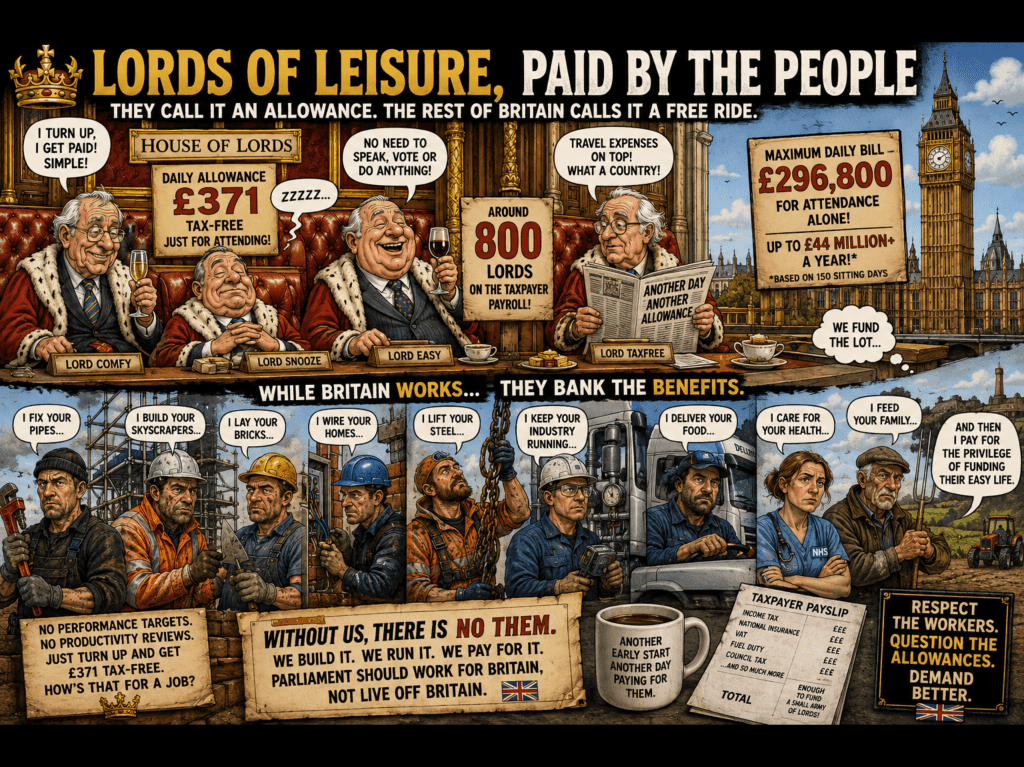
For the 2025-26 parliamentary year, members of the House of Lords can claim a daily allowance of £371 for attending Parliament. Not a wage. Not a salary. An allowance. A tax-free allowance. And according to the rules, there is no requirement to speak, vote, or remain for every minute of proceedings. Simply attending qualifies a member to claim it.
At this point, most plumbers are already checking whether unclogging Mrs Jenkins’ drain counts as parliamentary attendance.
The House of Lords currently has around 800 members, making it one of the largest legislative chambers on the planet. Eight hundred. That’s more people than many villages. It’s enough to fill a small town, a decent-sized football stand, or several very awkward Christmas dinners.
Now let’s do some terrifyingly simple maths.
If all 800 members claimed the full £371 allowance on a sitting day, the bill would come to nearly £297,000 for that day alone.
One day.
Not a week.
Not a month.
One day.
Stretch that across 150 sitting days and you’re looking at a theoretical annual cost of over £44 million in allowances.
Of course, not every member attends every day, and not every member claims the full amount. But even so, the figures are enough to make the average taxpayer clutch their wallet like it’s the last lifeboat on the Titanic.
Meanwhile, back in the real world, Britain wakes up.
The bricklayer is already laying courses.
The scaffolder is climbing steel in freezing winds.
The electrician is wiring a school.
The welder is fabricating components.
The instrument technician is keeping critical industry running safely.
The HGV driver is halfway through a delivery route before most politicians have found the coffee machine.
The farmer is feeding livestock.
The nurse is ending a night shift.
The care worker is helping somebody start their day.
The small business owner is wondering which tax bill is arriving next.
These are the people who generate the money that pays for everything.
The NHS.
The schools.
The benefits system.
The police.
The courts.
The defence budget.
The government departments.
The regulators.
The royal palaces.
And yes, the House of Lords.
That’s the part that often gets lost in political debates.
Government doesn’t create wealth. It spends wealth.
Before a single pound reaches Westminster, somebody somewhere has already earned it. Somebody has already paid income tax, corporation tax, VAT, fuel duty, national insurance, business rates or one of the countless other ways the state collects revenue.
The taxpayer isn’t some mythical creature living in a spreadsheet.
The taxpayer is the bloke fixing your boiler.
The woman driving the ambulance.
The couple running the corner shop.
The engineer maintaining the power station.
The lads pouring concrete at dawn.
The people whose alarm clocks ring before sunrise and who keep going when the weather, the economy and common sense are all telling them not to bother.
Yet somehow, Britain has reached a point where the people carrying the nation on their shoulders are often treated as background scenery, while the people signing attendance registers occupy the spotlight.
The defenders of the House of Lords will argue that the chamber contains experts, former ministers, academics, business leaders and specialists who scrutinise legislation and improve laws. That’s a fair argument.
The critics will ask why an unelected chamber of roughly 800 people still exists in modern Britain and whether taxpayers are receiving value for money.
That’s also a fair argument.
But whichever side of that debate you sit on, one fact remains unavoidable.
Every penny spent in Westminster begins life somewhere else.
It starts with a worker.
It starts with a business.
It starts with somebody taking risks, creating value and paying taxes.
Without them, there are no allowances.
No expenses.
No grants.
No subsidies.
No debates.
No Parliament.
No government.
Nothing.
Perhaps before we celebrate another taxpayer-funded allowance, we should spare a thought for the people funding it.
The plumber.
The scaffolder.
The brikie.
The electrician.
The rigger.
The welder.
The engineer.
The driver.
The farmer.
The nurse.
The care worker.
The millions who keep Britain moving while barely receiving a mention.
Because if anyone deserves a daily allowance for simply showing up, it’s the people who actually built the country in the first place. 🇬🇧🔨💷
🔥
Challenges
🔥
Would you swap your job for a seat in the House of Lords if all you had to do was attend for £371 a day?
Or do you think the chamber earns its keep?
Tell us what you think in the blog comments. We want the strongest arguments, the sharpest observations and the funniest one-liners. 💬🔥
👇 Like, comment and share. Tag someone who gets up before dawn to keep Britain running and ask them whether they’re in the wrong line of work.
🏆 The best comments will be featured in the next issue of the magazine.


 Chameleon Magazine
Leave a comment