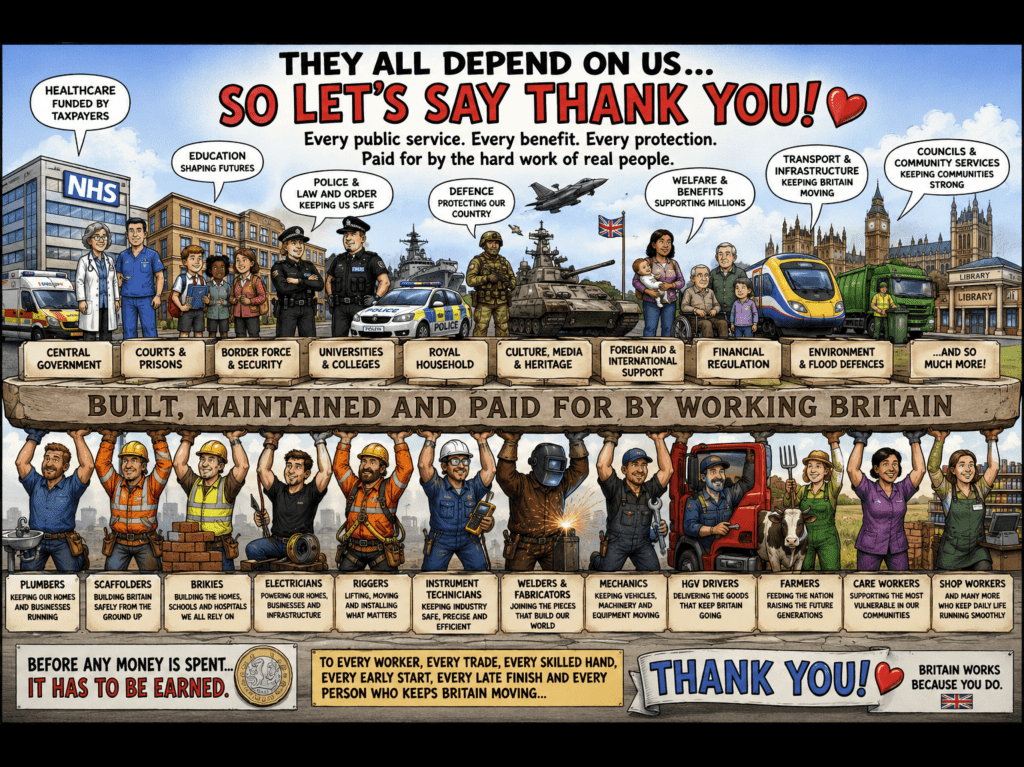
Britain is home to one of the largest publicly funded systems on Earth. From hospitals and schools to defence, welfare and government departments, the list of institutions funded wholly or partly by taxpayers is enormous.
Yet amid all the debates about spending, budgets and taxation, one crucial question rarely gets asked:
Who actually pays for it all?
Because before a single pound reaches Westminster, Whitehall, the NHS or any government agency, it first has to be earned by somebody working in the real economy. 🔨💷
🏛️ The Long List of Britain’s Taxpayer-Funded Institutions
The scale of taxpayer funding is staggering.
🏛️ Central Government
Everything from government departments to ministers, civil servants, regulators and agencies is funded through taxation.
This includes:
- The Treasury
- Home Office
- Department for Work and Pensions
- Ministry of Justice
- Foreign Office
- Department for Education
- Cabinet Office
- Hundreds of agencies, regulators and public bodies
🏥 Health Services
The NHS is one of the largest taxpayer-funded organisations in the world.
This covers:
- Hospitals
- GP surgeries
- Ambulance services
- Mental health services
- Prescription subsidies
- Public health programmes
- Community healthcare services
🚔 Law & Order
Taxpayers fund:
- Police forces
- Courts
- Prisons
- Probation services
- Crown Prosecution Service
- Border Force
- Crime prevention initiatives
🎓 Education
Taxpayers pay for:
- State schools
- Colleges
- Universities through grants and subsidies
- Student loan support
- Early years education
- Special educational needs provision
🏘️ Local Councils
Funded through a combination of council tax and central government funding.
Providing:
- Bin collections
- Adult social care
- Children’s services
- Road maintenance
- Libraries
- Housing departments
- Planning services
- Environmental services
- Trading standards
💷 Welfare & Benefits
One of the largest areas of government spending.
Including:
- State Pension
- Universal Credit
- Disability benefits
- Housing Benefit
- Child Benefit
- Pension Credit
- Employment support schemes
- Carer’s Allowance
🏰 The Monarchy
Taxpayers contribute through the Sovereign Grant which helps fund:
- Official royal duties
- Palace maintenance
- Security support
- Staff supporting constitutional functions
🛡️ Defence
Taxpayers fund:
- British Army
- Royal Navy
- Royal Air Force
- Nuclear deterrent
- Military bases
- Defence procurement
- Veteran support programmes
🚆 Transport
Public funding supports:
- Roads
- Motorways
- Rail infrastructure
- Some rail operators
- Local bus subsidies
- Major transport projects
- Traffic management systems
🌊 Infrastructure
Including:
- Flood defences
- Energy regulation
- Water regulation
- Broadband expansion projects
- National infrastructure developments
- Environmental protection schemes
🌍 International Spending
Taxpayers also contribute towards:
- Foreign aid programmes
- International organisations
- Diplomatic missions
- Overseas embassies
- International development projects
💰 Financial Institutions
Directly or indirectly taxpayers support:
- The Bank of England
- Financial regulators
- Deposit protection systems
- Financial stability mechanisms
- Bank rescue measures during crises
📺 Culture, Media & Heritage
Often forgotten but heavily taxpayer-supported:
- BBC funding mechanisms
- Museums
- National galleries
- Historic buildings
- Arts programmes
- Heritage preservation
- Public broadcasting infrastructure
⚖️ Regulators, Quangos & Public Bodies
The list runs into hundreds.
Including organisations overseeing:
- Communications
- Financial services
- Environment
- Health standards
- Food safety
- Competition law
- Workplace safety
- Transport regulation
💳 The Biggest Bills
Britain’s largest areas of spending are typically:
- Welfare and pensions
- Health (NHS)
- Education
- Defence
- Debt interest on government borrowing
In recent years, debt interest alone has cost tens of billions of pounds annually before a single classroom, hospital ward or road project is funded.
🔨 The Forgotten Shareholders of Britain Plc
Now comes the part rarely mentioned in official speeches.
Every institution above depends on one thing:
People earning money first.
The plumber fixing boilers. 🚿
The scaffolder working through winter storms. 🌧️
The bricklayer building homes. 🧱
The electrician wiring factories and offices. ⚡
The rigger lifting steel into place. 🏗️
The instrument technician keeping industry operating safely. 🔧
The welder, fitter and fabricator. 👨🏭
The engineer designing and maintaining infrastructure. ⚙️
The mechanic keeping vehicles moving. 🔩
The HGV driver delivering goods nationwide. 🚛
The roofer, carpenter and groundworker. 🏠
The factory worker producing goods. 🏭
The farmer feeding the nation. 🚜
The fisherman supplying markets. 🎣
The care worker supporting vulnerable people. ❤️
The shop worker serving customers. 🛒
The small business owner risking everything to employ staff. 📈
The self-employed tradesperson juggling rising costs and taxes. 💼
And millions more who get up every day and create the wealth that makes taxation possible.
Without their labour, skills, risk-taking and productivity, none of the institutions listed above could exist.
No NHS.
No schools.
No benefits.
No police.
No defence.
No government departments.
No regulators.
No royal palaces.
No ministers announcing new spending programmes.
Because government spending begins with somebody earning the money first. 💷
🔥Challenges🔥
Why is it that the people who physically build, maintain, transport, repair and power Britain often receive less recognition than the institutions funded by their work?
Should politicians spend more time talking about the workers who generate Britain’s wealth instead of only discussing how to spend it?
Tell us what you think in the blog comments. Which profession deserves more recognition for keeping Britain running? 💬🔥
👇 Like, comment and share. Tag a plumber, scaffolder, brikie, electrician, rigger, instrument technician, welder, engineer, driver, farmer or grafter who helps fund the entire system every single day.
🏆 The best comments, strongest arguments and funniest observations will be featured in the next issue of the magazine.


 Chameleon Magazine
Leave a comment