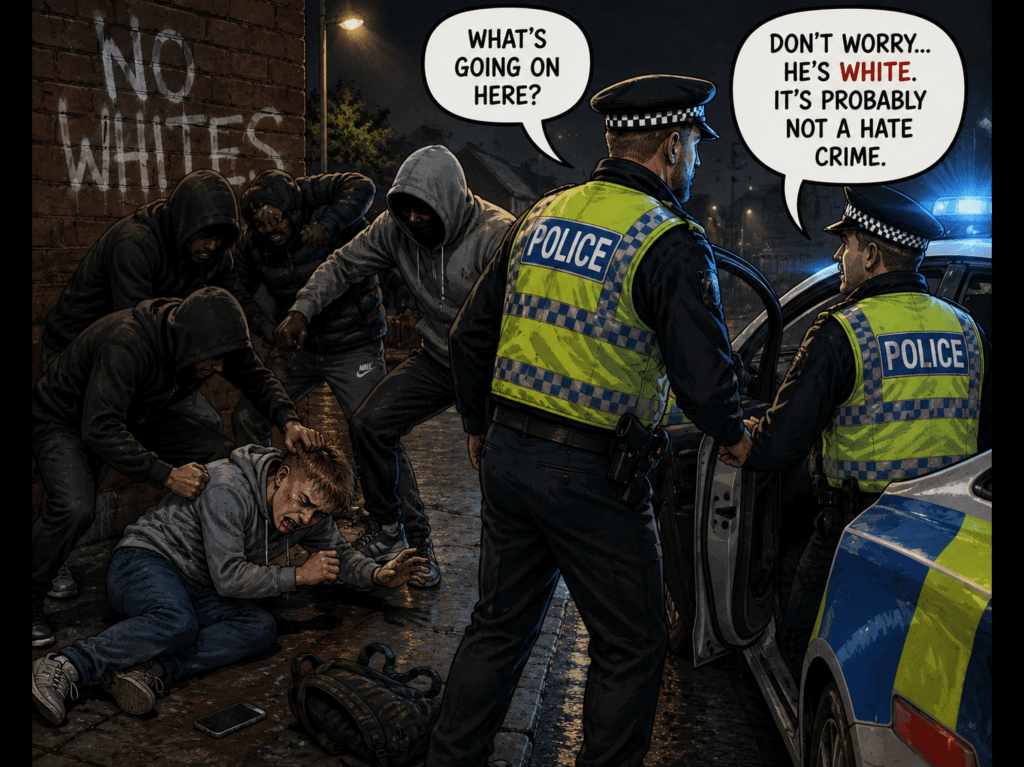
Nearly three years after the horrific Nottingham attacks, Barnaby Webber’s mother is still asking a question that many politicians and commentators seem reluctant to touch.
Why wasn’t the murder of her son investigated as a racist attack?
It’s a simple question.
Not an accusation.
Not a verdict.
A question.
And in a healthy democracy, questions should not be controversial.
Yet somehow this one is.
🤔 Does Race Only Matter Sometimes?
When a crime involves minority victims, police, politicians and media organisations are often quick to explore whether racism played a role.
And rightly so.
Racial hatred should always be investigated where evidence suggests it may exist.
But what happens when the victims are white?
Should exactly the same questions be asked?
Should exactly the same standards apply?
Or do we quietly move on because the answer might be politically uncomfortable?
That is the issue Emma Webber is raising.
Not whether racism definitely occurred.
But whether the possibility was given the same scrutiny it would have received under different circumstances.
🚨 Equality Means Equal Standards
A fair justice system cannot have one set of rules for some victims and another for everyone else.
Either race is relevant when investigating motive, or it isn’t.
Either every victim deserves the same consideration, or they don’t.
The principle seems straightforward.
Yet public confidence begins to erode whenever people suspect that difficult questions are being avoided rather than answered.
And confidence matters.
Because justice must not only be done.
It must be seen to be done.
🏛️ The Public Wants Consistency
Most people are not demanding predetermined conclusions.
They are demanding consistency.
If police routinely examine racial motives in some cases, the public naturally expects the same process to apply in all cases.
Not because of politics.
Not because of ideology.
But because equal treatment under the law is supposed to mean exactly that.
Equal.
Nothing more.
Nothing less.
🎭 The Real Problem
The real issue is not what the answer turns out to be.
The real issue is whether people feel able to ask the question without immediately being dismissed, attacked or accused of having ulterior motives.
Because once certain questions become off-limits, trust begins to disappear.
And when trust disappears, institutions have a much bigger problem than any single case.
🔥 Challenges 🔥
Should potential racial motives be investigated using exactly the same standards regardless of the race of the victim?
Has public confidence been damaged by perceptions of inconsistency?
And are there questions in modern Britain that people feel increasingly nervous about asking?
💬 Tell us what you think in the comments.
👍 Like it. 🔄 Share it. 🗣️ Challenge it.
The best comments will be featured in the next issue of the magazine. 🏆📝


 Chameleon Magazine
Leave a comment