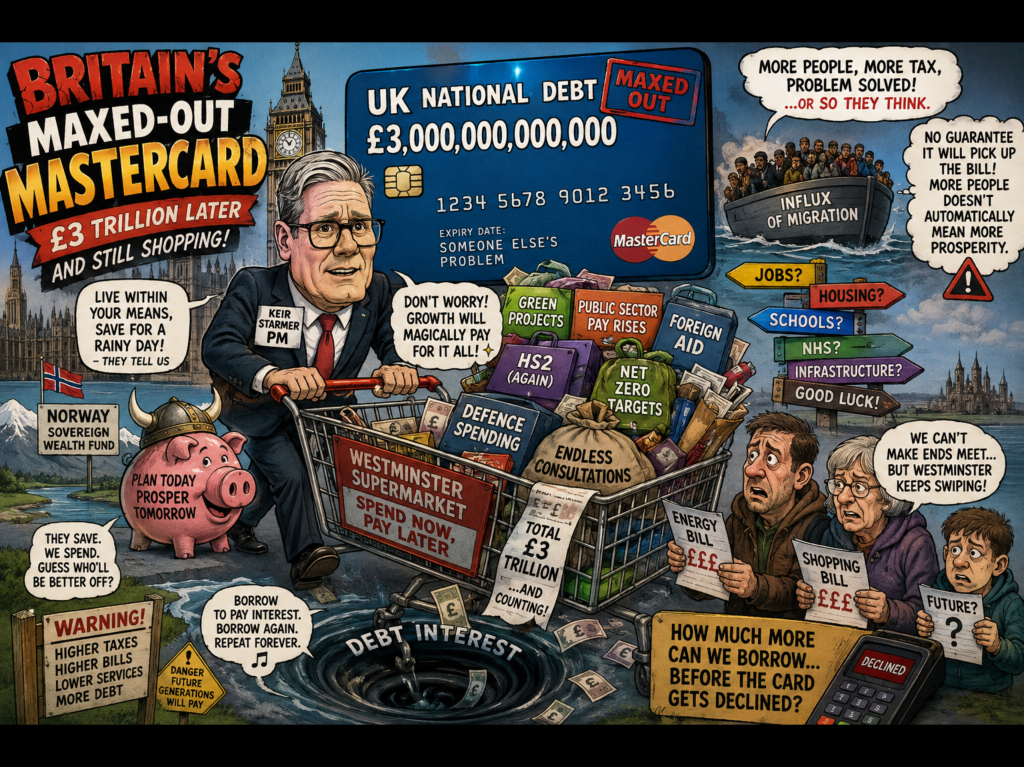
Britain is edging towards a jaw-dropping £3 trillion national debt milestone — a number so vast it sounds less like a financial statistic and more like the final score in a game nobody remembers playing.
For decades, politicians have offered the same household advice to the public: live within your means, save for emergencies, and don’t spend money you don’t have.
Curiously, those rules appear to stop at the gates of Westminster. 🏛️💸
💰 Do As We Say, Not As We Spend
If a family repeatedly maxed out their credit cards, borrowed more to cover the interest, and assured everyone that a future pay rise would magically solve everything, friends would stage an intervention.
When governments do it, it’s called economic management. 🎩📊
Britain’s debt mountain didn’t appear overnight. Financial crashes, pandemics, energy shocks, wars, bailouts and endless spending commitments have all added bricks to the wall. Each crisis arrived with promises that borrowing was temporary.
Temporary, it turns out, can last a very long time.
Meanwhile, countries such as Norway quietly built sovereign wealth funds, squirrelling away resources and investments for future generations. Britain’s approach often feels more like finding a forgotten tenner in an old coat pocket and immediately spending twenty. 🇳🇴☔
The real concern isn’t simply the debt itself.
It’s the interest.
Every year, billions disappear servicing debt before a single pothole is filled, hospital upgraded, or classroom improved. The nation increasingly resembles someone paying one credit card with another while insisting everything remains perfectly sustainable.
Nothing says financial confidence quite like refinancing your refinancing. 😬💳
📈 The Migration Miracle That May Never Arrive
Another assumption lurking beneath Britain’s long-term economic forecasts is that a growing population will help support public finances through a larger workforce and higher tax receipts.
On paper, it sounds wonderfully convenient.
More people arrive. More people work. More people pay tax. Problem solved.
Reality, however, has a habit of refusing to read government briefing notes.
Many voters are increasingly sceptical that migration alone can rescue Britain’s finances. The challenge isn’t simply population growth—it’s whether the economy is creating enough productive, well-paid jobs, housing, infrastructure and opportunities to generate the revenues politicians seem to be counting on.
Critics argue that if public spending rises as quickly as the population, the expected fiscal benefits become far less certain. More pressure on housing, schools, healthcare and local services can mean that the promised economic gains take far longer to materialise than optimistic forecasts suggest.
If Westminster believes migration by itself will somehow pay off a £3 trillion debt pile, they may be in for a rude awakening. Demographics are not an economic strategy. Productivity, investment, innovation and growth are.
A bigger population doesn’t automatically create a richer country.
And spreadsheets have a nasty habit of looking better than reality. 📊⚠️
🎭 The Leadership Vacuum Nobody Ordered
Adding to public anxiety is a growing sense that nobody appears fully in control.
Trust in political institutions has been steadily eroding. Governments change. Leaders come and go. Policies arrive with great fanfare before quietly disappearing into the same filing cabinet as all the previous “long-term plans.”
Meanwhile, political parties spend increasing amounts of time battling each other internally while voters wonder whether anyone is actually steering the ship.
The result is a widening gap between Westminster and ordinary people trying to balance household budgets that don’t come with the luxury of unlimited borrowing. 🚢⚠️
The public sees rising debt, rising taxes, struggling services and endless promises that prosperity is just around the corner.
At some point, even the most patient passengers start asking who’s holding the map.
🚨 The Dashboard Is Flashing Red
Britain hasn’t hit the wall.
The engine still runs.
The lights are still on.
But when warning lights start blinking across the dashboard, sensible drivers don’t solve the problem by turning up the radio.
The uncomfortable question facing Britain isn’t whether borrowing can ever be useful—it clearly can be.
The question is whether anyone still remembers where the brakes are. 🚗🔥
🔥 Challenges 🔥
Britain’s debt is heading towards £3 trillion.
Taxes are already at historically high levels.
Public services remain under pressure.
Politicians continue promising that growth is just around the corner.
So where exactly is the plan?
If governments tell families to save for rainy days, should they be held to the same standard?
Has borrowing become a necessary economic tool, or a political addiction passed from one administration to the next?
And if another major crisis arrives tomorrow, how much room is really left on Britain’s national credit card?
💬 Drop your thoughts in the blog comments below. Is £3 trillion manageable? A ticking time bomb? Or simply the inevitable result of decades of kicking difficult decisions down the road?
👇 Like, comment and share if you think Britain needs an honest conversation about debt, spending, migration, growth and leadership.
🏆 The best comments will be featured in the next issue of the magazine.


 Chameleon Magazine
Leave a comment