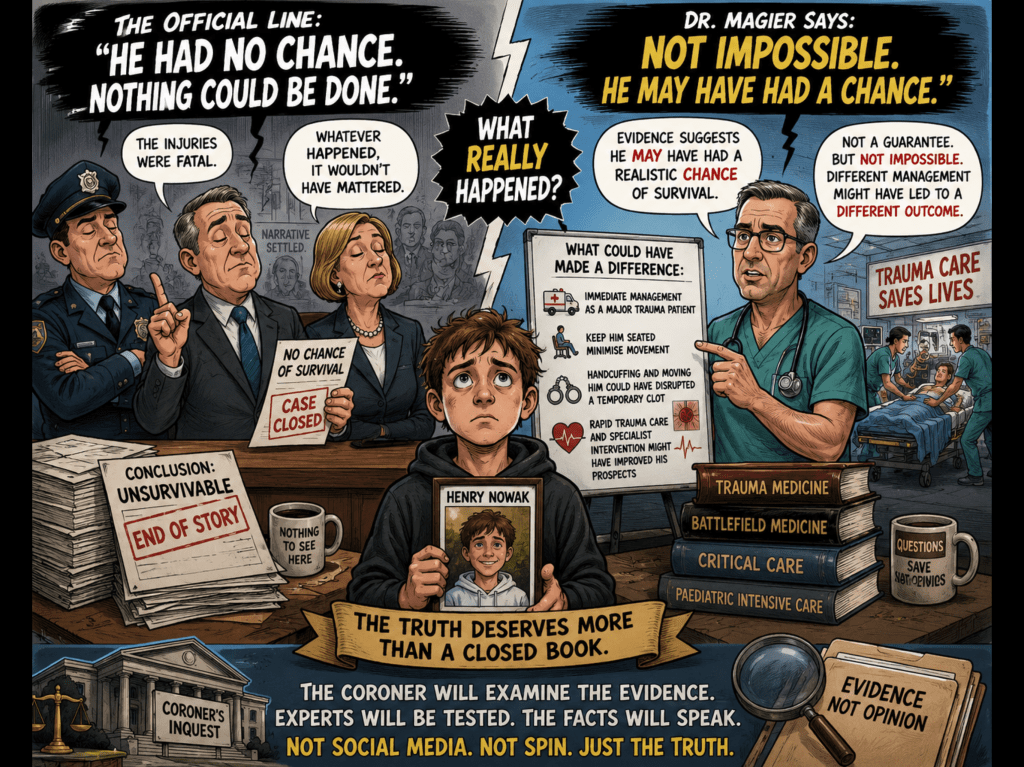
⚖️🚨For months, much of the public discussion surrounding Henry Nowak’s death revolved around a single, seemingly settled claim: that his injuries were so catastrophic that survival was never a possibility. End of story. Case closed. Move along.
Except now, one experienced consultant physician has stepped forward and essentially said: “Not so fast.”
Dr. Magier, who reportedly leads a paediatric intensive care unit and has experience in advanced trauma and battlefield medicine training, has publicly challenged the conclusion that Henry had no realistic chance of survival. He is not claiming survival was certain. He is questioning whether it was impossible.
And that small distinction may turn out to be absolutely enormous. 🩺⚠️
🤔 The Medical Debate Nobody Was Supposed to Have
Imagine a football match where everyone declares the result settled before the final whistle. Then a referee appears with a replay showing the winning goal might have been offside.
That’s effectively what has happened here.
According to reports, Dr. Magier argues that Henry may have had a realistic chance of survival if treated immediately as a major trauma patient. He has reportedly suggested that keeping Henry still and seated may have been preferable to physically restraining him and moving him.
Why? Because in severe trauma cases, a blood clot can sometimes act like nature’s emergency plug. Disturb it, and catastrophic bleeding can follow. 🩸
The reported argument is that forcing movement, handcuffing, or repositioning could potentially have disrupted a clot that was temporarily limiting blood loss.
Again, this is not a claim of certainty.
It is a challenge to certainty.
And that’s where things get uncomfortable.
Because “he definitely couldn’t survive” and “he might have survived with different management” are two very different propositions indeed. 🚔❓
🎭 From “Nothing Could Be Done” to “What If?”
The fascinating part is how quickly public narratives can harden into concrete.
One minute, complex medical questions are being debated.
The next minute, social media experts armed with a profile picture and half a headline are confidently declaring that every issue has already been resolved.
Then along comes a consultant physician saying there is a legitimate medical question worth examining.
Suddenly the neat, tidy explanation develops cracks.
And that’s precisely why coroners’ inquests exist. Not to satisfy online tribes. Not to provide ammunition for activists. Not to protect institutions. But to examine evidence, test expert opinions, and establish facts.
What Dr. Magier appears to have introduced is not a final answer but a significant question:
Did the actions taken after Henry was injured affect his chances of survival?
That question now sits squarely in the spotlight. 🔦⚖️
🔥
Challenges
🔥
If one qualified expert says survival was impossible and another suggests there may have been a significant chance of survival with different treatment, how should the public respond?
Should difficult questions be explored fully, regardless of where they lead?
Or are we too quick to accept the first explanation that offers certainty?
💬 Join the discussion on the blog and tell us what you think. Do expert disagreements strengthen confidence in the system, or expose weaknesses that deserve greater scrutiny?
👇 Like, comment, and share if you believe difficult questions deserve proper answers.
🏆 The most insightful comments will be featured in the next issue of the magazine.


 Chameleon Magazine
Leave a comment