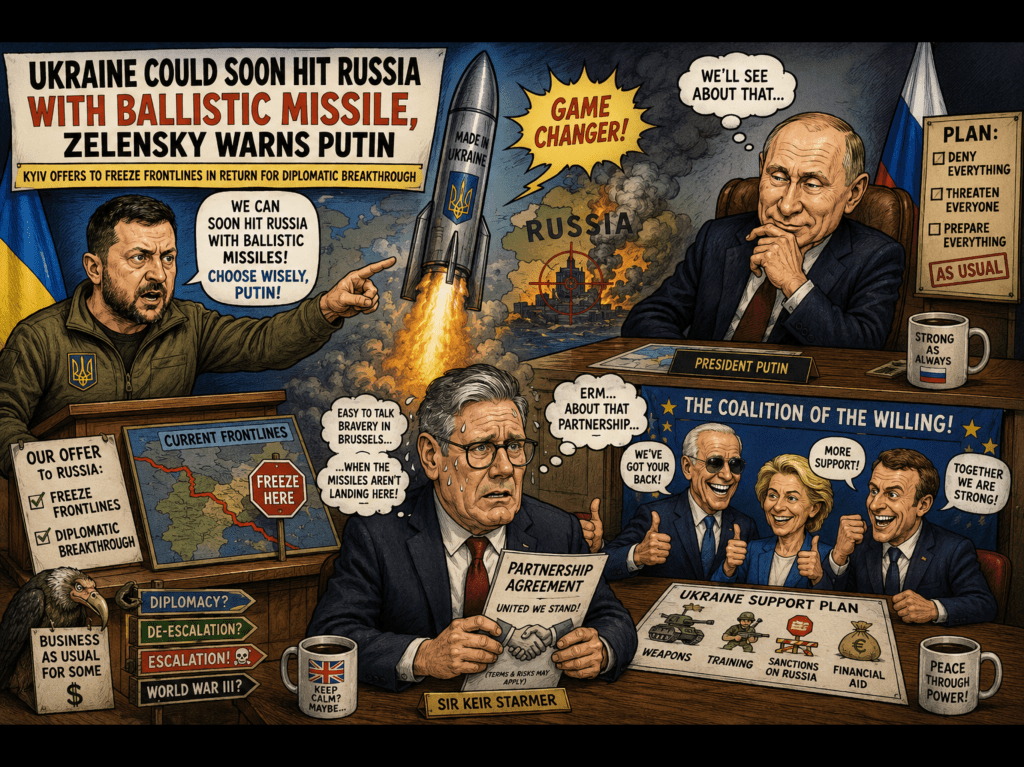
Ukraine’s President Volodymyr Zelensky has suggested that Kyiv could soon possess the capability to strike deep into Russia with ballistic missiles, while simultaneously floating the idea of freezing current front lines in exchange for a diplomatic breakthrough. In other words, one hand extends an olive branch while the other checks the launch codes. 🌿🚀
Meanwhile, European leaders continue discussing security partnerships, defence commitments, and long-term support arrangements, all under the comforting assumption that nobody accidentally turns a regional war into an international fireworks display.
🎯 The Coalition of the Willing… Until the Missiles Start Flying
It’s always easy to sound enthusiastic about strategic partnerships when the biggest risk involves a strongly worded press release and a buffet lunch in Brussels. 🥐☕
The real test comes when headlines start featuring phrases like “ballistic missile exchange” rather than “constructive diplomatic dialogue.”
One suspects there may be a noticeable difference between politicians eagerly posing for summit photographs and politicians being asked whether their country is prepared to become more directly involved in a conflict involving long-range missile strikes. 📸😬
For Sir Keir Starmer, the challenge is obvious. Supporting allies sounds noble. Standing up to aggression sounds principled. Maintaining international security sounds responsible.
Explaining to voters why Britain should become more deeply entangled in a conflict that appears to be escalating? That’s where the PowerPoint presentation starts catching fire. 🔥📊
Of course, nobody wants escalation. Every leader publicly insists that diplomacy remains the preferred path. Yet the modern geopolitical strategy seems to consist of everyone simultaneously preparing for peace while ordering increasingly sophisticated ways to wage war.
It’s a bit like watching two neighbours negotiate a fence dispute while both are shopping for flamethrowers. 🏡🔥
And so the question hangs in the air: if ballistic missiles start crossing borders in greater numbers, will today’s enthusiastic coalition remain quite so enthusiastic tomorrow?
Or will some leaders suddenly discover urgent appointments elsewhere? 🚪🏃♂️
🔥 Challenges 🔥
At what point does supporting an ally become risking direct involvement?
Should Britain continue deepening security commitments regardless of how the conflict evolves, or should there be clear limits if the war escalates further?
Drop your views in the blog comments. Keep it sharp, keep it civil, and tell us whether today’s partnerships are acts of courage, necessity, or dangerous optimism. 💬⚡
👇 Like, comment, and share if you think politicians should answer the difficult questions before events answer them instead.
🏆 The best comments will be featured in the next issue of the magazine.


 Chameleon Magazine
Leave a comment