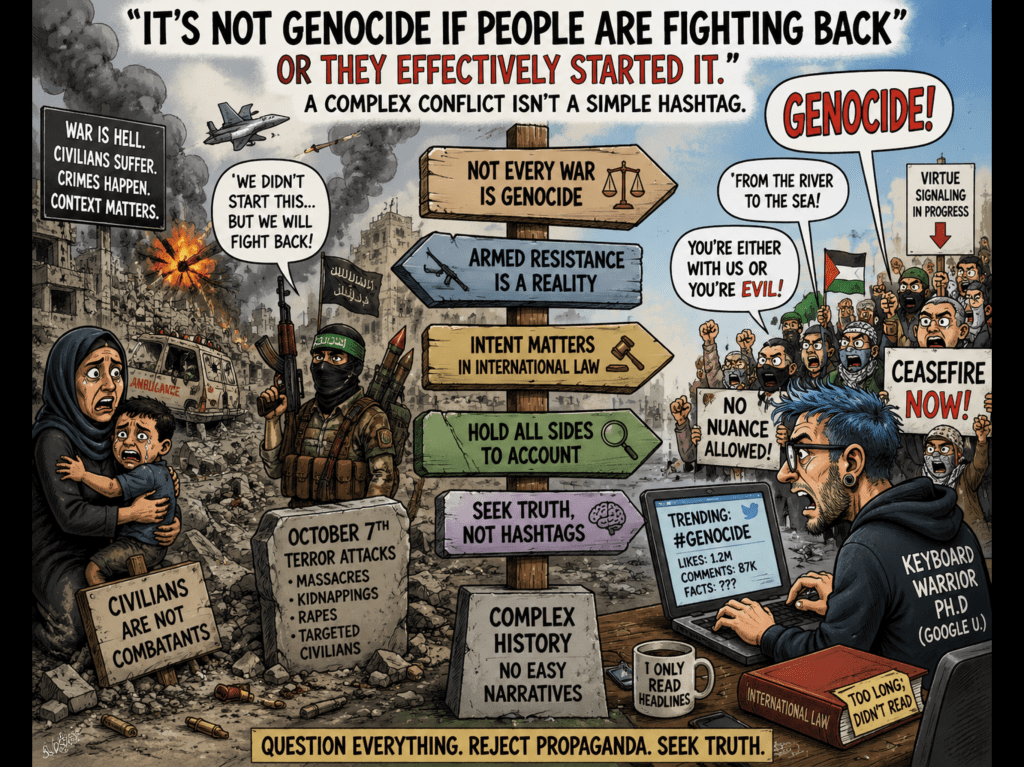
Calls of “genocide” now fly across social media faster than facts, context, or even basic history. One side points to civilian casualties and destruction. The other points to armed resistance, rocket attacks, terrorist atrocities, and the reality that wars involve combatants fighting back. Somewhere in the middle lies a question that many people seem terrified to ask: does the existence of a war automatically make every tragedy a genocide?
🎭 The Internet’s New Favourite Legal Expert
Apparently, everyone with a smartphone is now an international lawyer. One viral clip, one emotional image, one carefully cropped headline—and suddenly the verdict is in.
But reality is far messier.
Genocide is a specific legal accusation, not a catch-all phrase for every brutal conflict. Wars can be horrific. Governments can make terrible decisions. Militaries can commit war crimes. Civilians can suffer unimaginable losses. None of those facts automatically settle the genocide question.
Yet online debates often skip straight from outrage to certainty. Context gets thrown out the window faster than yesterday’s trending hashtag. 🚀
If armed groups are actively fighting, launching attacks, holding territory, or continuing military operations, that raises difficult questions about how a conflict should be understood. Equally, massive civilian suffering raises difficult questions that cannot simply be dismissed. Both realities can exist at the same time.
The problem is that many activists, politicians, and keyboard warriors seem determined to turn complex conflicts into cartoon storylines with heroes, villains, and a ready-made verdict.
🔥 Challenges 🔥
Are we becoming addicted to simple answers for complicated wars? 🤔
Should emotionally charged labels be used more carefully? Or do they help bring attention to genuine suffering?
Whatever your position, don’t just repeat slogans. Bring evidence. Bring facts. Bring arguments that can survive more than thirty seconds of scrutiny.
💬 Drop your thoughts in the blog comments below.
👍 Like if you’re tired of politics being reduced to hashtags.
📢 Share if you believe difficult questions deserve honest debate—even when the answers make people uncomfortable.
🏆 The best comments, strongest arguments, and sharpest observations will be featured in the next issue of the magazine.


 Chameleon Magazine
Leave a comment