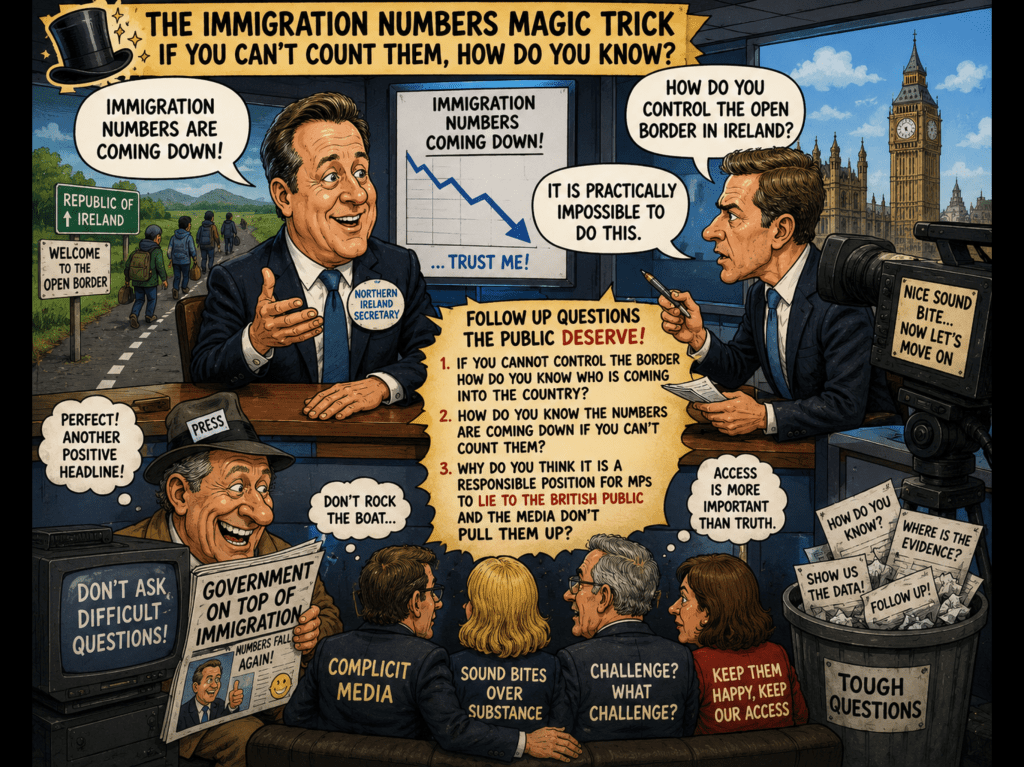
Watching politicians discuss immigration has become a bit like watching a magician perform the same trick every week and expecting the audience not to notice.
This week, the Northern Ireland Secretary was asked about immigration numbers and confidently assured viewers that the figures were coming down. We’ve heard it before. We’ve heard it from this government and previous governments. Every few months another minister appears on television to tell us that everything is under control and that progress is being made.
Then came the awkward question.
How do you control immigration across the open border between Northern Ireland and the Republic of Ireland?
The answer was remarkable in its honesty.
You can’t.
Or at least, according to the minister, it is practically impossible.
And that should have immediately triggered the most obvious follow-up question of the entire interview.
If it is practically impossible to control the border, how do you know exactly who is crossing it?
If you don’t know exactly who is crossing it, how can you know exactly how many people are entering the country?
And if you cannot accurately count them, on what basis are you confidently telling the public that the numbers are falling?
That wasn’t the question viewers needed. That was the question viewers deserved.
Instead, the interview moved on. As it so often does.
And that is where the media deserves scrutiny too.
Journalists love describing themselves as holding power to account. They tell us they speak truth to power. They portray themselves as fearless interrogators of politicians.
Yet far too often an obvious contradiction is allowed to pass without challenge.
A minister makes one claim.
A few moments later they make another claim that appears difficult to reconcile with the first.
The interview ends.
The politician leaves.
The audience is left shouting at the television.
Because the issue isn’t whether somebody supports or opposes immigration.
The issue is whether claims made to the public are being properly tested.
If politicians state that numbers are falling, people are entitled to ask how those numbers are measured.
If politicians acknowledge difficulties monitoring movement across a border, people are entitled to ask how accurate those figures really are.
That isn’t extremism. That isn’t controversy. That’s accountability.
Yet accountability seems to have become an endangered species in modern political interviews.
Instead of digging deeper, too many broadcasters appear satisfied collecting headlines and soundbites before moving on to the next segment.
The result is a public increasingly convinced that politicians are never challenged and journalists are no longer interested in challenging them. Perhaps that’s unfair. But it is certainly a perception that is growing.
Because if a politician can confidently tell the country that immigration numbers are falling while simultaneously explaining how difficult it is to monitor movement across a border, surely somebody in the studio should be asking the obvious question.
Not next week. Not tomorrow. Not after the commercial break.
Immediately. The public doesn’t need more political slogans.It needs answers.
And if the people asking the questions won’t ask the obvious ones, voters will inevitably start wondering who exactly the interview was for in the first place.
🔥 Challenges 🔥
Should interviewers be tougher when politicians make claims about immigration figures?
Are political interviews about accountability or simply about giving ministers a platform?
And when obvious follow-up questions go unasked, is it any wonder public trust continues to fall?
💬


 Chameleon Magazine
Leave a comment