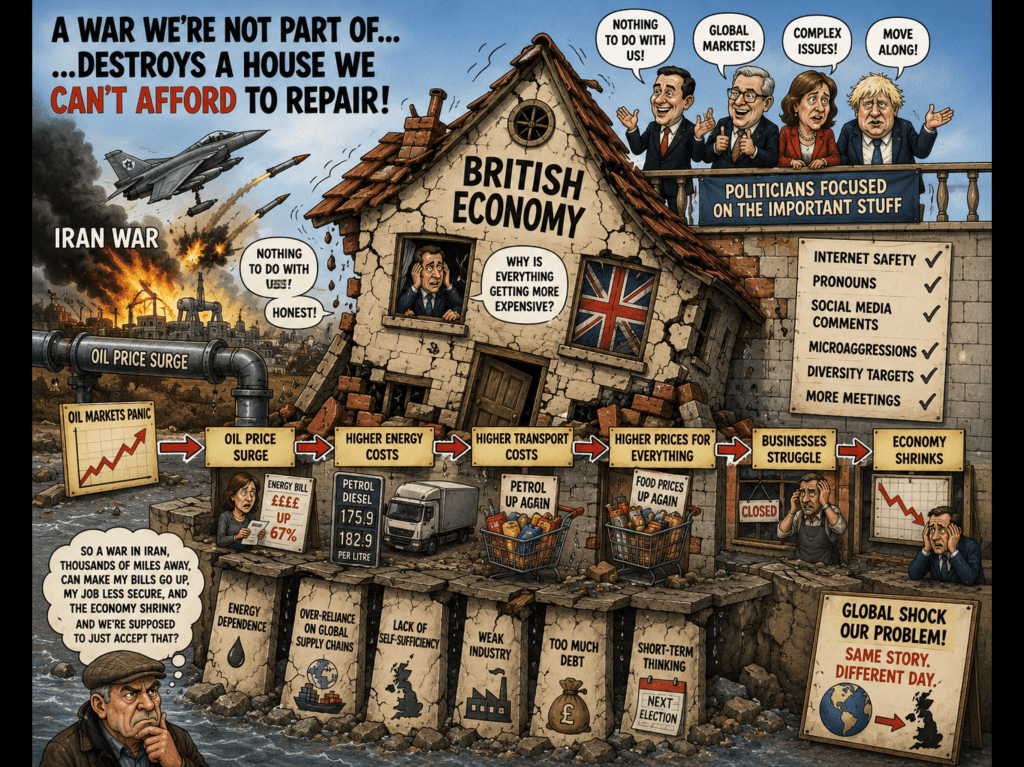
The economy shrinks. Energy prices surge. A war thousands of miles away sends shockwaves through household budgets.
Petrol prices climb. Businesses struggle. Growth stalls.
Families worry about paying their mortgages. And Westminster springs into action. Not to secure Britain’s energy supplies.
Not to reduce our dependence on global markets.
Not to make the country more resilient.
No.
They’re investigating what your teenager is looking at on the internet.
Thank goodness.
For a moment there, people thought politicians might start focusing on the economy.
Imagine the horror.
The UK now finds itself in the remarkable position where a conflict in the Middle East can instantly make millions of Britons poorer. A missile lands near an oil field and suddenly Dave from Doncaster is paying more for diesel.
That’s not an economy.
That’s a hostage situation.
Yet instead of asking why Britain is so vulnerable to events happening thousands of miles away, our political class appears determined to save civilisation by regulating comment sections and worrying about whether little Johnny has seen a rude video on TikTok.
The roof is on fire. The walls are collapsing. The foundations are cracking. And politicians have formed a committee to inspect the curtains.
This obsession with internet safety would be understandable if everything else was working perfectly.
But it isn’t. The country can’t build enough houses. Can’t keep energy prices stable. Can’t secure its borders. Can’t grow the economy. Can’t fill potholes. Can’t run trains on time.
Yet somehow has limitless time to debate what people are posting online.
It’s the modern equivalent of the captain of the Titanic making an announcement about appropriate deck-chair etiquette while the ship is disappearing beneath the waves.
Meanwhile, ordinary people are left wondering why every international crisis immediately empties their wallets.
Why can a war in Iran affect the price of filling a Ford Fiesta in Falkirk?
Why does every global shock end up landing on the doorstep of British households?
Why are we constantly told the economy is growing while everyone feels poorer?
These are not difficult questions.
They’re simply inconvenient ones.
Because answering them would require politicians to talk about resilience, energy security, industrial strategy and long-term planning.
And let’s be honest, that’s nowhere near as exciting as another emergency debate about social media.
So while ministers continue their heroic battle against memes, algorithms and online opinions, the rest of the country can sit back and enjoy the consequences of an economy so fragile that a disagreement in the Persian Gulf can knock billions off national output.
But don’t worry.
Your children are being protected from dangerous internet content.
Unfortunately nobody seems to be protecting them from the future they’re going to inherit. What makes the whole thing so frustrating is that nobody is suggesting internet safety doesn’t matter.
Of course it matters.
But so does an economy that doesn’t collapse every time somebody starts firing missiles on the other side of the planet. This is where the government should be putting its collective brainpower.
Not endlessly debating what people are watching online. Not launching another task force into offensive memes. Not commissioning a 400-page report into hurt feelings on social media.
How about figuring out why a war in Iran can make it more expensive to fill a car in Falkirk? How about making Britain less vulnerable to global energy shocks?
How about building an economy that can survive international crises without immediately raiding the wallets of ordinary families?
That’s the real safeguarding issue.
Because while politicians are busy protecting children from the internet, nobody seems particularly interested in protecting their future from economic decline.
The harsh reality is that Britain doesn’t have an internet resilience problem. It has an economic resilience problem.
And until politicians pull their heads out of their own arses and start addressing it, we’ll continue living in a country where every foreign crisis becomes a domestic bill.


 Chameleon Magazine
Leave a comment