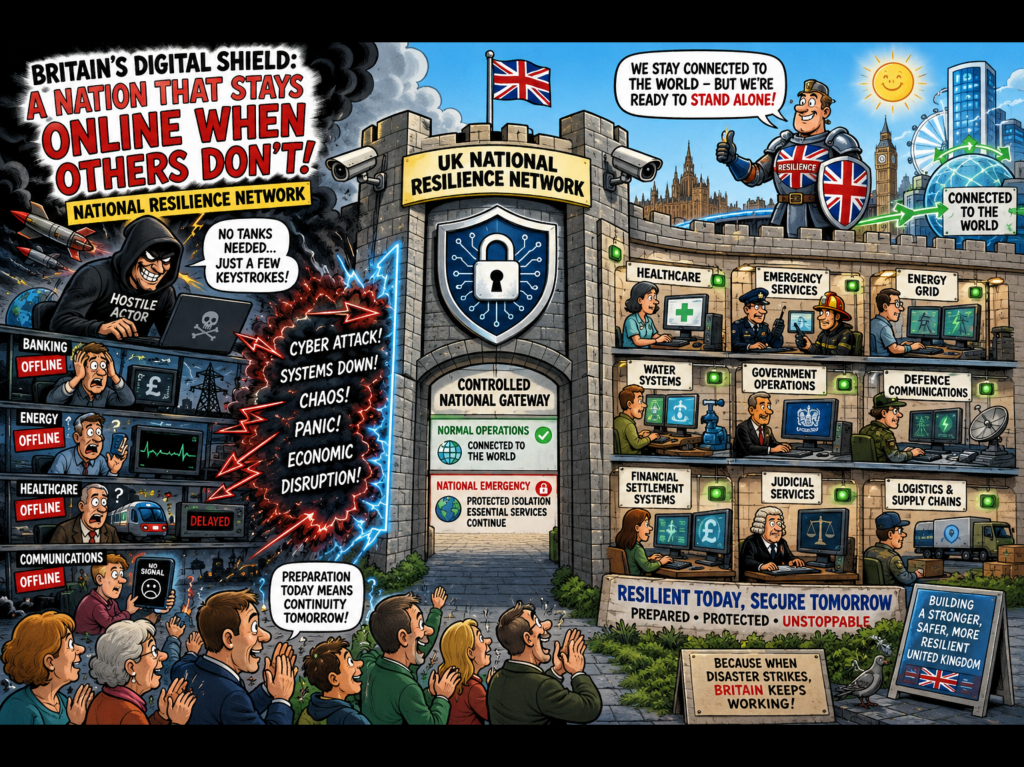
🛡️💻🇬🇧The United Kingdom has spent centuries building fleets, armies, air defences, and intelligence networks to protect itself from external threats. But in 2026, the greatest danger to national stability might not arrive in a battleship or bomber—it might arrive disguised as an email attachment, a malicious software update, or a well-timed attack on critical infrastructure.
A proposal for a National Resilience Network suggests creating a secure domestic digital backbone capable of keeping essential services running even if the wider internet becomes compromised. Think of it as Britain’s emergency generator for the digital age: not glamorous, not exciting, but incredibly useful when everything suddenly goes dark.
🚨 Welcome to the Age of Keyboard Warfare
Once upon a time, invading a nation required tanks, troops, and a willingness to be photographed standing awkwardly beside a captured flag.
Today? A hostile actor can potentially cause chaos from a swivel chair thousands of miles away while wearing slippers and eating cereal.
Imagine the panic if banking systems froze, hospitals lost access to critical networks, transport systems stalled, and communication services collapsed—all before lunchtime. No explosions. No mushroom clouds. Just millions of people staring at loading screens and repeatedly refreshing apps that no longer work.
That’s why the National Resilience Network proposal has gained attention. The idea isn’t to create some dystopian “British Internet” where citizens are trapped behind digital drawbridges while civil servants manually approve cat videos.
Instead, it would function as a protected emergency lane for the systems that genuinely matter: healthcare, emergency services, utilities, government functions, financial settlement systems, and national security communications.
Think of it as separating the nation’s life-support machines from the public Wi-Fi at a motorway service station.
The proposal’s logic is difficult to dismiss.
Modern economies are built on interconnected systems. The more efficient those systems become, the more vulnerable they can be when things go wrong. One major cyberattack could ripple across sectors, disrupt daily life, and undermine public confidence far faster than traditional threats ever could.
And unlike a damaged bridge or building, digital systems can be extraordinarily difficult to restore once trust has been compromised. You can rebuild a wall. Rebuilding confidence is much harder.
The most interesting aspect may be deterrence itself. Criminal groups and hostile states tend to favour easy targets. A nation capable of isolating, protecting, and rapidly restoring critical services becomes a far less attractive victim.
In simple terms: burglars prefer houses without alarm systems.
Here’s the question few politicians seem eager to answer:
If we accept that cyberattacks are now among the most significant threats facing modern nations, why are resilience measures still treated as optional upgrades rather than essential infrastructure?
Should digital continuity be considered as important as military readiness?
Would a National Resilience Network strengthen national security, or would it create new risks and concentrations of power?
Most importantly—are governments preparing for tomorrow’s threats, or are they still building defences for yesterday’s wars?
💬 Drop your thoughts in the blog comments. Do you support the idea, oppose it, or think there’s a better solution? We want to hear every perspective.
👍 Like it. 🔄 Share it. 💥 Challenge it.
The best comments, arguments, and debates will be featured in the next issue of the magazine.


 Chameleon Magazine
Leave a comment