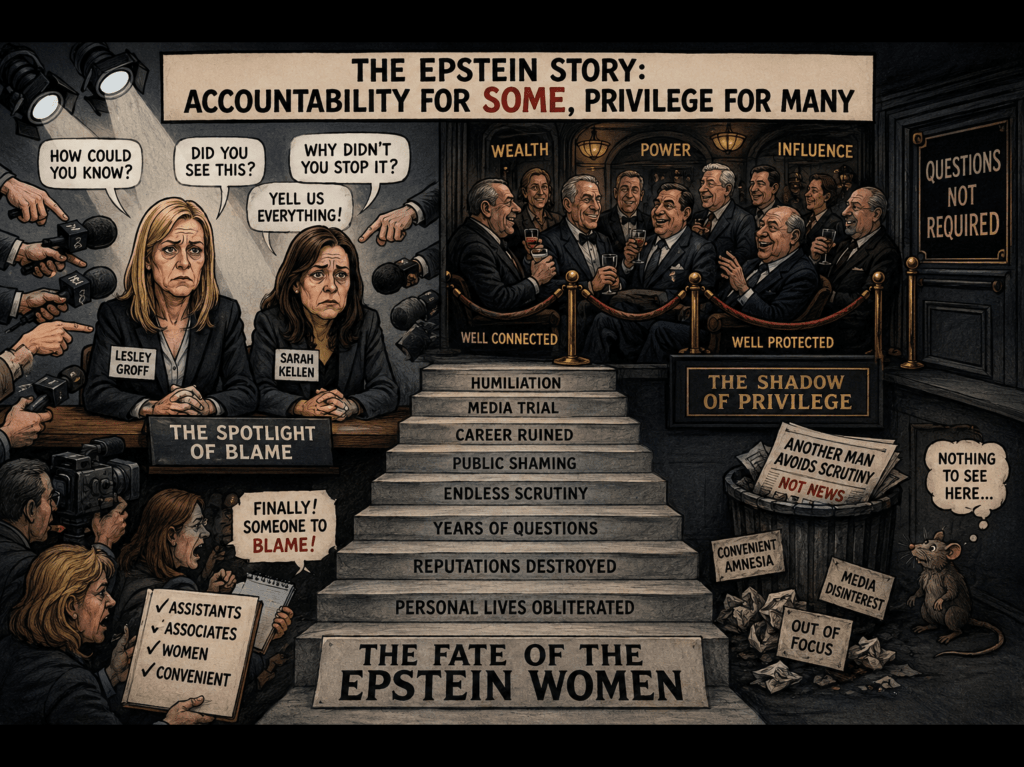
For years, the public has been told that Jeffrey Epstein’s operation was a sprawling web of influence, power, wealth, and protection. Yet somehow, as fresh scrutiny emerges, the spotlight keeps narrowing onto a familiar cast of female assistants and associates while many of the powerful men who occupied the same world seem to drift quietly into the background.
Nobody is arguing that anyone who knowingly enabled abuse should escape difficult questions. But if accountability is truly the goal, then it shouldn’t come with selective vision.
🎭 The World’s Most Exclusive Game of Hide-and-Seek
It’s a remarkable phenomenon.
A man builds an empire of exploitation, fills it with billionaires, celebrities, financiers, politicians, socialites, and power brokers—and somehow the public conversation repeatedly circles back to the women answering phones, scheduling appointments, and managing diaries.
Now, before anyone starts clutching pearls, this isn’t a defence of anyone who facilitated wrongdoing. If people played a role, they should be questioned.
All of them.
That’s where things become awkward.
Because the Epstein story wasn’t sold to the public as “The Curious Case of Two Office Assistants.” It was presented as a vast ecosystem of privilege, influence, and protection. A network. A machine. A world.
Yet when the time comes for public accountability, the microscope seems laser-focused on a handful of women while a surprising number of powerful men remain comfortably out of frame. 🔍🤔
It’s a bit like investigating a bank robbery by interrogating the receptionist while ignoring everyone seen carrying sacks of cash out the back door.
The public isn’t asking for special treatment. Quite the opposite.
They’re asking for equal treatment.
If someone knowingly helped abuse occur, investigate them.
If someone protected abuse, investigate them.
If someone benefited from abuse, investigate them.
If someone used influence to shield abuse, investigate them.
Simple.
What becomes difficult to explain is why the demands for answers seem to lose volume whenever the conversation drifts toward wealthy, connected, influential men.
Strange, that. 🎩💰
Because the central fact remains unchanged.
Jeffrey Epstein abused girls and young women.
The question isn’t whether assistants deserve scrutiny.
The question is why so many others appear to have escaped comparable levels of public examination.
And the longer that imbalance persists, the more people begin to wonder whether accountability is being pursued—or carefully managed.
🔥 Challenges 🔥
If this was truly a network, where are the questions for the entire network? Why does scrutiny seem to stop where power begins? 🤨
What do you think—is the public getting the full story, or are some uncomfortable questions being quietly left on the cutting-room floor?
Head over to the blog comments and let us know. We want your take, your theories, your frustrations, and your toughest questions. 💬🔥
👇 Like, comment, and share if you think accountability should apply equally—regardless of wealth, status, or connections.
🏆 The best comments will be featured in the next issue of the magazine.


 Chameleon Magazine
Leave a comment