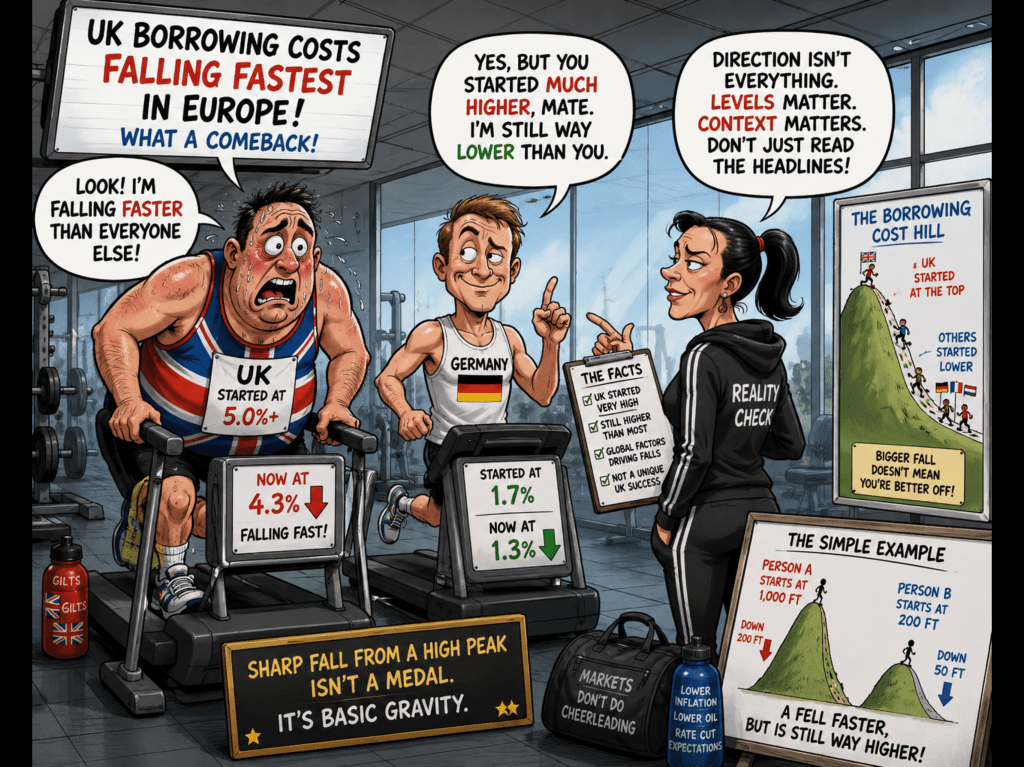
Britain is being told that UK borrowing costs are falling at the sharpest pace in Europe. Sounds impressive, doesn’t it? The sort of headline that practically demands a victory parade, a brass band, and a minister standing in front of a Union Jack declaring economic genius.
There’s just one tiny problem: context exists. 😏
🎪 Welcome to the Statistical Circus! 🤹♂️
Imagine boasting that you’ve lost weight faster than anyone else at the gym… while conveniently forgetting to mention you started three stone heavier than everybody else.
That’s essentially what’s happening here.
UK government borrowing costs didn’t start from a position of strength. They started from some of the highest levels in the developed world. Investors were demanding eye-watering returns to lend money to Britain, with gilt yields hitting levels not seen for decades.
So when borrowing costs fall sharply, the obvious question isn’t “How fast are they falling?” It’s “How high were they in the first place?” 🤔
If you jump off the top rung of a ladder, you’ll fall faster than someone stepping off the bottom rung. It doesn’t mean you’re winning.
Meanwhile, some politicians seem desperate to turn every downward wiggle on a graph into proof of economic mastery. By that logic, a house fire is good news because the flames eventually get smaller. 🔥➡️🧯
The reality is far less glamorous. Bond markets across the world have been moving in similar directions as investors react to lower inflation expectations, changing interest-rate forecasts, and global economic conditions.
In other words, Britain isn’t necessarily leading Europe. It may simply be floating in the same tide as everyone else. 🌊
And even after the recent declines, UK borrowing costs remain significantly higher than many European counterparts. Germany isn’t exactly looking over the Channel in envy while paying substantially lower rates to borrow money.
But that inconvenient detail rarely makes the headline.
Because “Still Expensive But Slightly Less Terrifying” doesn’t fit neatly on a campaign leaflet. 📰😂
The trick is simple: focus everyone’s attention on the direction of travel while quietly avoiding discussion about where the journey started.
It’s political marketing dressed up as economic triumph.
And like all good magic tricks, it only works if nobody looks too closely behind the curtain. 🎭
🔥 Challenges 🔥
Here’s the question nobody seems eager to answer:
If UK borrowing costs are supposedly such a success story, why are they still among the highest in Europe?
Are headlines being used to create an illusion of strength, or is there genuine evidence that Britain’s fiscal position is outperforming its neighbours?
Drop your thoughts in the blog comments. 💬👇
Do you think this is economic progress, statistical spin, or a bit of both? Let us know.
👍 Like it.
🔄 Share it.
💬 Comment on the blog.
The sharpest, funniest, and most insightful comments will be featured in the next issue of the magazine. 🏆📝


 Chameleon Magazine
Leave a comment