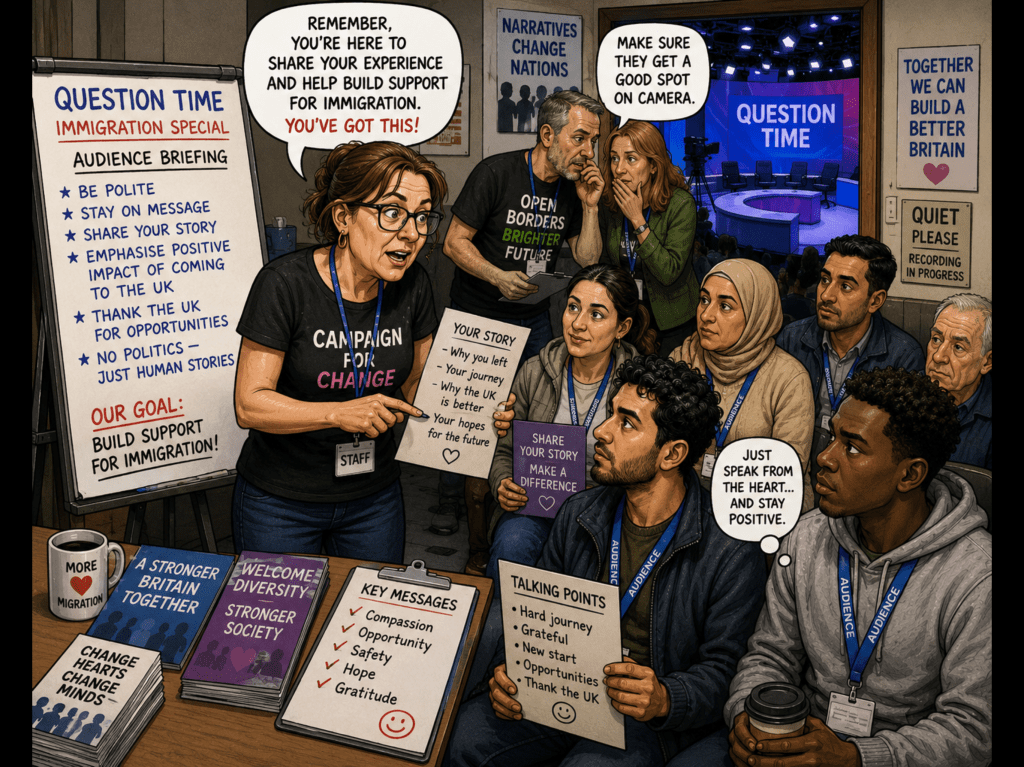
😂🎭The BBC’s Question Time has spent decades assuring viewers that it is a balanced platform reflecting a broad range of public opinion.
Which makes recent revelations rather awkward.
It has emerged that small boat migrants who appeared on an immigration special were reportedly placed in the audience by campaigners whose stated aim was to help shift public opinion and build support for immigration. (The Telegraph)
Now, perhaps this is all perfectly innocent.
Perhaps campaigners influencing who appears on a major political debate programme is merely a remarkable coincidence.
And perhaps my local kebab shop accidentally ends up sponsoring Formula One.
🎪 The Amazing Coincidence Machine 🎪
Millions of licence-fee payers tune in expecting a debate that reflects public opinion.
Instead, critics are asking whether public opinion was being carefully curated before the cameras even started rolling. (The Telegraph)
The concern isn’t that migrants appeared.
The concern is whether activists were helping decide who got the microphone.
There’s a difference.
One is participation.
The other starts looking suspiciously like production.
🎭 Britain’s Favourite Political Theatre 🎭
Imagine if campaign groups on every side started supplying audience members.
Tax campaigners for Budget specials.
Prison reformers for crime debates.
Fox hunters for animal welfare programmes.
The BBC studio would resemble Glastonbury for lobbyists.
Every audience member would arrive wearing a badge saying:
“Definitely here by complete chance.”
💷 The Licence Fee Question 💷
The BBC is funded by the public.
Which means viewers expect impartiality, not persuasion.
Whether you support more immigration, less immigration, or simply wish politicians would answer a question directly for once, most people can agree on one thing:
If a debate programme is supposed to reflect public opinion, audiences should not appear to be assembled by people trying to change it.
Because once viewers start believing the audience is being curated, they stop trusting the conversation.
And when trust disappears, all that’s left is theatre.
🔥 Challenges 🔥
Do you think this was harmless audience selection or an attempt to shape the debate?
Should campaign groups have any role in influencing who appears on flagship political programmes?
Drop your thoughts in the blog comments below. 💬🔥
👇 Like, comment and share.
🏆 The best comments will be featured in the next issue of the magazine.


 Chameleon Magazine
Leave a comment