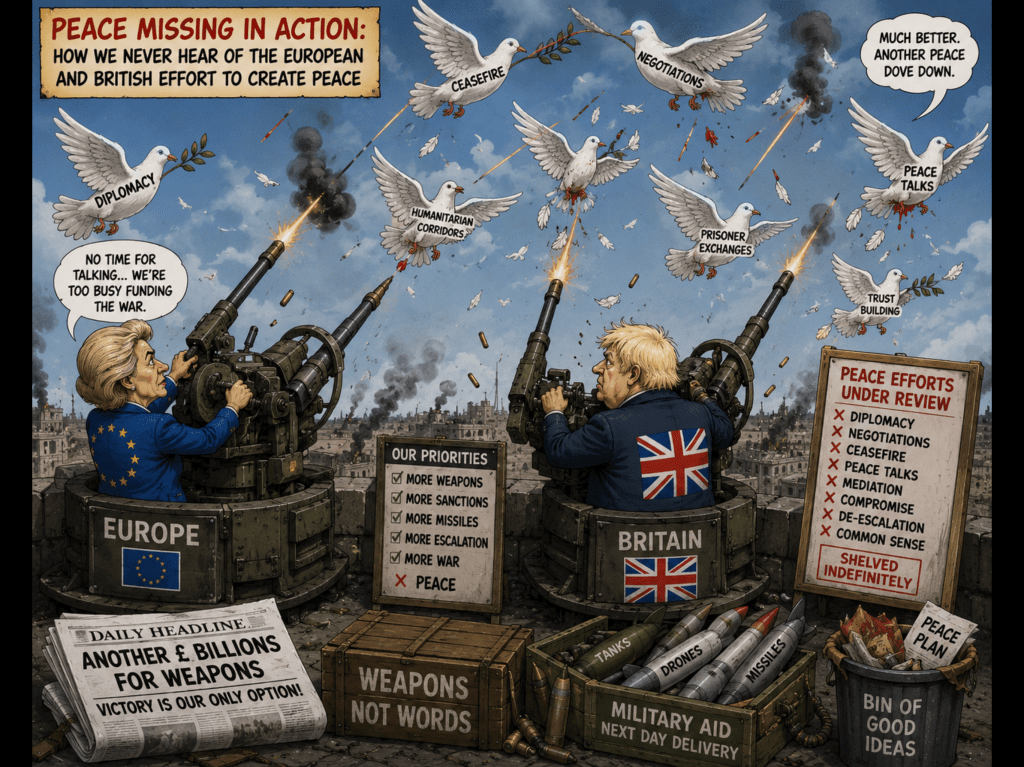
As the war in Ukraine grinds on into another year, one question keeps getting louder among ordinary people: where exactly is the peace plan?
Every week brings another headline about missiles, drones, tanks, military aid packages, sanctions, or battlefield developments. Politicians line up at podiums to announce billions more in support, defence commitments, and security guarantees. Yet somehow the words “negotiation,” “settlement,” and “ceasefire” seem to appear only as an afterthought. 🤔📺
For governments that insist they desperately want peace, they have a strange way of showing it.
🕊️ The Invisible Peace Offensive
Perhaps Europe’s great diplomatic offensive is so sophisticated that nobody can actually see it. 🔍😏
Maybe somewhere beneath Brussels, London, Paris, Berlin, and Washington, highly trained negotiators are working around the clock to bring both sides together.
If they are, they’re doing it with the stealth technology usually reserved for military aircraft.
Because the public sees endless discussions about weapons systems and defence spending, but very little public discussion about what a realistic pathway to peace might actually look like.
Every new military package gets a press conference.
Every new missile system gets headlines.
Every battlefield advance gets analysis.
But where are the weekly updates on diplomatic progress? Where are the high-profile peace initiatives? Where are the leaders standing together demanding negotiations with the same enthusiasm they announce military assistance? 🎤📰
The silence is deafening.
💷 Billions for War, Pennies for Peace?
Taxpayers are constantly told that supporting Ukraine is essential.
That may well be a position many support.
But surely it’s not unreasonable to ask whether the same energy is being invested in ending the war as is being invested in sustaining it.
For every billion allocated to military assistance, how much political capital is being spent pushing all parties towards the negotiating table?
The uncomfortable truth is that wars are often easier to fund than peace.
Peace requires compromise.
Peace requires diplomacy.
Peace requires politicians willing to accept imperfect outcomes.
And in modern politics, compromise often attracts fewer votes than grandstanding. 🎭📉
🎯 The Question Nobody Wants to Answer
Most people don’t want Russia rewarded for aggression.
Most people don’t want Ukraine abandoned.
Most people don’t want endless war either.
Yet public debate increasingly feels trapped between two extremes: more escalation or surrender.
What happened to the adults in the room asking how this actually ends?
Because eventually every war ends the same way: somebody sits around a table and starts talking.
The question is whether that happens after tens of thousands more deaths—or before.
🔥
Challenges
🔥
Why do we hear so much about weapons deliveries and so little about peace initiatives? Are European leaders doing more behind the scenes than the public realises, or has diplomacy become the forgotten casualty of this war? 🤔🔥
Drop your thoughts in the blog comments.
💬 Should Britain and Europe be leading a bigger push for negotiations?
👍 Like if you think peace deserves as much attention as military aid.
🔄 Share if you believe the public deserves to hear more about diplomatic efforts and less about the next shipment of weapons.
The best comments will be featured in the next issue of the magazine. 🎯📝


 Chameleon Magazine
Leave a comment