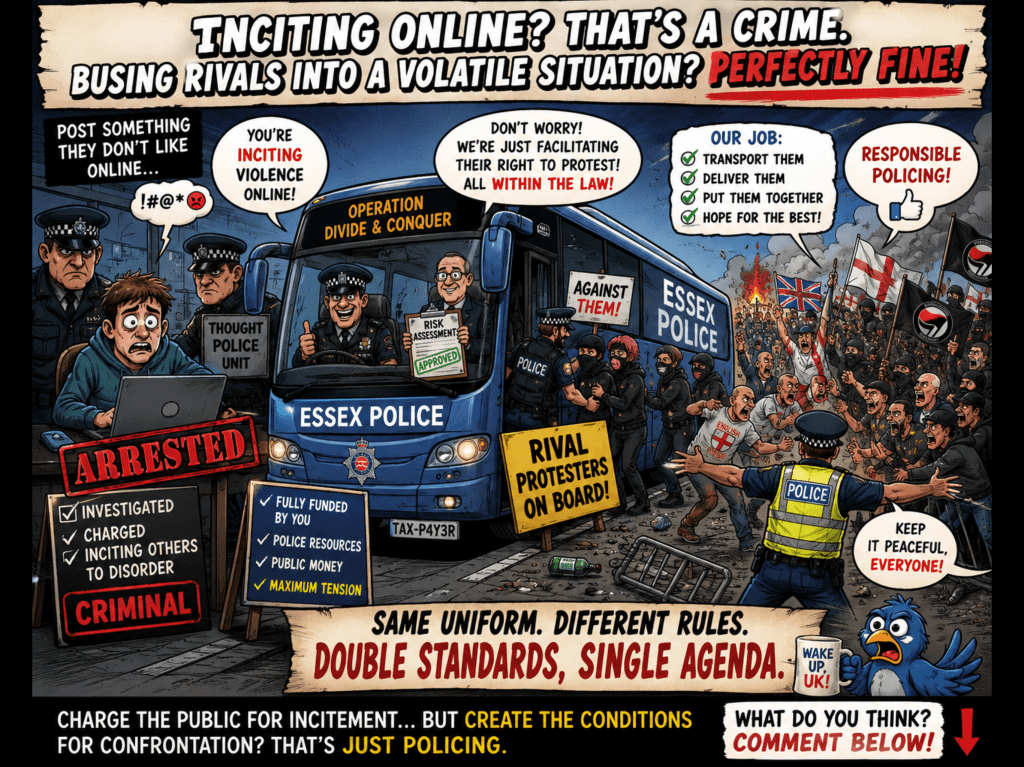
When police forces start sounding less like peacekeepers and more like event planners for rival demonstrations, eyebrows tend to rise. Essex Police now face criticism after claims they facilitated the transport of counter-protesters while insisting they were acting within the law. The question many are asking isn’t whether they can do it—it’s whether they should. 🤔⚖️
🚨 Incitement for Thee, Logistics for Me?
Nothing says “de-escalation” quite like allegedly giving opposing protesters a lift to the same location and hoping everyone behaves. 🚍💥
Supporters of the move argue that police have a duty to facilitate lawful protest and ensure all voices can be heard. Fair enough. In a democracy, freedom of expression matters.
But here’s where many people see a glaring contradiction. Citizens can find themselves investigated, arrested, or even charged for allegedly encouraging disorder online, sharing inflammatory messages, or inciting others into volatile situations. Yet when authorities are accused of physically transporting an opposing group into an already tense environment, we’re told it’s responsible public-order management. 🤷♂️🚔
That’s a difficult distinction for many to swallow.
The average person might reasonably ask: if stirring people up from behind a keyboard can be considered reckless, how does helping move rival factions into the same flashpoint location automatically become a masterclass in risk reduction? It’s a question that deserves an answer.
Of course, police would argue that one is unlawful incitement and the other is lawful crowd management. Critics, however, see something that looks suspiciously like a double standard. The message appears to be: “Don’t encourage confrontation online—but if we’re organising the transport, trust the process.” 🎪
Even if every legal box has been ticked, the optics are dreadful. Public confidence depends not only on what authorities do, but whether their actions pass the common-sense test. And to many observers, busing opposing groups into a potentially volatile situation feels less like preventing friction and more like delivering sandpaper. 🧯🔥
The issue isn’t simply legality. It’s trust. People want to know whether police are preventing conflict or inadvertently helping stage-manage it. When confidence in institutions is already under strain, perceptions matter almost as much as reality.
🔥 Challenges 🔥
If police can prosecute people for encouraging disorder, where should the line be drawn when authorities themselves facilitate the movement of rival groups into a tense situation? 🤔
Is this sensible crowd management, or does it create the very conditions they claim to be preventing?
Drop your thoughts in the blog comments and tell us what you think. 💬👇
👍 Like, 🔥 share, and 🗣️ comment if you believe public institutions should be held to the same standards they expect from everyone else.
🏆 The sharpest comments, strongest arguments, and funniest observations will be featured in the next issue of the magazine.


 Chameleon Magazine
Leave a comment