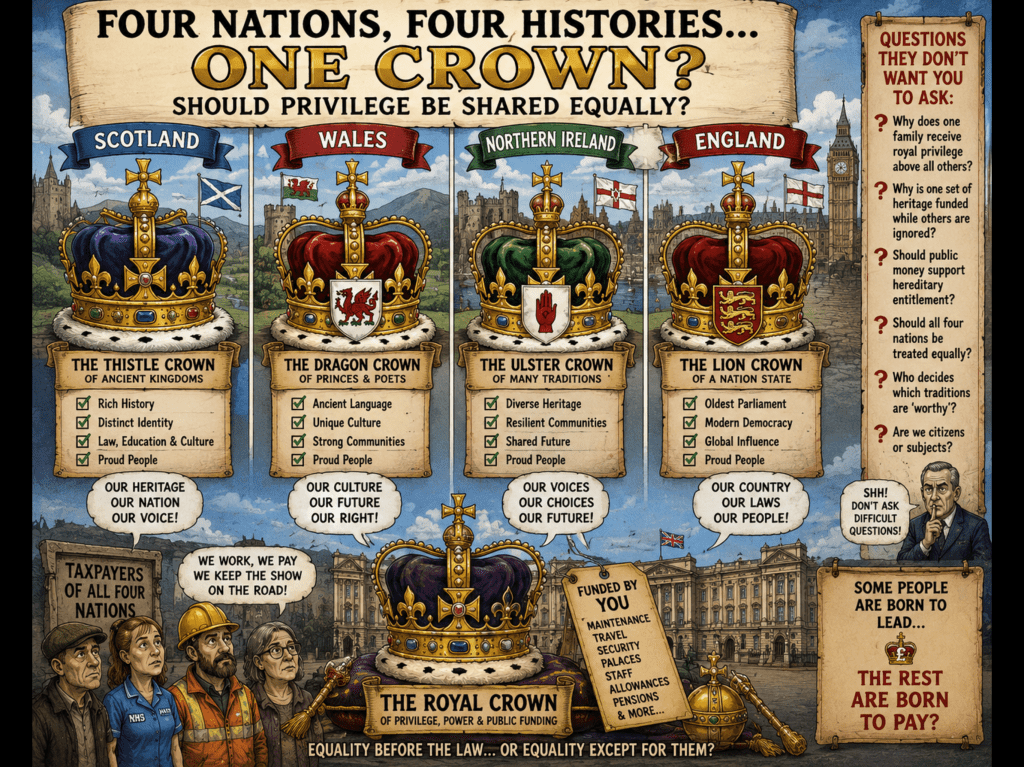
As more details emerge about royal finances, many taxpayers may find themselves asking familiar questions.
How much does it cost?
Who pays?
What value does it provide?
But perhaps there is a more interesting question that few politicians seem willing to ask.
If one family receives national recognition, constitutional status, public funding and extraordinary privilege because of its ancestry, why does that principle stop there?
The United Kingdom is made up of four nations.
England.
Scotland.
Wales.
Northern Ireland.
So why is one hereditary institution elevated above all others?
Why is royal lineage considered worthy of protection and funding, while the histories and identities of the nations themselves often compete for scraps of political attention?
Why is inherited royal status treated as a national asset while inherited cultural identity is often treated as little more than local colour?
And who decided that?
If heritage matters, whose heritage matters?
If tradition deserves public funding, which traditions qualify?
If ancestry creates entitlement, where does the principle end?
Could any politician seriously argue that a child born into a royal bloodline deserves greater constitutional significance than a child born in Glasgow, Cardiff, Belfast or Newcastle?
If not, why does the system continue to operate as though that is exactly the case?
Perhaps supporters of the monarchy are right.
Perhaps the institution generates value.
Perhaps it contributes to stability.
Perhaps it provides continuity.
But if those arguments are valid, shouldn’t they survive scrutiny?
Shouldn’t taxpayers be encouraged to ask difficult questions?
Shouldn’t every publicly funded institution justify its existence?
Or are some institutions considered beyond challenge simply because they have existed for a long time?
And what does that say about democracy?
In a modern society built on equality before the law, should birth still determine status?
Should ancestry still determine privilege?
Should governments continue to reinforce the idea that some people are born into a higher station than those who fund them?
Or has Britain simply become so accustomed to the arrangement that few people stop to ask whether it still makes sense?
🔥Questions for Readers🔥
❓ Are all four nations treated equally within the Union?
❓ Should hereditary privilege continue to receive public support?
❓ Does the monarchy strengthen or weaken national unity?
❓ Should all publicly funded institutions be held to the same standards of transparency?
❓ If Britain were designed today, would anyone create a hereditary monarchy?
❓ Is respect for tradition the same thing as acceptance of privilege?
❓ At what point does tradition become entitlement?
❓ Who ultimately serves whom?
The public funds the institutions.
The public funds the government.
The public funds the monarchy.
So why are taxpayers so often told to stop asking questions?
💬 Tell us what you think in the comments.
👇 Like, comment and share.
🏆 The best comments will be featured in the next issue of the magazine.


 Chameleon Magazine
Leave a comment