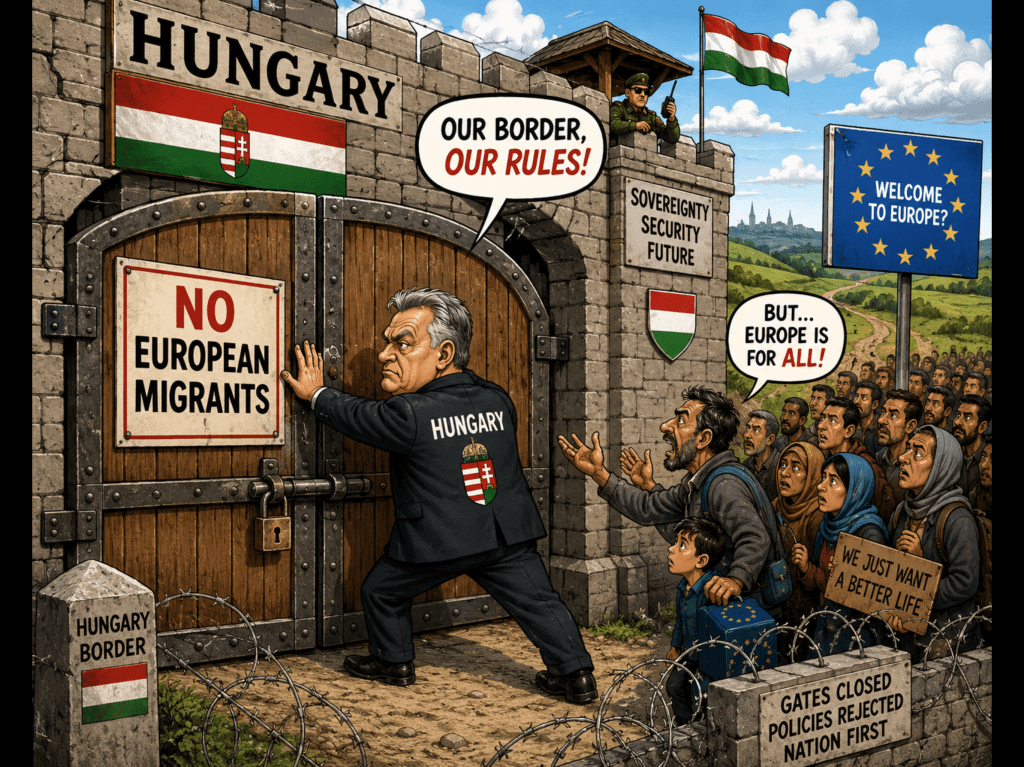
🇭🇺🚧Hungary has once again planted its boots firmly in the mud and declared, “Thanks, but no thanks,” to European migration policies. While many EU leaders continue debating quotas, relocation schemes, and shared responsibility, Budapest has doubled down on border controls and national sovereignty, arguing that a country’s borders should be controlled by the country itself—not by bureaucrats hundreds of miles away.
For supporters, it’s a simple question: if a nation can’t decide who enters its territory, is it really in control of its own future? For critics, Hungary’s hardline stance risks undermining collective European solutions and fuels division across the continent. Either way, Hungary seems perfectly comfortable playing the role of Brussels’ least obedient child at the family dinner table. 🍽️😏
🚪 “Do Not Disturb”: Hungary’s Message Arrives Loud and Clear
While EU officials draft another mountain of paperwork explaining why everyone should work together, Hungary appears to have responded with a much shorter document consisting of two words: “Border closed.”
The political establishment in Brussels often talks about solidarity. Hungary talks about fences. Brussels proposes redistribution mechanisms. Hungary proposes padlocks. One side sees humanitarian obligations; the other sees a map and asks why lines were drawn on it in the first place.
The result? A political standoff that has become as predictable as rain in Britain. Brussels expresses outrage. Hungary shrugs. Brussels threatens consequences. Hungary shrugs harder. 🤷♂️
To supporters of the policy, Hungary is defending national identity, security, and democratic self-determination. To opponents, it’s turning its back on European cooperation and vulnerable migrants. Regardless of where you stand, Hungary has become the EU’s most enthusiastic practitioner of the ancient political art of saying, “No.”
And unlike many governments that soften their rhetoric after criticism, Hungary seems to treat every condemnation as free advertising. 📢🔥
🔥Challenges🔥
Is Hungary protecting its sovereignty or damaging European unity? Is Brussels trying to coordinate a shared challenge, or has it become too detached from public concerns about migration?
Whatever your view, this debate isn’t going away. The arguments over borders, identity, security, and sovereignty are only getting louder. Tell us where you stand—and more importantly, why.
💬👇 Drop your thoughts in the blog comments. Agree with Hungary? Think Brussels is right? Have a better solution? Let everyone know.
👍 Like it. 🔄 Share it. 💥 Challenge someone else’s opinion.
The best comments, hottest takes, and sharpest observations will be featured in the next issue of the magazine. 📰🏆


 Chameleon Magazine
Leave a comment