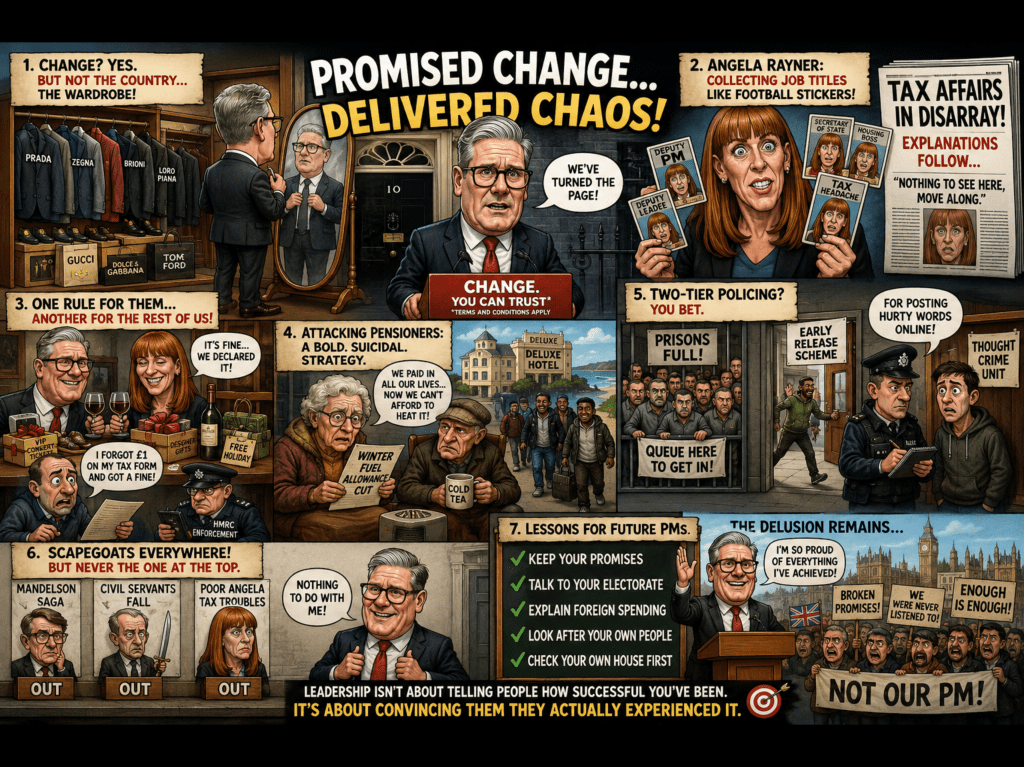
When he first walked into Downing Street, he promised change. Most of us assumed he meant the country. We didn’t realise the first transformation project would involve his and his wife’s wardrobe. 👔✨
It was a curious start for a man who had spent years attacking others over standards in public life. The very behaviour that had been used to batter previous Prime Ministers suddenly seemed a lot less scandalous when the designer labels were hanging a little closer to home.
Then there was Angela Rayner, who found herself caught up in her own tax controversies while seemingly collecting job titles with the enthusiasm of a child collecting football stickers. The headlines rolled in, the explanations followed, and Westminster once again reached for its favourite defence: “Nothing to see here, move along.”
What made the whole thing so fascinating was the lesson it appeared to teach. Ordinary people are expected to pay for everything. Every bill. Every tax. Every parking ticket. Every forgotten penny is hunted down with the determination of a Hollywood bounty hunter.
Meanwhile, politicians spent weeks explaining gifts, freebies, declarations and technicalities.
You almost began to wonder whether shoplifters were taking notes.
After all, if the people running the country can spend months discussing why they didn’t personally pay for things immediately, some chancer wandering out of Tesco with a basket full of shopping might reasonably conclude he was simply embracing modern leadership principles.
Obviously, the law sees things rather differently. But politics is supposed to lead by example, and the example being set looked suspiciously like a masterclass in “rules for thee, but not for me.”
Just when you thought things couldn’t get any worse, the government decided to head straight for the political equivalent of a live electrical cable: pensioners.
Of all the groups in Britain to pick a fight with, they chose the people who had spent decades working, paying taxes and contributing to the country before finally reaching retirement.
It was a bold strategy.
Some might even call it suicidal.
At a time when many elderly people were already worrying about rising household costs, ministers appeared determined to convince them that heating their homes had become an extravagant luxury rather than a basic necessity. ❄️🥶
The message seemed to be that sacrifices had to be made.
Curiously, those sacrifices always appeared to be made by somebody else.
Critics looked on in disbelief. Here was a government asking pensioners to tighten their belts while simultaneously finding money, accommodation and resources for a growing number of people arriving in small boats.
To many voters, it looked like the government had opened its book of political ideas, skipped past “How to Win Public Support” and gone straight to the chapter titled “How to Annoy Absolutely Everyone.”
The backlash was swift.
It turns out that taking money away from pensioners is about as popular as replacing tea with warm tap water.
Who could possibly have seen that coming? ☕🔥
Then came crime and what critics called two-tier policing.
It seemed the prisons had become so popular that there were more people queuing to get in than there was room to hold them. They were so overcrowded that the government started looking for ways to throw people out. 🚪
But that wasn’t enough for Starmer.
The result was a strange spectacle where the public watched prison places being freed up on one hand while, on the other, Starmer appeared determined to fill them with people posting hurty words online.
He wanted them to feel the full force of the law.
Then came the point where he completely lost the plot and started blaming everyone but himself for what was happening in government.
People were going down like ducks at a carnival shooting gallery. 🎯🦆
There was the Mandelson saga. There were civil servants falling on their swords. Then there was poor Angela, facing endless questions over tax affairs in a country where paying tax is supposedly quite important.
The pattern was always the same.
Something went wrong. A headline appeared. Somebody else took the blame.
Yet somehow the blame always stopped one desk short of the Prime Minister. 🤡
Even as he leaves office, the Prime Minister appears alive and well inside his own delusion.
His resignation speech was filled with achievements, successes and glowing self-assessments. Missing, however, were the failures. Missing were the broken promises. Missing was any acknowledgement that perhaps the biggest mistake of all was never learning how to communicate with the British people.
For two years, voters were told what they should think rather than listened to about what they actually felt.
If there is one lesson future Prime Ministers should learn from this mess, it is simple.
If you make promises, don’t abandon them the moment you walk through the door of Number 10.
Talk to the people who elected you.
If you’re going to spend billions overseas, explain to taxpayers why that money is a greater priority than the problems they face at home.
And if you’re looking for savings, stop starting with pensioners, workers and the people already carrying the burden.
Take a long look around your own house first.
Because leadership isn’t about telling people how successful you’ve been.
It’s about convincing people they actually experienced it. 🎯


 Chameleon Magazine
Leave a comment