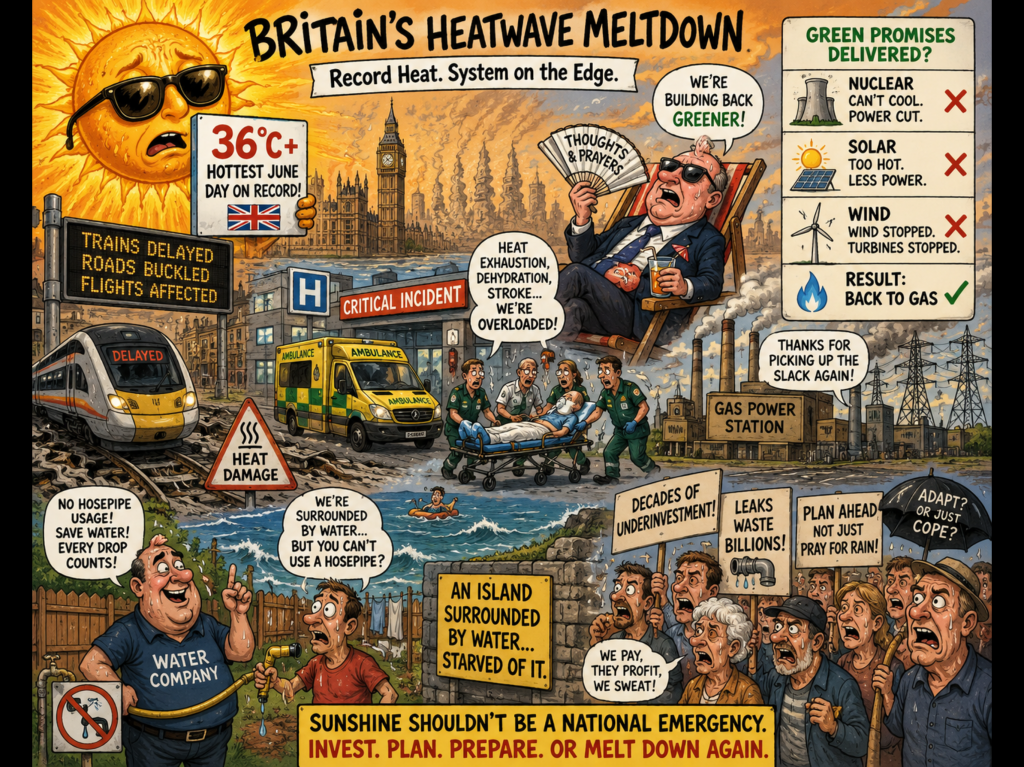
Britain has just chalked up its hottest June day on record, with temperatures climbing above 36°C. Hospitals have declared critical incidents, trains have slowed or stopped, roads have buckled, and health warnings remain in force across large parts of the country. A nation that prides itself on resilience suddenly discovers that sunshine is apparently our greatest national security threat. ☀️🚆
🥵 The Great British Heatwave Survival Plan: “Please Don’t Turn Anything On”
For years we’ve been promised modern, resilient infrastructure fit for the future. Then one proper heatwave arrives and the national strategy appears to be:
- Don’t travel. 🚄
- Don’t use too much electricity. ⚡
- Don’t use too much water. 🚿
- Stay indoors. 🏠
- Hope for rain. 🌧️
The electricity system also came under pressure. Some nuclear stations had to reduce output because warmer rivers and seas made cooling more difficult, solar panels become less efficient as temperatures climb well above their optimum operating range, and when high-pressure weather systems settle over Britain, the wind often drops just when electricity demand is rising. The result? Gas-fired power stations once again stepped in to help keep the lights on. 🔥⚡
Then there’s the water situation. We’re surrounded by sea on every side, yet households are told to put away the hosepipes while leaks continue to lose huge amounts of treated water every day. To many people, it’s hard not to ask: if we can send rockets into space and stream films in 4K, why does filling a paddling pool become a national emergency every summer? 🌊🤷
Of course, turning seawater into drinking water is perfectly possible—but desalination is expensive and energy-intensive. Critics argue that decades of underinvestment in reservoirs, pipelines, water storage and leak repairs have left the country increasingly vulnerable whenever prolonged dry weather arrives.
The result is a familiar cycle: every few years Britain gets either too wet or too dry, and the public is told to simply adapt while wondering where all the long-term planning went. For a nation that helped pioneer the Industrial Revolution, it’s a remarkable achievement that a few days of sunshine can still leave us scrambling for emergency measures.
🔥 Challenges 🔥
Has Britain invested enough in the infrastructure needed for a changing climate, or are we paying the price for decades of short-term thinking? We want to hear your view.
Drop your thoughts in the blog comments. 💬👇
👍 Like it. 🔄 Share it. 💥 Challenge it.
The sharpest, funniest and most thought-provoking comments will be featured in the next issue of the magazine. 📝🏆


 Chameleon Magazine
Leave a comment