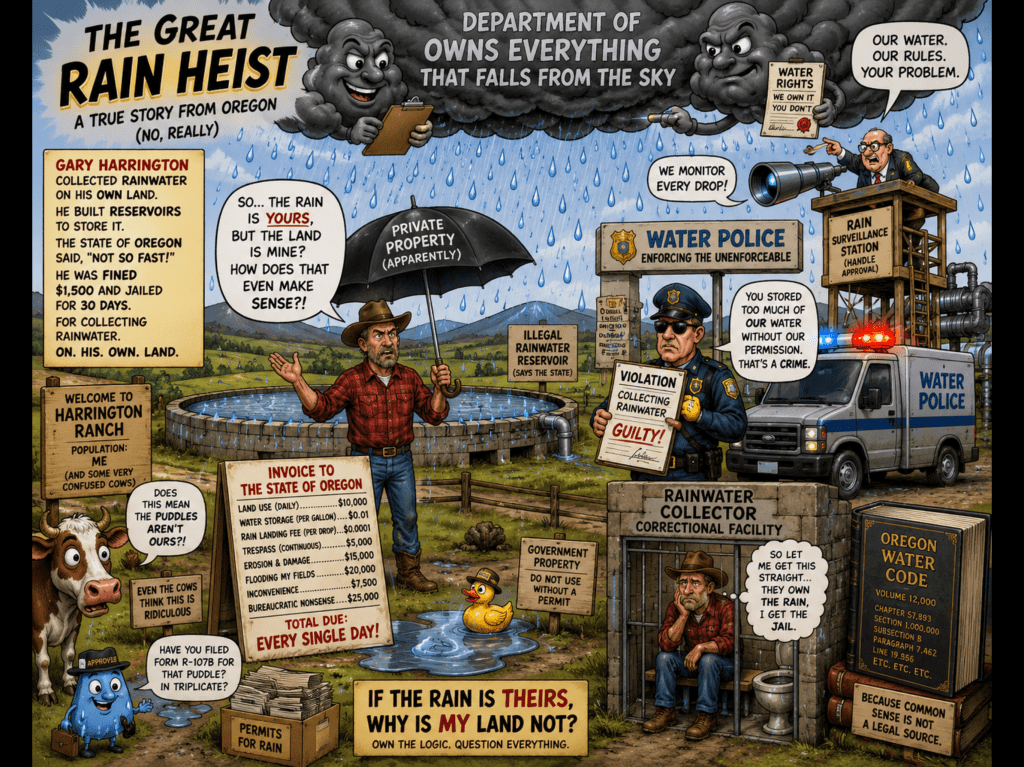
Imagine telling someone they could end up in jail because they collected rainwater on their own land.
Most people would laugh.
They’d assume it was another internet myth.
Except, in Oregon, something remarkably close to that really happened.
Gary Harrington owned land in rural Oregon. Over time, he built three large reservoirs that collected rainwater and snowmelt. The reservoirs were enormous, capable of holding millions of gallons of water.
The State of Oregon took the view that this wasn’t simply “his” rainwater. Officials argued the water would naturally have flowed into streams and rivers where other people held legal water rights. They said he had repeatedly ignored warnings and continued storing the water without the necessary permits.
Eventually, he was prosecuted.
He was fined.
And he served time in jail.
Now, supporters of the decision will immediately point out that this wasn’t about someone filling a water butt outside their house. They are right. It wasn’t.
It was about water rights, reservoirs and permits.
But once you’ve understood the legal explanation, you’re left with a question that sounds almost too ridiculous to ask.
Who exactly owns the rain?
Because if the answer is “the government” or “the public”, then things start becoming very strange indeed.
The rain falls from the sky.
It lands on my land.
It soaks into my soil.
It runs across my fields.
It floods my property.
It erodes my banks.
It occupies my land.
Yet somehow…
…it isn’t mine.
Really?
If that’s true, then surely the government is using my property to store its water.
Where is my storage fee?
Where is my rental income?
Where is my compensation every time government-owned rain floods my fields?
Where is the trespass notice for millions of gallons of publicly owned water arriving on private property without permission?
You can’t have it both ways.
Either the rain becomes part of my property when it lands on my land…
…or it remains your property, in which case you’re using my land free of charge.
Imagine any other situation.
A government vehicle is parked in your driveway.
“Sorry, that’s public property.”
A shipping container is left in your garden.
“Not yours. It belongs to the state.”
Most people would expect somebody to pay rent.
But apparently, when the property happens to be water, different rules apply.
Now, there is a practical reason these laws exist. If every upstream landowner captured huge amounts of water, rivers could be deprived of flow, affecting downstream farmers, communities and wildlife. That’s a genuine public policy concern.
But acknowledging the reason doesn’t stop the principle from sounding extraordinary.
Because at its heart, the law asks us to accept something that feels completely at odds with everyday ideas of ownership.
Rain can fall on your property.
Sit on your property.
Damage your property.
Flow across your property.
And still belong to somebody else.
Whether you think that’s sensible resource management or one of the strangest legal concepts ever devised is a matter of opinion.
But one thing is certain.
It is the sort of law that makes ordinary people stop, shake their heads and ask,
“Hang on… if the rain isn’t mine, what’s it doing on my land?”


 Chameleon Magazine
Leave a comment