The Green Party has come up with another headline-grabbing idea.
This time, it’s a proposal that would give workers who menstruate up to three days’ paid leave every month—potentially adding up to 36 extra paid days a year. The proposal has reportedly been submitted as a motion ahead of the party’s Autumn Conference and is not yet party policy. (The Spectator)
On paper, it might sound compassionate.
In the real world, how is this supposed to work?
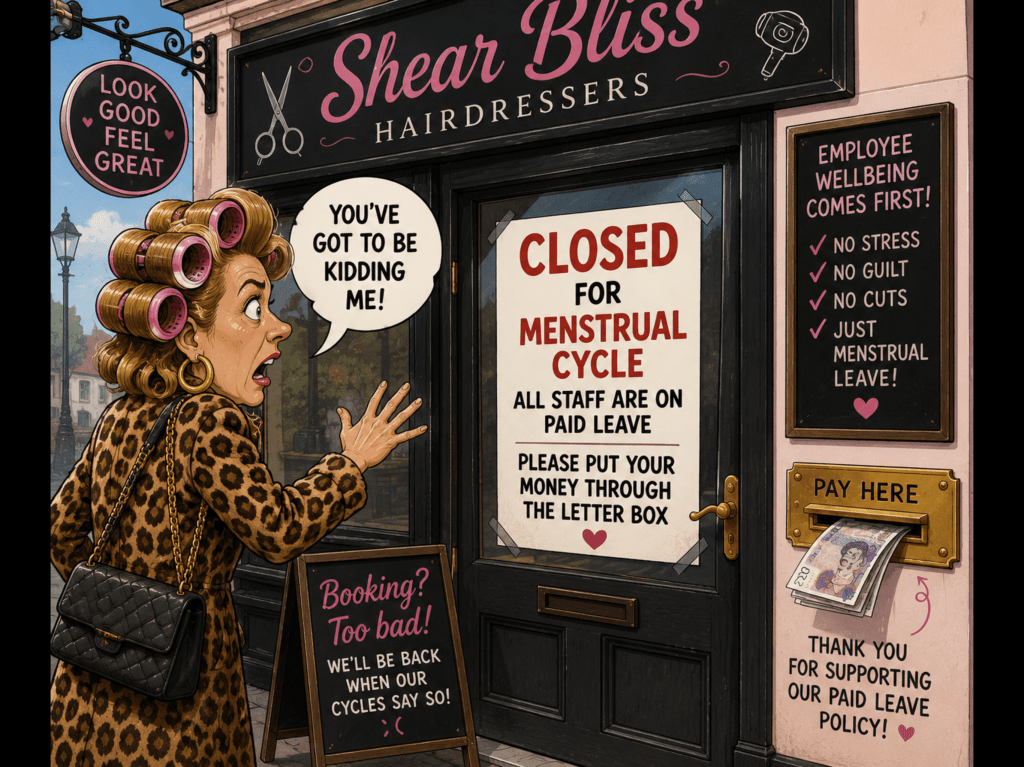
Imagine you’ve booked your hair appointment for the wedding of the year. You arrive at the salon to find a sign on the door:
“Closed this week. Staff are on menstrual leave. See you next month.”
Or imagine you’re responsible for running a power station, an airport, a hospital ward, or a manufacturing plant.
Do you simply put a sign outside saying:
“Sorry, we’re closed. We’ll switch the lights back on when everyone’s back.”
Businesses don’t run on wishful thinking. Small employers especially have to balance staff welfare with keeping the doors open. Every additional employment cost has consequences—whether that’s higher prices, fewer jobs or businesses deciding not to expand.
Of course, people with serious medical conditions such as endometriosis deserve understanding and appropriate workplace support. But that’s very different from creating a blanket entitlement to dozens of extra paid days off every year regardless of individual circumstances.
Sometimes the Green Party seems more interested in producing eye-catching policies than asking one simple question:
Who pays?
Because in the end, it’s businesses, taxpayers and customers who pick up the bill.
💬 Challenge
Is this sensible employment policy—or another idea that sounds good in a conference hall but falls apart in the real world?
Let us know what you think in the comments. The best responses could feature in the next edition of the magazine.
👍 Like it. 💬 Comment on the blog. 🔄 Share it if you think others need to see it.
Next, they will be wanting time off for having babies!


 Chameleon Magazine
Leave a comment