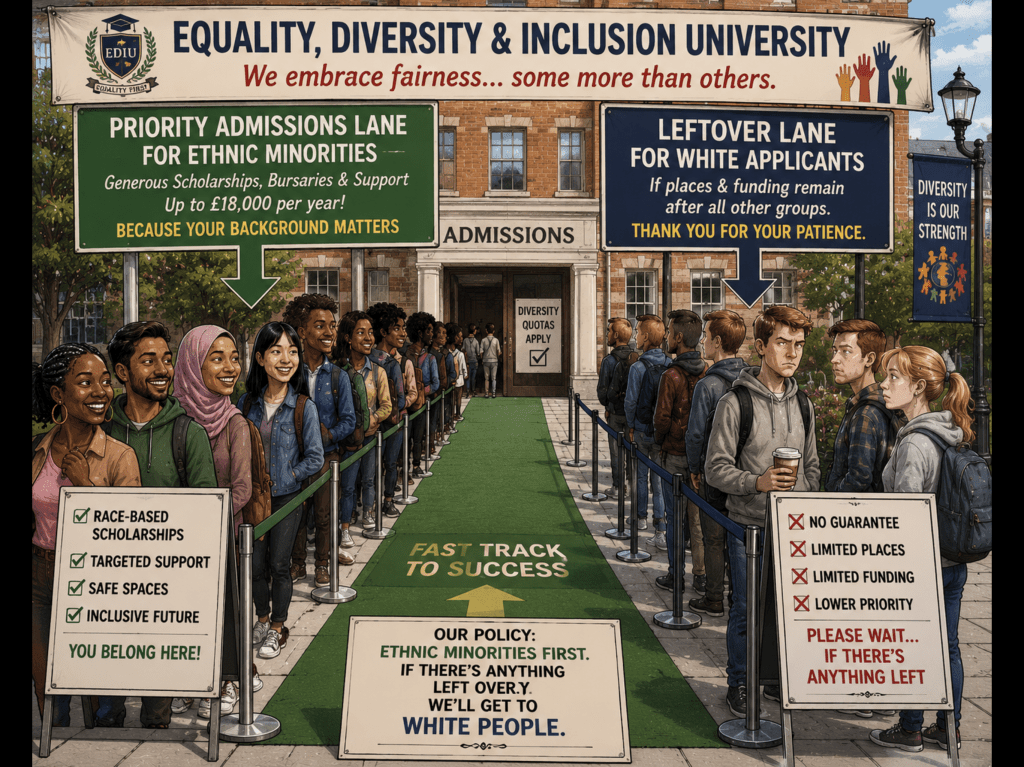
🎓📋Universities proudly tell us that equality is their guiding principle.
Then they unveil scholarships that, in some cases, are only open to applicants from particular ethnic backgrounds.
So let’s get this straight.
Two students.
Same grades.
Same financial hardship.
Same determination.
But one qualifies for thousands of pounds in support because of their ethnicity, while the other doesn’t.
That’s an interesting definition of equality.
The message can sometimes feel like this:
“We’ll look at your circumstances… just as soon as we’ve looked at your ethnicity.”
Universities insist these schemes are designed to address historic underrepresentation and widen participation.
Critics argue that if the aim is to help disadvantaged students, then assistance should be based on financial need, educational disadvantage and individual circumstances—not race.
After all, hardship doesn’t check your ethnicity before arriving.
A student struggling to pay rent is still struggling, regardless of the box they tick on an application form.
Equality should be blind to race.
Otherwise, it risks becoming exactly what it claims to oppose: treating people differently because of their background.
Perhaps it’s time to stop asking, “What colour are you?”
And start asking, “What help do you actually need?”
Now there’s a revolutionary idea.
🔥 Challenges 🔥
Should scholarships be awarded based on financial need and personal disadvantage rather than ethnicity?
Or do targeted ethnicity-based awards still have an important role to play?
Join the debate in the blog comments. We want your views, your experiences and your best arguments. 💬👇
👍 Like it. 🔄 Share it. ✍️ Leave your comments below.
The best comments could feature in the next issue of the magazine.


 Chameleon Magazine
Leave a comment