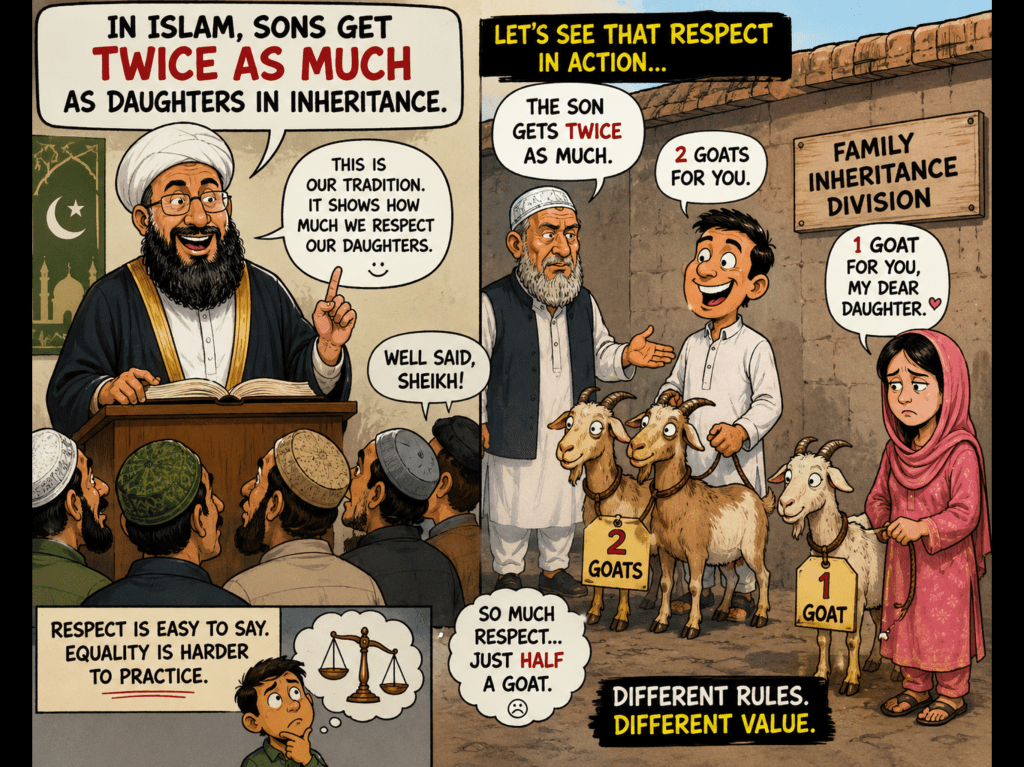
An Islamic preacher recently explained the traditional inheritance rule that sons receive twice the share of daughters. The justification is rooted in classical Islamic law, where men were historically expected to bear greater financial responsibilities. But to many modern ears, it raises an uncomfortable question: if respect is equal, why isn’t the inheritance?
🐑When “Respect” Comes with a 50% Discount
It’s always fascinating when unequal treatment is presented as a sign of honour. Apparently, giving someone less is now evidence of valuing them more.
Imagine the family farm. The son gets two goats. The daughter gets one.
“But don’t worry,” she’s told. “We respect you immensely.”
It’s a remarkable sales pitch. Somewhere along the way, mathematics packed its bags and left the conversation.
Of course, supporters argue that the rule reflects different financial obligations placed on men in traditional Islamic society. Critics respond that in today’s world—where daughters often work, contribute financially, and care for ageing parents just as much as sons—the justification no longer reflects reality.
Respect is easy to proclaim. Equality is a little harder to demonstrate.
That’s why the women are asked to wear the hijab, so cannot see their tears.
🔥Challenges🔥
Does a rule designed for a seventh-century society still make sense in the twenty-first century? Can unequal inheritance be justified by different family responsibilities, or should sons and daughters be treated equally under modern circumstances?
Share your thoughts in the blog comments. Keep it respectful, challenge the arguments, and debate the ideas—not each other. 💬
👇 Like, comment, and share if you think this debate deserves an honest conversation.
🏆 The best comments will be featured in the next issue of the magazine.


 Chameleon Magazine
Leave a comment