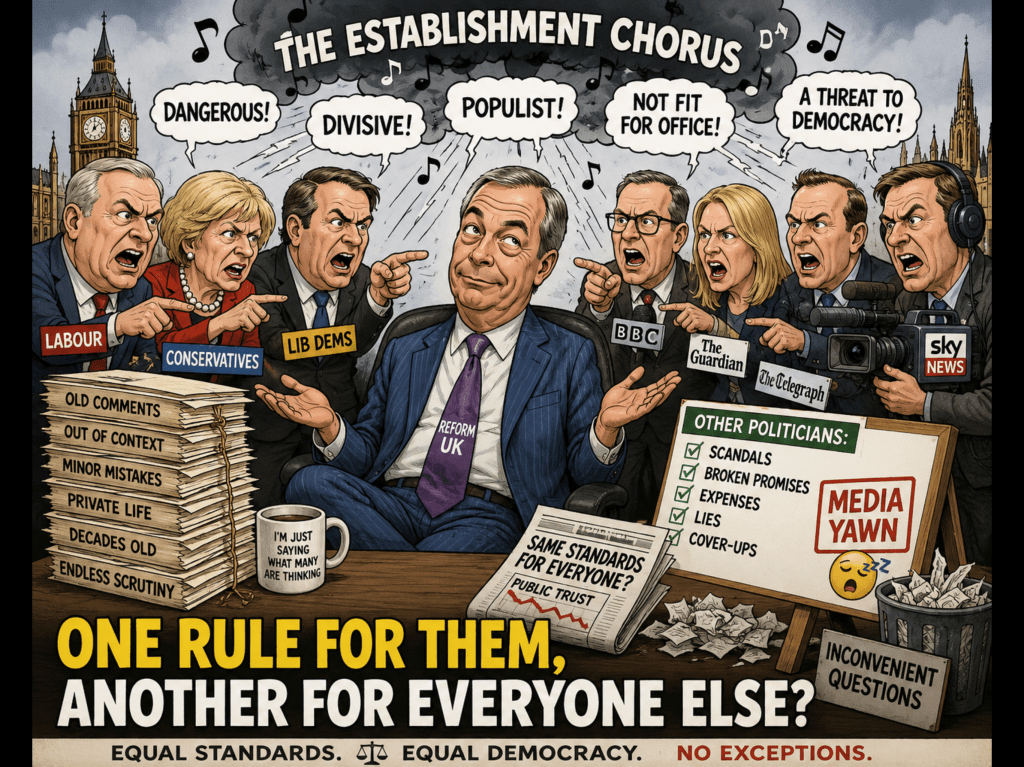
There is no denying that Nigel Farage dominates headlines. Whether he’s praised, criticised, mocked or condemned, he attracts a level of media attention that few politicians can rival. 📺🔥
That isn’t especially surprising. As one of the most polarising figures in British politics, every speech, interview and policy announcement is guaranteed to spark a storm. Some of that relentless scrutiny simply comes with the territory of leading a party that has shaken up the political landscape.
But here’s where things become far more interesting…
🎭 When Everyone Sings from the Same Hymn Sheet
Reform UK is no longer a fringe protest movement waving placards from the political sidelines. It has become a genuine electoral threat to the established parties. 🗳️
History tells us that when an outsider starts winning over large numbers of voters, rivals don’t politely applaud—they attack. That’s politics.
The real question isn’t whether Nigel Farage deserves criticism. Every political leader should face tough questions.
The question is why so many institutions often appear to move in the same direction at the same time.
When major political parties, prominent commentators and large sections of the media all arrive at remarkably similar conclusions, many voters naturally begin wondering whether this is simply independent judgement or whether an establishment consensus has formed.
That perception matters.
Importantly, similar criticism does not automatically prove coordination or conspiracy. People can genuinely reach the same conclusions independently because they disagree with policies or because they see a political threat.
But perception is everything in politics—and once public trust begins to erode, rebuilding it becomes incredibly difficult.
The real democratic concerns arise when:
- criticism becomes personal instead of policy-focused;
- different politicians appear to be judged by different standards;
- some scandals dominate headlines while similar stories involving others barely register; and
- institutions seem more interested in influencing political outcomes than informing the public.
Those are questions worth asking regardless of which party someone supports.
Even recent discussions around potential by-elections illustrate the problem. If several established parties appear reluctant to compete while an outsider is left as the sole challenger, many people will inevitably interpret that as the political establishment closing ranks. Whether that perception is accurate or not almost becomes secondary—the damage is done if voters begin believing meaningful political competition has disappeared.
The media faces the same challenge.
A genuinely free press should investigate Nigel Farage rigorously.
It should investigate Labour ministers, Conservative ministers and every other political party with exactly the same determination. 📰
When people believe different standards are being applied depending on political affiliation, confidence in journalism suffers just as confidence in politics does.
Ultimately, this debate shouldn’t revolve around one politician.
It should revolve around one principle.
Equal treatment.
Because once voters begin believing that political elites, media organisations and powerful institutions protect one another while applying exceptional scrutiny to outsiders, faith in democracy itself begins to crack. 🇬🇧⚖️
Whether you support Nigel Farage, Keir Starmer, the Conservatives, Reform UK—or none of them at all—the same standards should apply equally to everyone.
That’s not a partisan argument.
It’s the foundation of a healthy democracy.
💬 Challenges
Here’s the question that really matters…
Do you believe Britain’s politicians, media and public institutions apply the same standards to everyone—or do some figures receive dramatically different treatment depending on who they are?
Tell us what you think in the blog comments, not just on social media. Is this simply politics as usual, or is public confidence being steadily undermined? We’d love to hear your perspective. 👇
👍 Like it. 🔄 Share it. 💬 Join the debate.
The most insightful, funniest and thought-provoking comments will be featured in the next issue of the magazine!


 Chameleon Magazine
Leave a comment