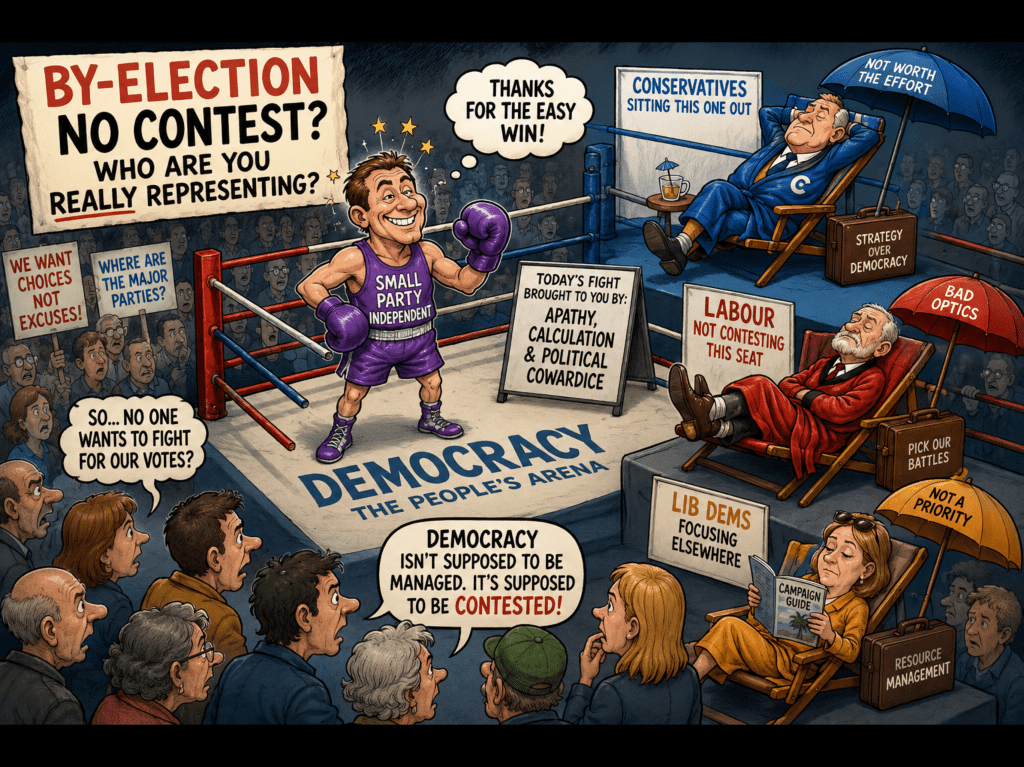
Democracy was never meant to be a polite dinner party. It was built to be loud, argumentative, occasionally chaotic, and forever uncomfortable. Elections exist for one simple reason: to let competing ideas battle it out while the public decides who deserves the keys to the country.
So what happens when the biggest players don’t even bother showing up?
🗳️ The Curious Case of the Missing Opposition
Imagine paying for a boxing match only to discover one fighter stayed home because the odds looked a bit grim. That’s increasingly how some by-elections can feel when major political parties quietly decide they’re “strategically unavailable.”
Of course, it’s perfectly legal. Nobody is forced to field a candidate. Campaigns cost money, resources are limited, and political strategists love nothing more than spreadsheets full of probability charts.
But democracy isn’t supposed to run on calculators.
If you genuinely believe your ideas deserve to govern Britain, surely every election is a chance to prove it. Choosing not to compete risks sending an awkward message: that protecting party strategy has become more important than representing the voters who are left wondering where everyone went.
The irony is impossible to ignore. Politicians endlessly tell us democracy is precious—until democracy asks them to stand in a difficult contest.
When elections become something to avoid rather than embrace, voters naturally start asking uncomfortable questions. Has politics become less about winning public confidence and more about carefully managing public perception?
That’s not a healthy look for any democracy.
Trust in Westminster is already hanging together with little more than crossed fingers and carefully rehearsed press conferences. Every uncontested political battle feeds the suspicion that the establishment has become more interested in protecting its own position than earning fresh support from the people it’s supposed to serve.
Democracy isn’t strengthened by avoiding difficult verdicts. It’s strengthened by facing them head-on.
After all, if your policies really are the answer, why fear the question?
Perhaps the greatest test of democratic confidence isn’t winning elections—it’s being willing to stand in them, even when the forecast looks politically miserable. 🌧️🗳️
🔥 Challenges 🔥
Here’s the challenge: should every major political party contest every by-election, regardless of the odds? Or is strategic withdrawal simply smart politics in a world of limited resources?
Jump into the discussion on the blog and tell us where you stand. Is democracy healthier when every voice competes—or are uncontested elections becoming the new normal? 💬⚖️
👇 Like it. Share it. Most importantly, leave your thoughts in the blog comments and keep the debate alive.
🏆 The best comments will be featured in the next issue of the magazine.


 Chameleon Magazine
Leave a comment