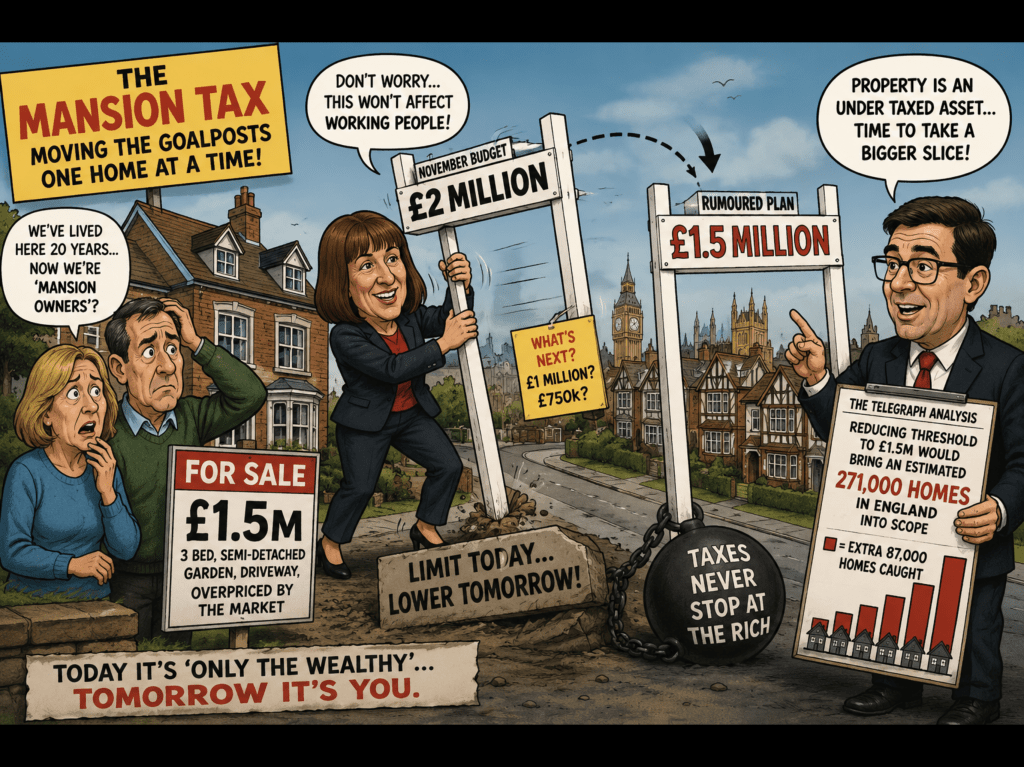
💷🏠When Rachel Reeves unveiled Labour’s new mansion tax on homes worth more than £2 million in her November Budget, it was presented as a measure aimed squarely at Britain’s wealthiest property owners. The message was simple enough: if you own a multi-million-pound mansion, you can probably afford to contribute a little more.
Few people object to taxing billionaires with sprawling country estates.
The question is whether that’s where it stops.
History has a funny way of turning “only the richest” into “more people than we originally intended.” Tax thresholds have an unfortunate habit of standing perfectly still while house prices quietly march past them.
Now, according to reports, Greater Manchester Mayor Andy Burnham is preparing to widen the net. Burnham has long argued that property is one of Britain’s most undertaxed assets, and analysis by The Telegraph suggests reducing the threshold from £2 million to £1.5 million would bring an estimated 271,000 homes in England into scope.
That’s around 87,000 additional properties suddenly finding themselves labelled as “mansions.”
It’s amazing what passes for a mansion these days.
In some parts of London, £1.5 million buys a perfectly ordinary family home with enough room to swing a cat—provided the cat has booked an appointment first.
Outside the capital, of course, that same money might still buy a genuinely spectacular property. But that’s precisely the problem with national property taxes. Britain’s housing market isn’t one market at all. It’s dozens of vastly different local markets squeezed into a single set of rules.
A house can be worth over £1.5 million not because its owners are swimming in cash, but simply because they’ve lived there for decades while property prices have soared around them.
They may be asset rich…
…and income poor.
Yet the taxman rarely distinguishes between someone with millions in disposable income and someone sitting on paper wealth they never asked for.
Supporters argue that housing wealth has escaped taxation for too long. With residential property worth around £7 trillion across Britain, they see untapped revenue sitting behind millions of front doors.
Critics see something rather different.
They see another example of fiscal creep.
Governments often introduce taxes with reassuring promises that they’ll affect only a tiny number of people. Years later, thresholds remain frozen while inflation, wage growth and rising asset prices quietly drag more households across the line.
What began as a tax on the very wealthy gradually becomes a tax on the comfortably off… and eventually, perhaps, on people who never imagined they belonged in either category.
It’s a story we’ve seen before.
Income tax thresholds.
Inheritance tax.
Stamp duty.
Each began life targeting relatively few people before inflation and rising values steadily expanded the number caught.
The rules didn’t necessarily change.
Reality did.
That’s why many homeowners hear the words “mansion tax” with more than a little scepticism.
Today it’s £2 million.
Tomorrow it’s £1.5 million.
Who’s willing to bet that’s where it ends?
Labour insists it isn’t increasing taxes on working people, pointing to its manifesto commitments. Strictly speaking, taxing property rather than income may allow ministers to make that claim.
But many of those living in higher-value homes are still very much working people. They simply happen to own houses in areas where prices have risen dramatically over several decades.
Calling someone a millionaire because their semi-detached house has appreciated in value doesn’t necessarily mean they have millionaire lifestyles—or millionaire bank balances.
This is where politics meets perception.
Supporters will describe the proposal as asking those with the broadest shoulders to contribute more.
Opponents will argue that today’s luxury tax has a habit of becoming tomorrow’s middle-class burden.
Both sides will find statistics to support their case.
The real question isn’t whether property wealth exists.
It’s whether governments can resist the temptation to keep moving the goalposts every time they need another slice of the pie.
Because taxes introduced for “other people” have an uncanny habit of becoming taxes that affect everyone else eventually.
🔥 Challenges 🔥
Do you think a £1.5 million home is really a “mansion” in today’s property market, or is this another case of the tax net quietly expanding? Should property wealth be taxed more heavily, or are homeowners being punished simply because prices have risen around them? Join the debate in the comments below—we’d love to hear where you stand. 💬🏡
👇 If this got you thinking, like, share and leave your opinion in the comments.
🏆 The sharpest comments will be featured in the next issue of the magazine.


 Chameleon Magazine
Leave a comment