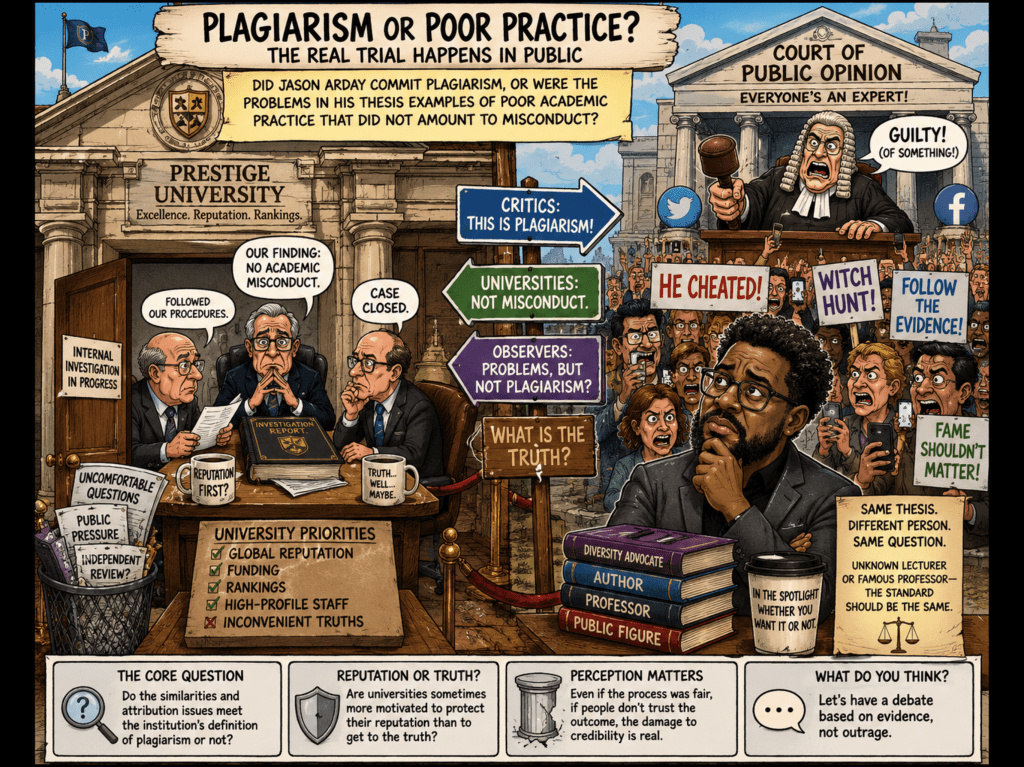
The debate surrounding Professor Jason Arday isn’t actually as simple as “he cheated” or “he didn’t.” The real question is far more nuanced—and far more important.
Did Jason Arday commit plagiarism, or were the problems in his thesis examples of poor academic practice that did not amount to academic misconduct?
That distinction matters. Universities examined the allegations and concluded they did not amount to academic misconduct. Critics disagree, arguing that the similarities and attribution issues are serious enough to cross the line into plagiarism. Others fall somewhere in the middle, accepting there may be referencing problems while questioning whether they meet the institutional threshold for plagiarism.
So why has this become such a lightning rod? ⚡
🎭 Welcome to the Court of Public Opinion
Once a case escapes the university and lands on social media, everyone suddenly becomes a professor, barrister and plagiarism detective—all before breakfast. 📱☕
One camp insists the evidence speaks for itself. Another argues that institutional investigations should be respected unless compelling new evidence emerges. A third suspects the entire debate has become less about footnotes and more about headlines.
Because Arday is a prominent academic and a visible advocate for diversity, every opinion arrives carrying political luggage. 🎒
To some, he’s being unfairly singled out because of his profile. To others, prominence should mean even greater scrutiny. Somewhere in the middle sits an awkward truth: fame tends to amplify everything, including disputes that might otherwise remain inside an academic committee room.
If exactly the same thesis had belonged to an unknown lecturer at a little-known university, would it have become a national talking point? Probably not. Yet the central question would remain unchanged:
Do the similarities and attribution issues satisfy the institution’s definition of plagiarism—or don’t they?
That’s the issue. Everything else risks becoming background noise. 🔍
🏛️ Reputation First… or the Truth First? 🤔
Another uncomfortable question refuses to go away: when universities investigate allegations against their own high-profile academics, are they primarily searching for the truth—or protecting their reputation?
Universities have a duty to investigate fairly, follow their own procedures and reach evidence-based conclusions. At the same time, they also have powerful incentives to safeguard public confidence, attract funding, recruit talented staff and students, and protect their global standing. Those interests can create a perception—fairly or unfairly—that institutions may be reluctant to admit failings involving prominent figures.
That doesn’t mean any university has acted improperly in this case. There is no public evidence proving that reputation influenced the outcome. But perception matters. When controversial decisions leave large numbers of people unconvinced, questions about transparency and independence are almost inevitable.
Perhaps the better question isn’t whether the university was protecting its reputation, but how can any institution demonstrate beyond reasonable doubt that reputation played no part in its decision?
In an era where public trust is increasingly fragile, simply saying “we investigated ourselves and found no misconduct” may not satisfy everyone. Sometimes the process has to be as convincing as the conclusion itself. 🔍
🔥 Challenges 🔥
Forget the personalities for a moment.
Should allegations be judged solely against the evidence and the institution’s published standards? Or is public confidence damaged when controversial cases involving high-profile academics produce conclusions that many people continue to question?
We want to hear your view—but keep it thoughtful, respectful and evidence-based. 💬
👇 Like, comment and share if you think difficult questions deserve careful debate rather than instant verdicts.
🏆 The best comments will be featured in the next issue of the magazine.


 Chameleon Magazine
Leave a comment