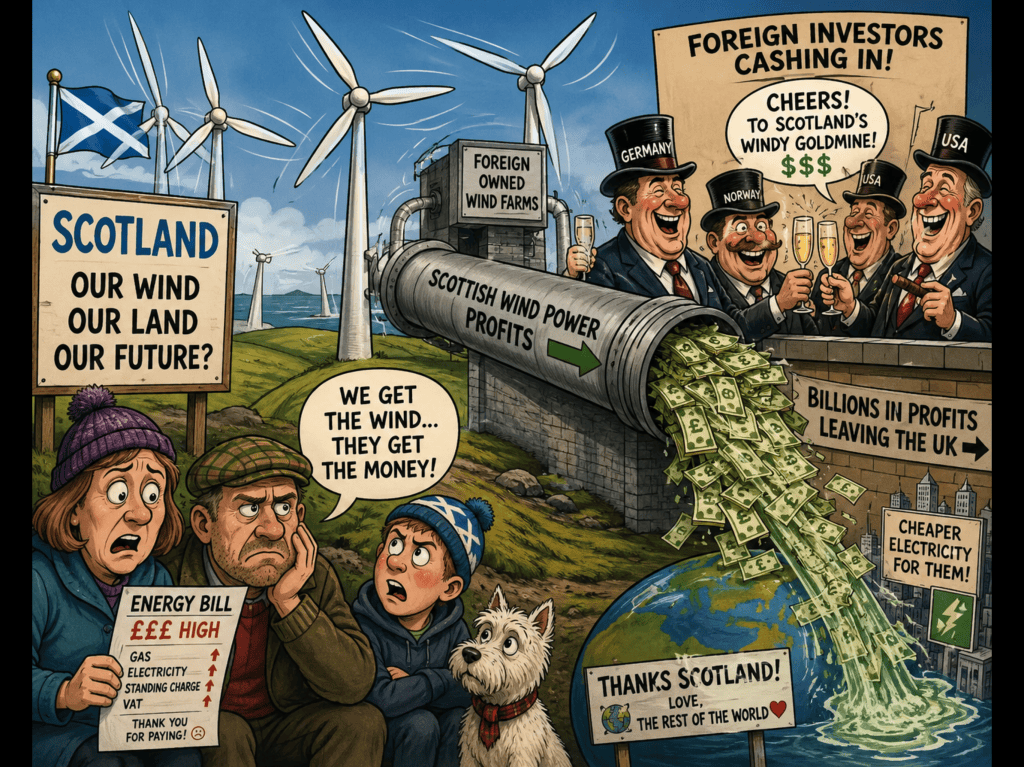
Scotland has some of the richest wind resources in Europe, yet somehow we’ve managed to pull off the political magic trick of generating enormous wealth while watching someone else walk away with the wallet. 🪄💸
Foreign-owned energy giants have poured billions into UK wind farms—many of them built on Scottish land or in Scottish waters—and they’re now reaping eye-watering profits from electricity sold to UK households. Meanwhile, families across Scotland are still staring at energy bills that would make a loan shark blush.
Apparently, this is what “green success” looks like. 🌍👏
⚡ Britain’s Greatest Export? Scottish Wind… and Common Sense 🤦♂️
Think about it for a second.
Scotland supplies vast amounts of renewable electricity. Our hills, coastline and seas are doing the hard work. Our weather—normally the punchline of every joke—is suddenly one of the most valuable natural resources in Europe.
So who wins?
Not the Scottish public.
Instead, foreign governments and overseas investment funds are collecting healthy dividends from infrastructure sitting on Scottish soil. Those profits leave the country while Scots continue paying some of the highest domestic energy costs in Europe. 💷➡️🌍
It’s almost impressive.
We’ve somehow created a system where the people producing the energy don’t enjoy cheap electricity, but the investors who own the turbines make fortunes.
You couldn’t script it better if you were writing a satire.
Even better, many of those profits may ultimately help strengthen the economies of the countries that own these companies. So while Scottish families tighten their belts, someone elsewhere could be benefiting from the returns generated by Scotland’s natural resources.
If this were happening anywhere else, people would call it a spectacular own goal.
Instead, we’re told it’s a victory for the environment.
Don’t misunderstand—renewable energy is essential. Clean energy is the future.
But surely the people who live beside the turbines, who see them every day, and whose natural resources generate the electricity should receive some meaningful benefit too?
Cheaper energy.
Lower bills.
Investment in local communities.
A fair return.
Instead, many Scots are left wondering why being one of Europe’s renewable energy powerhouses feels remarkably similar to being mugged in broad daylight. 🌬️💰
🔥 Challenges 🔥
Here’s the question nobody seems eager to answer:
If Scotland can help power the nation, why can’t Scottish households enjoy some of the cheapest electricity in Britain?
Why are ordinary people paying premium prices while multinational investors celebrate record returns?
Who do you think should benefit first from Scotland’s natural resources—the communities who live here, or overseas shareholders?
👇 Drop your thoughts in the blog comments, not just on social media. Challenge the narrative, agree, disagree, or tell us what you’d do differently.
👍 Like it if it struck a nerve.
🔄 Share it if you think more people should be asking these questions.
💬 Comment below—because the best comments will be featured in the next issue of the magazine!


Leave a comment