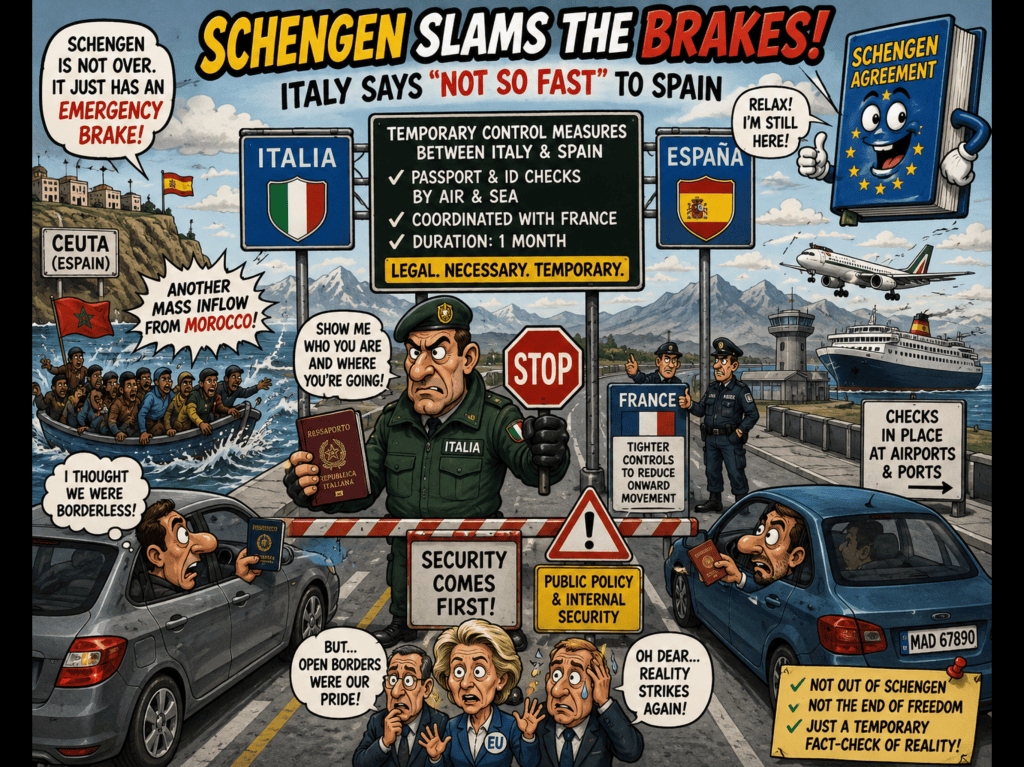
Italy has hit the pause button—not on the Schengen Agreement itself, but on free movement with Spain. Following the latest surge of migrants entering the Spanish enclave of Ceuta from Morocco, Rome has decided that waving everyone through isn’t quite the tourism campaign it had in mind. Temporary passport and ID checks are back, proving that even Europe’s most cherished open-border dream comes with an emergency brake.
🛂 Welcome Back to Border Control… Population: Common Sense? 🤔
Cue the predictable chorus. Half the internet is screaming, “Schengen has collapsed!” while the other half insists nothing has happened at all. The truth, as always, is far less dramatic—and far more interesting.
Italy hasn’t stormed out of Schengen. It hasn’t shredded the treaty or built a medieval wall across the Alps. Instead, it’s simply dusted off a perfectly legal clause that allows countries to temporarily restore border checks when public security is at risk.
Suddenly, those borders everyone claimed were purely “symbolic” have become very real again. Funny how quickly governments rediscover the value of passports when thousands of undocumented migrants begin moving across Europe.
Airports and ports between Italy and Spain will once again ask travellers to prove who they are. Meanwhile, Italy and France are tightening their shared frontier to reduce onward movement, because apparently “everyone else’s problem” eventually becomes everyone’s problem.
The measure is expected to last one month—but if history has taught us anything, temporary government measures have a habit of developing a very comfortable long-term lease. ⏳
Whether you see this as sensible border management or evidence that Europe’s migration policy needs a complete overhaul, one thing is certain: reality has once again interrupted political slogans.
Perhaps the biggest surprise isn’t that Italy acted—it’s that anyone is surprised they did. 🌍🚨
🔥 Challenges 🔥
Has Europe finally admitted that completely open borders only work when everyone plays by the rules? Or is this simply a sensible, temporary response to an exceptional situation?
We want to hear your take—but don’t just argue on social media where it’ll disappear into the algorithm. Bring the debate to the blog and tell us whether Italy has acted responsibly or whether this is the beginning of a wider shift across Europe. 💬👇
👍 Like it. 🔁 Share it. 💥 Comment on it.
The sharpest comments, funniest observations, and strongest arguments will be featured in the next issue of the magazine. 📰🏆


Leave a comment