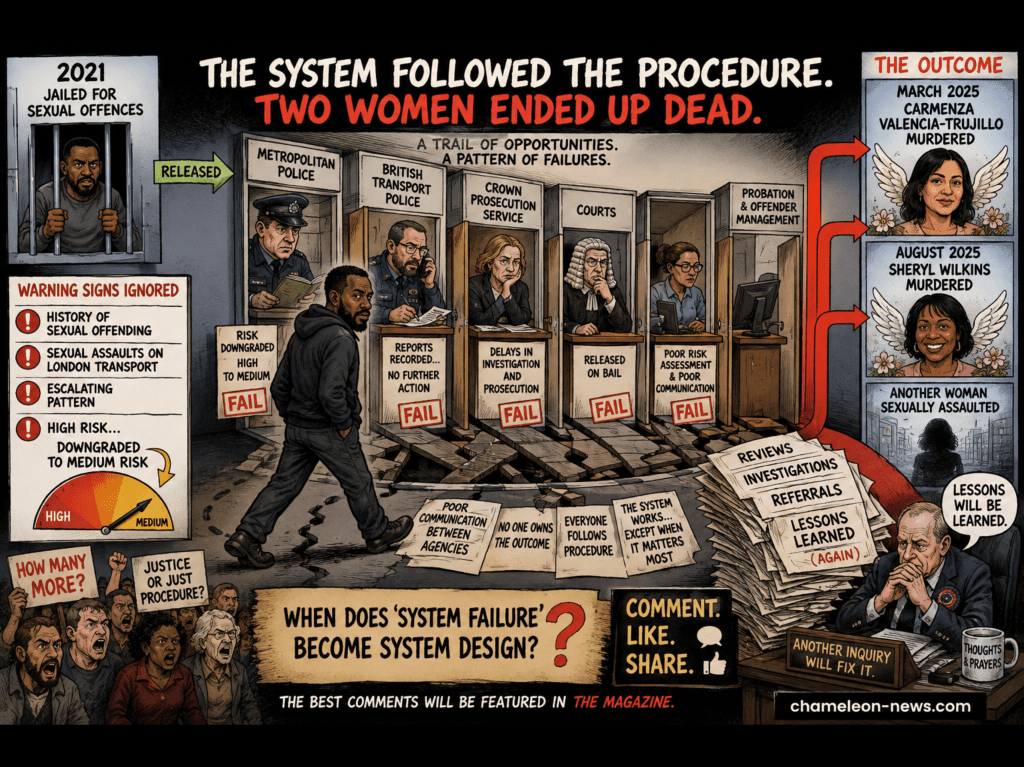
Simon Levy was not an invisible predator nobody knew existed. He was a convicted sexual offender with an escalating history of attacks — a man repeatedly encountered by the machinery supposedly designed to protect the public.
Yet somehow, through delays, bail decisions, flawed risk assessment and failures between agencies, that machinery kept producing the same extraordinary result:
Simon Levy was back on the street.
An Old Bailey jury has now convicted Levy, 40, of murdering Carmenza Valencia-Trujillo in March 2025 and Sheryl Wilkins five months later, as well as horrific sexual violence against another woman. Reporting has exposed a catalogue of failures involving policing and prosecution before and between those killings. (Reuters)
This isn’t merely a story about one monstrous criminal.
It’s a question about what happens when everyone has a procedure, everyone has a department, everyone has a file — but nobody successfully stops the danger.
📋 Welcome to the Great British Responsibility-Passing Championships
Imagine designing a security system with seventeen locks, nine alarms and twelve people holding different keys — then discovering nobody is actually responsible for shutting the bloody door.
That is what makes the Levy case so enraging.
Levy had previously been jailed for sexual offences. After release, he sexually assaulted women on London’s transport network. Errors and delays hindered the process of bringing him before the courts. He was later arrested on suspicion of murdering Valencia-Trujillo but released while inquiries continued. He subsequently committed more sexual offences before murdering Wilkins. (Reuters)
At one stage, the Metropolitan Police had even downgraded his assessed risk from high to medium. That decision is now under scrutiny. (Reuters)
You couldn’t write this as satire because an editor would send it back marked:
“Too implausible.”
And yet here we are.
The Metropolitan Police, British Transport Police and Crown Prosecution Service have all faced questions over failures or errors connected with the case. Police forces have referred matters to oversight bodies. (Reuters)
So perhaps the biggest question isn’t:
“Who made the mistake?”
Perhaps it’s:
“What happens when the system itself becomes the mistake?”
Because justice has competing obligations. Suspects have rights. The presumption of innocence matters. Bail exists for good reason. Rehabilitation matters too.
But here’s the apparently revolutionary concept:
Protecting the public matters as well.
When someone has an established record of sexual offending and allegations or convictions keep accumulating, risk management cannot simply become an administrative side quest.
The question isn’t only:
Can we prove this particular allegation beyond reasonable doubt right now?
It must also be:
What evidence-based risk does this person present while the machinery of investigation and prosecution grinds onwards?
⚙️ Police investigate.
📂 Prosecutors prosecute.
⚖️ Courts decide bail.
📝 Offender-management systems assess risk.
Everyone owns a piece.
And sometimes it appears nobody owns the outcome.
That’s institutional fragmentation at its most dangerous: each cog can explain what its cog was supposed to do while the machine itself drives through somebody’s living room.
And when catastrophe finally arrives?
Reviews.
Referrals.
Investigations.
Lessons will be learned.
Procedures will be strengthened.
Perhaps somebody will even unveil Britain’s most renewable natural resource:
a strongly worded statement. 📄🇬🇧
But Carmenza Valencia-Trujillo and Sheryl Wilkins don’t get another procedure.
They don’t get another risk assessment.
They don’t get another hearing.
They are dead.
And no sentence subsequently imposed on Levy can reverse that.
🔥 Challenges: When Does “System Failure” Become System Design? 🔥
Here’s the uncomfortable question Britain needs to confront:
How many separate organisations can share responsibility before responsibility effectively disappears?
That matters far beyond this individual case.
Because public confidence in justice doesn’t collapse merely because criminals exist. People understand that no state can prevent every crime.
Confidence collapses when the public begins believing that obvious danger can travel through multiple institutions, trigger multiple warning lights and still emerge on the other side free to offend again.
And that’s when something politically dangerous begins.
People stop asking whether the existing system needs another review.
They start asking whether they want the existing system at all.
That anger can produce necessary reform.
It can also produce something much darker: demands for governments willing to sacrifice due process, proportionality and individual liberty in exchange for the promise of absolute security.
And therein lies the real Devil’s Game:
When institutions repeatedly fail to exercise legitimate power competently, they create the public appetite for somebody willing to exercise illegitimate power ruthlessly.
💬 So where should responsibility ultimately sit? Police? CPS? Courts? Offender management? Or does Britain need one body with explicit responsibility for managing high-risk repeat sexual offenders across institutional boundaries?
👇 Comment on the blog. Like it. Share it. Challenge it. Tell us what you would change — because “lessons will be learned” stopped being reassuring several lessons ago.
🏆 The best comments, arguments and suitably brutal observations will be included in the magazine.


Leave a comment