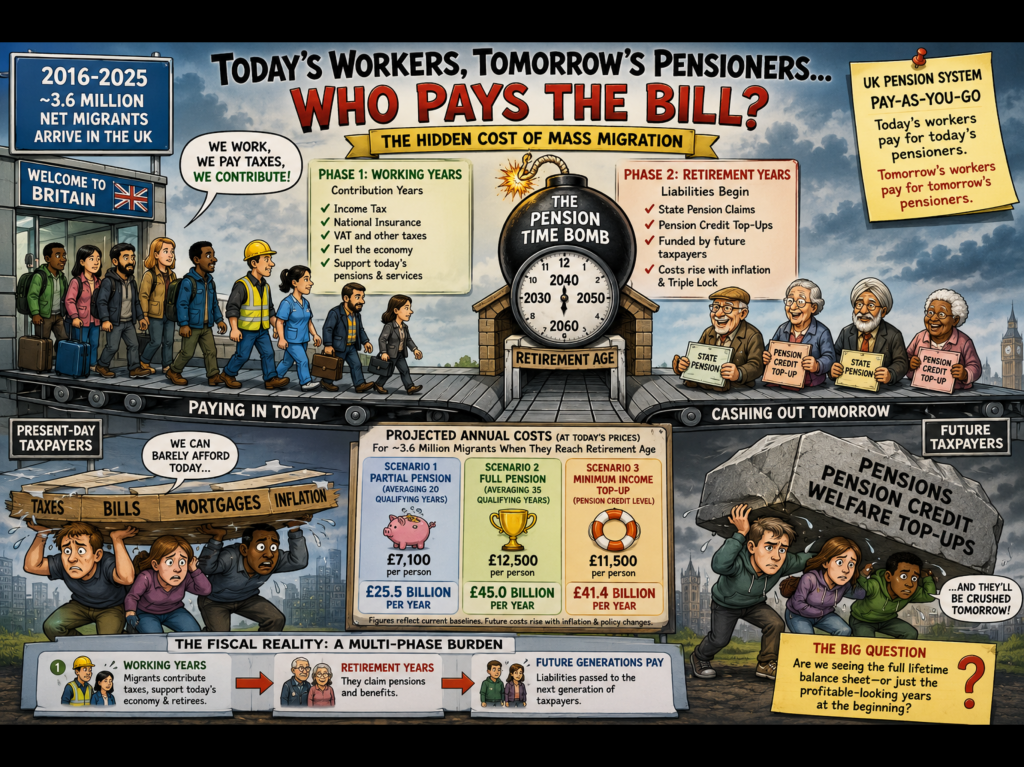
💷⏳Britain’s pension system runs on a fairly simple principle: today’s workers fund today’s retirees. So when roughly 3.6 million net migrants are added to the population over a decade, the fiscal story does not end when their first payslip lands. If they remain in the UK into retirement, many will eventually qualify for State Pension payments, while some with shorter contribution histories or low retirement incomes may also qualify for means-tested support.
Using the assumptions in the figures above, that could translate into future annual pension-related spending running into tens of billions of pounds at today’s prices. The uncomfortable bit is that those bills would not be paid from a magical National Insurance piggy bank marked “Do Not Open Until 2060.” They would largely be financed by whoever is working and paying taxes at the time.
🧾 Welcome to Britain’s Favourite Accounting Trick: Send the Invoice to the Future
For years, migration debates have been conducted like a supermarket advert: “Look! More working-age taxpayers!” 🎉
Lovely. And during their working lives, many migrants absolutely will pay Income Tax and National Insurance, helping finance public services and the pensions of people already retired.
But apparently mentioning what happens when those same workers eventually become pensioners is considered terribly unfashionable.
The State Pension does not arrive courtesy of a vault beneath Westminster stuffed with everyone’s carefully labelled NI contributions. Britain operates a pay-as-you-go system: workers today finance pensioners today, while tomorrow’s workers inherit tomorrow’s bill.
Which makes the long-term arithmetic rather more interesting.
Under the assumptions supplied here, a cohort averaging around 20 qualifying NI years could eventually represent roughly £25.5 billion a year in State Pension expenditure. If the cohort accumulated full pension entitlement, the figure rises towards £45 billion annually. And where retirement incomes remain sufficiently low for means-tested support, Pension Credit could add another layer to the equation. 💸
Of course, these scenarios are not forecasts carved into the Treasury walls. People leave Britain, die at different ages, build private pensions, earn different wages, qualify under different rules, and future governments can change pension ages, benefits and eligibility requirements.
But that is precisely the point.
A serious migration debate should examine the whole lifetime fiscal ledger, not merely photograph somebody at age 32, notice they are paying National Insurance, and announce that the calculation is finished.
That is like praising a 30-year mortgage because the first monthly payment cleared successfully. 🏠👏
The central question is not whether migrants contribute. Many plainly do.
The question is whether governments are honestly modelling taxes paid, public services consumed, pensions eventually claimed, welfare eligibility, dependants, earnings, productivity and length of residence across an entire lifetime.
Because demographics do not disappear merely because the spreadsheet becomes politically inconvenient.
Today’s additional worker can become tomorrow’s additional pensioner. Then governments face the same familiar menu: higher productivity, higher taxes, later retirement, reduced benefits, more borrowing—or another generation of younger workers added to keep the PAYG machine humming.
At which point Britain risks discovering the demographic equivalent of borrowing from one credit card to pay another while proudly announcing that the minimum payment has been met. 💳🔥
🔥Challenges🔥
So here is the question politicians of every stripe should be made to answer: when migration figures are presented as an economic benefit, are we being shown the lifetime balance sheet—or just the profitable-looking years at the beginning?
If these pension assumptions are too high, challenge them. If they are too low, explain why. If productivity and future tax revenues outweigh the liabilities, show the numbers.
But pretending future pension obligations simply vanish because today’s arrivals are currently working is not analysis. It is accounting by selective eyesight. 👀📊
👇 Comment on the blog with your calculation, criticism or counterargument. Like it, share it, and bring some numbers to the argument—not just slogans.
The best comments, rebuttals and statistical demolition jobs will be included in the magazine. 🎯📝


Leave a comment