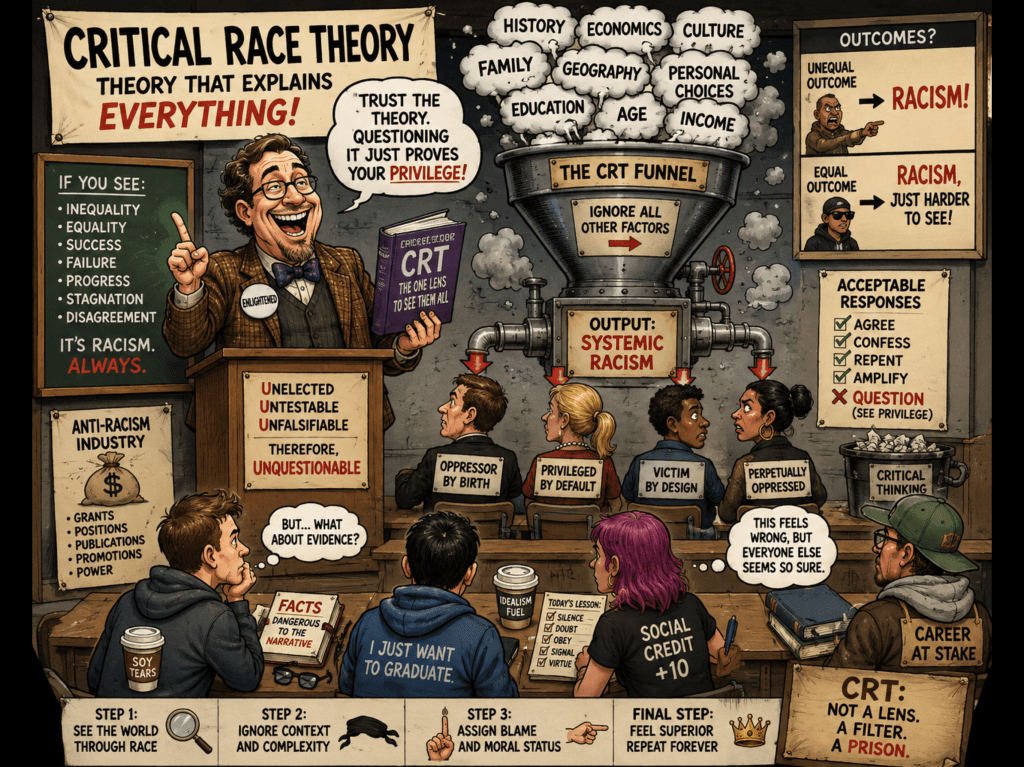
🎓🪤Critical Race Theory starts with a sensible little seed: yes, racism can shape institutions, not just individual behaviour. Fair enough. But then it grows into a sprawling academic jungle where every unequal outcome is racism, every equal outcome is suspicious, and every objection is conveniently diagnosed as proof that the objector is part of the problem. At that point, it stops being a tool for understanding society and starts looking suspiciously like an intellectual mousetrap baited with moral superiority. 🧀📚
The Gospel of “Heads I Win, Tails You’re Problematic”
🪙🔥Here’s the neat trick: if racial disparities exist, CRT can point and shout “systemic racism!” If disparities shrink or disappear, it can whisper, “Ah, the racism has simply become more hidden.” Very clever. Very unfalsifiable. Very much like arguing with a horoscope wearing a PhD gown.
A serious theory must risk being wrong. CRT often seems to prefer a safer hobby: being right no matter what happens. Unequal outcomes? Racism. Equal outcomes? Camouflaged racism. Criticism? Fragility. Doubt? Privilege. Evidence? Optional, but vibes encouraged. 🎭
And then comes the grand irony: a theory claiming to dismantle racial prejudice often asks us to view people primarily through race. Individuals become walking representatives of categories they never chose—oppressor, oppressed, guilty, victim, beneficiary, burden-bearer—before anyone has bothered asking who they are, where they came from, what they endured, or what choices shaped their life.
That is not liberation. That is prejudice with better stationery. 📝
Disparities deserve investigation. Racism exists. Historical injustice can echo into the present. But none of that means every difference between groups arrives pre-labelled with one cause. Income, geography, family structure, education, age, culture, migration history, personal choices, law, policy, and sheer human complexity all matter. Declaring the verdict before examining the evidence is not analysis. It is courtroom cosplay with a diversity seminar badge. ⚖️🎓
So why do educated people fall for it? Because education does not make people immune to fashionable nonsense. Sometimes it just gives them longer words for it. Universities reward novelty, moral drama, and theories that make the theorist feel like a priest of hidden truths. “Society is complicated” gets you a shrug. “I have uncovered another invisible architecture of oppression” gets you a conference panel, a reading list, and possibly a tote bag. 👜📖
Once careers, departments, reputations, and publishing pipelines attach themselves to an idea, questioning it becomes less like academic debate and more like poking a beehive in a library. Disagreement is not treated as disagreement. It becomes evidence of unconscious bias, privilege, denial, or moral defect. A closed circle forms: criticism does not test the theory; it feeds it.
That is the intellectual trap. Not the idea that racism matters. It does. Not the idea that institutions should be examined. They should. The trap is turning race into the master key for every locked door in society, then calling anyone who asks for another key “part of the lock.” 🔑🚪
People should be judged as individuals. Institutions should be examined with evidence. Discrimination should be proved, not presumed. And no society will overcome racial division by polishing the racial lens, strapping it to everyone’s face, and calling the blurred view enlightenment. 👓💥
🔥
Challenges
🔥
Here’s the question nobody in the seminar room wants shouted too loudly: when does “anti-racism” become just another way of making race the centre of everything? If a theory cannot be disproved, should it be trusted—or treated like academic incense smoke drifting through a very expensive room? 💨🎓
👇 Drop your take in the blog comments, like the post, and share it with someone brave enough to argue without hiding behind buzzwords. 💬🔥
The best comments will be included in the magazine. 🎯📝


Leave a comment