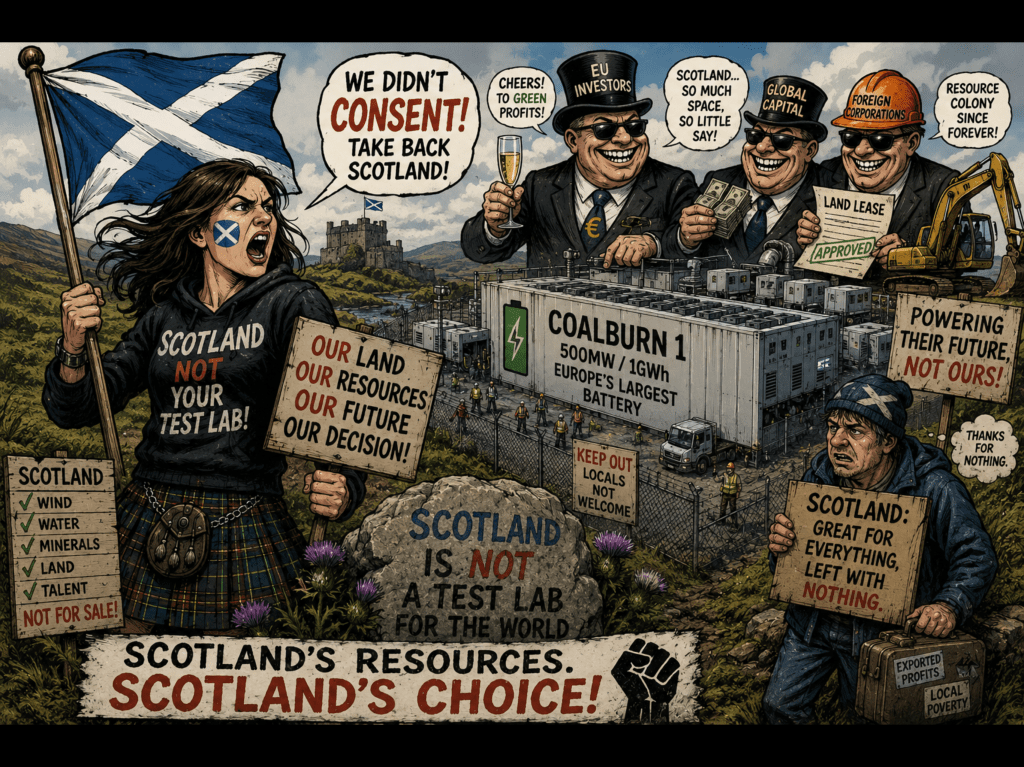
🔋🏴Europe’s largest battery has come online in Scotland: the 500 MW/1 GWh Coalburn 1 BESS, planted on a former coal mining site and now proudly declared the biggest operational battery energy storage system in Europe. Lovely. Another “green future” trophy polished up for press releases while ordinary Scots are left wondering when, exactly, anyone asked them if their land should become the continent’s experimental charging dock.
Welcome to Scotland: Where the Land Is Yours, Until Someone With a Spreadsheet Wants It
⚡🧾Isn’t it marvellous? Scotland, once treated as the place to dig up coal, is now treated as the place to bury giant batteries. Same tune, new fiddle. The old industries scarred the land with soot and pits; the new ones arrive wearing recycled lanyards, smiling like they’ve discovered morality in a wind turbine brochure.
And of course, it’s all sold as “progress.” Progress for whom? The investors? The developers? The nations queuing up to plug their ambitions into Scottish soil while communities get the usual buffet of buzzwords: sustainability, innovation, resilience, transition. Translation: “Stand still while we monetise your horizon.” 🌍💸
Scotland has energy, water, wind, land, ports, minerals, talent, fertile soil, and strategic value — which is exactly why everyone seems so keen to manage it, extract from it, profit from it, and explain to Scots how lucky they are to be “hosting” the future. Hosting, apparently, is what you call it when the guests arrive with cranes, contracts, and a business model, then tell you the house rules afterwards.
And here’s another bright idea: if corporations and overseas investors want to swallow up perfectly good Scottish farmland for energy schemes, storage sites, infrastructure, and profit farms dressed up as “green necessity,” then Scotland should tax them properly for the privilege. Not a polite little fee. Not a handshake and a ribbon-cutting ceremony. A serious land-use tax that reflects the real cost of taking productive land out of future food security. 🌾💷
Because if the climate keeps warming, farmland will not be some quaint old backdrop for tourist brochures and corporate drone footage. It will be survival infrastructure. Food-growing land may become one of the most important resources Scotland has. So why are we letting it be treated like spare carpet in a corporate showroom? If they want to occupy the land, they can pay Scotland — and pay enough to make sure Scottish communities, farmers, and future generations actually benefit. 🚜🔥
This is not anti-renewable. It is anti-being-treated-like-a-laboratory with mountains. Scotland should not be the testing ground where decisions are made over people’s heads, dressed up in green wrapping paper, and handed back as a gift we never asked for. If our resources are valuable enough to power Europe’s future, then they are valuable enough for Scotland to control, benefit from, tax, protect, and decide upon. 🔋🏴
🔥Challenges🔥
Here’s the real spark: who gets the power, who gets the profit, and who gets left staring at the machinery? Are these projects building Scotland’s future — or just turning Scotland into someone else’s infrastructure cupboard?
And should companies using Scottish land — especially farmland we may desperately need in a warming future — be taxed heavily for the privilege? Or are we supposed to keep smiling while they pave the pantry and call it progress? 🌾⚡
Drop your take in the blog comments. Do you think Scotland is leading the green revolution, or being quietly strip-mined in a hi-vis vest? ⚡💬
👇 Comment, like, and share — because silence is exactly what they budgeted for.
The best comments will be included in the magazine. 📝🔥


Leave a comment