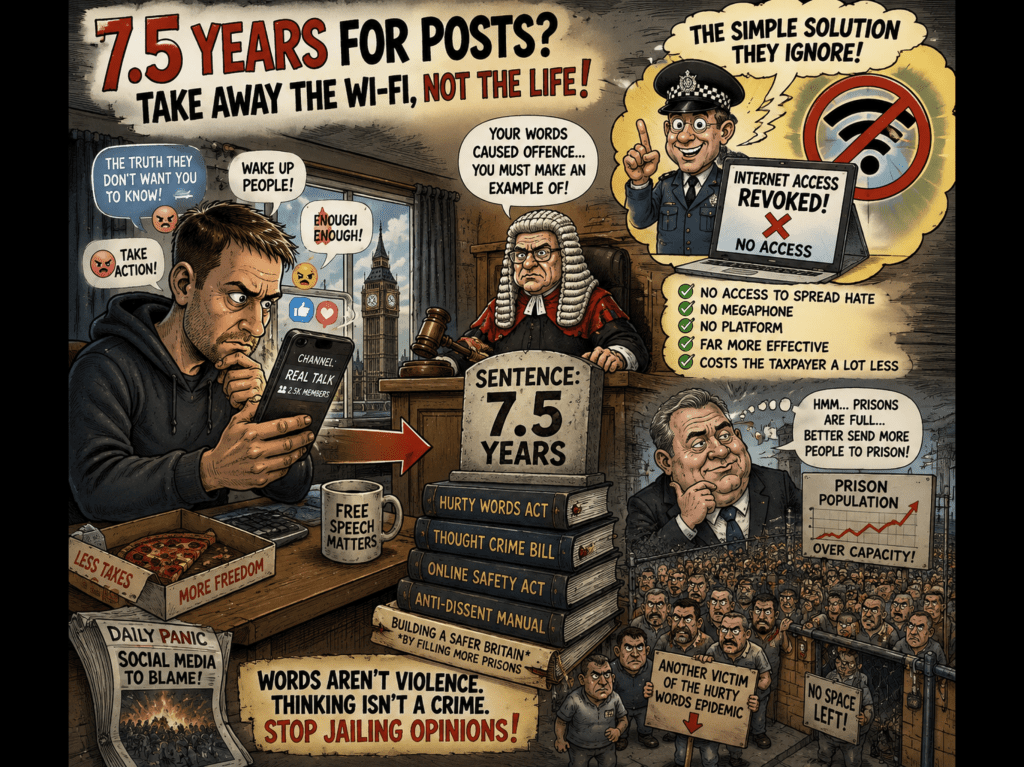
📱🔒Andrew Robert McIntyre was jailed for seven-and-a-half years after pleading guilty to encouraging violent disorder and criminal damage, plus possession of a bladed article in public, following the Southport disorder. Police said he sent Telegram messages encouraging others to take part in violent disorder and made failed attempts to stir up trouble elsewhere.
🚨 The Government’s Favourite App: JailMail Premium
Here we are again in modern Britain, where the prisons are bursting, the courts are creaking, and the state’s grand solution is apparently: “Have we tried adding more people?”
Now, let’s be absolutely clear: McIntyre did stupid, reckless, inflammatory things. Using social media to stir up chaos after a horrific tragedy is not brave, noble, or clever. It is the digital equivalent of throwing a match into a petrol station and then acting shocked when everyone starts shouting. 📱🔥
But seven-and-a-half years?
That is where the argument starts to wobble like a government minister explaining prison capacity on live television.
He did not personally assault anyone. He did not personally burn anything down. He did not personally smash a window, attack a police officer, or physically harm a member of the public. He posted. He encouraged. He behaved like an idiot with a phone and a cause. That deserves punishment—but does it deserve a sentence that can look heavier than what some violent and sexual offenders receive?
Because here’s the bit the public are expected not to notice: there were other tools available. Take away his internet access. Ban him from Telegram, encrypted channels, and public social media. Confiscate devices. Tag him. Put him under curfew. Make him report to a police station every day. Put him under strict licence conditions. Monitor him so closely he has to ask permission before checking the football scores. ⚽📵
In other words: remove the megaphone.
But no. Instead, they may have simply sent the megaphone to prison with him—only now it comes with worse lighting, more paperwork, and a much bigger invoice for the taxpayer. Because let’s not pretend prisons are sealed Victorian caves where nobody ever gets online. Prisoners can have limited, controlled digital access in some settings, and illegal phones are a long-running problem behind bars. So if the internet was the danger, how exactly has the state solved it by moving him into an overcrowded building where access can still exist—restricted, monitored, smuggled, shared, or abused? 📱🔒
That is not precision justice. That is using a hammer to uninstall an app.
If the problem was online influence, why was the answer a seven-and-a-half-year prison sentence instead of digitally cutting the wires? Why not manage the risk directly, rather than dumping another body into an already overloaded prison system and pretending that is strategy?
The government keeps warning that the jails are full, then behaves like every social problem can be solved by opening the cell door and yelling, “Next!”
And this is where people understandably lose trust. When someone gets years in prison for online incitement while the public sees cases where rapists, sexual offenders, or violent criminals appear to receive lighter outcomes, the justice system starts to look less like balanced law and more like a malfunctioning fruit machine: pull the lever, hope for logic, receive nonsense. 🎰⚖️
No one is saying there should be no consequence. Consequences matter. Public safety matters. Incitement matters.
But proportionality matters too.
A justice system that cannot tell the difference between a dangerous keyboard warrior and someone who physically destroys lives is a justice system begging to be mocked. And if ministers want to know why prisons are overflowing, perhaps they should stop treating jail like the nation’s universal remote control: press it for everything, then act surprised when the batteries die.
🔥Challenges🔥
Where is the line between punishing dangerous incitement and using prison as political theatre? If the internet was the weapon, why wasn’t internet access the first thing removed?
And if he can still find some route online from inside prison—whether officially restricted, indirectly accessed, or illegally smuggled in—what exactly has been achieved besides making the taxpayer fund the world’s most expensive content moderation policy? 💸📵
Drop your take in the blog comments—was seven-and-a-half years proportionate, or should the punishment have focused on cutting off his platform, restricting his movements, and forcing daily police check-ins instead? 💬⚖️
👇 Comment, like, and share if you think Britain needs smarter justice, not just fuller jails and louder politicians.
The best comments will be included in the magazine. 🎯📝


Leave a Reply