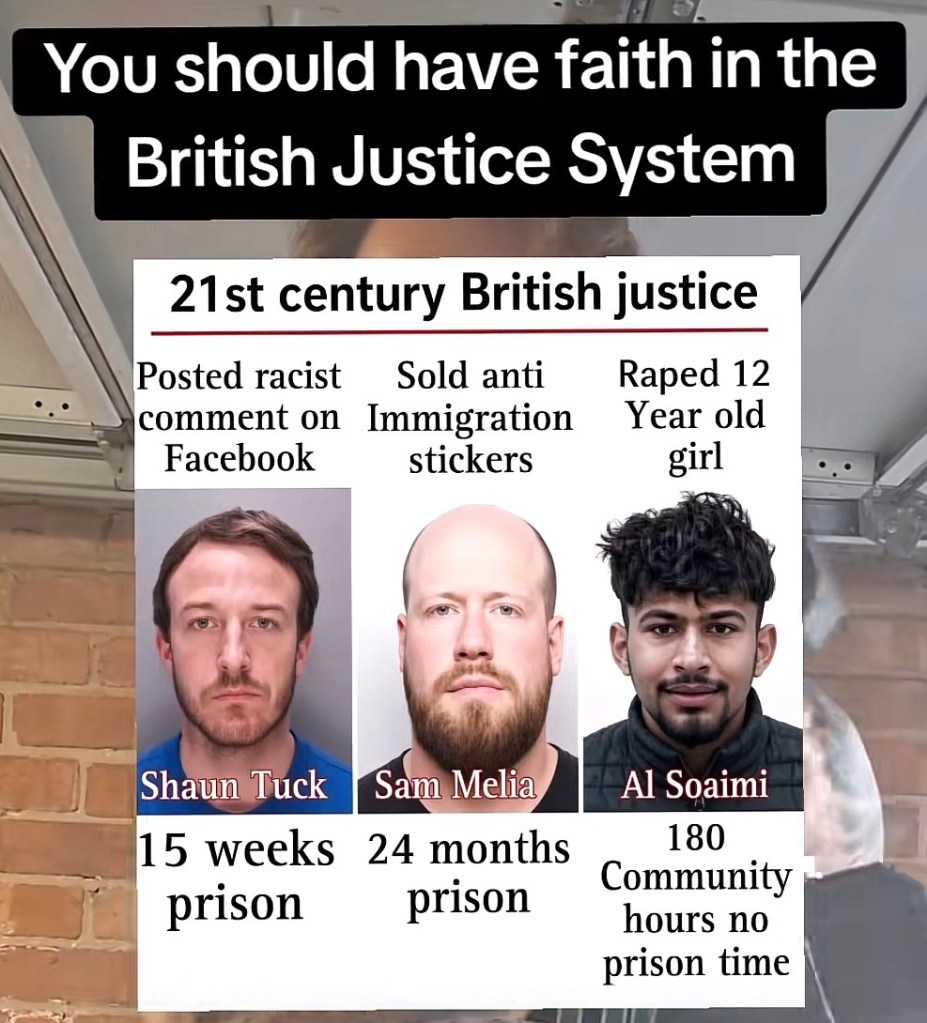
⚖️🇬🇧We are constantly told to trust the justice system.
Fair enough.
But trust is not a religious obligation. It has to survive contact with actual sentencing decisions.
And when members of the public see one man sent to prison for racist abuse on Facebook, another jailed for two years for a campaign involving racist and antisemitic material, while a man convicted of serious sexual offences against a child receives a suspended prison sentence, they are entitled to ask an extremely uncomfortable question:
How does British justice decide what deserves an actual prison cell?
Before the outrage machine starts overheating, the viral graphic above needs one important correction.
Shaun Tuck really was jailed for 15 weeks after being convicted over racist abuse posted on Facebook. (ITVX)
Samuel Melia really was sentenced to two years in prison, but describing his offence simply as “selling anti-immigration stickers” leaves out rather a lot. A jury convicted him of distributing material intended to stir up racial hatred and intentionally encouraging or assisting racially aggravated criminal damage. (The Times)
And the third case is particularly important to describe accurately.
Hamoud Al-Soaimi was not convicted of rape, as the meme suggests. He was convicted of three counts of sexual assault and assaulting a child under 13 by penetration. ITV reported that he received a two-year prison sentence suspended for two years; reporting on the case also records 180 hours of unpaid work. He had been 15 at the time of the offences. (ITVX)
Correcting the meme does not make the underlying question disappear.
If anything, it makes that question stronger.
🤡 Welcome to the Sentencing Calculator Nobody Understands
Imagine explaining this to somebody who had never encountered the British justice system.
“Right, so racist Facebook comments?”
Prison.
“Material intended to stir up racial hatred?”
Prison.
“Sexually assaulting a child and assaulting a child under 13 by penetration?”
Well…
Two years suspended.
At this point the visitor would probably assume we had accidentally handed the sentencing guidelines to a malfunctioning bingo machine. 🎰⚖️
This is not an argument that racist abuse should be legal.
It is not an argument that stirring up racial hatred should carry no consequences.
And it certainly is not an argument for removing laws protecting people from threats, harassment or incitement.
It is something much simpler:
The public needs to understand the moral hierarchy being expressed by sentencing.
Because punishment is not merely about what happens to the offender.
It sends a message about what society considers serious.
And when the public sees a person physically enter prison for words while somebody convicted of penetrating a child receives a suspended sentence, the justice system should expect people to stare at the result and say:
“Excuse me?” 🤨
That reaction is not automatically extremism.
It is not automatically racism.
It is not proof that somebody hates judges, police officers or the rule of law.
Sometimes it is simply what happens when ordinary people possess eyes.
⚖️ Justice Cannot Just Demand Trust — It Has to Explain Itself
There may be legal reasons why apparently shocking sentences differ.
Age at the time of offending matters.
Individual charges matter.
Sentencing guidelines matter.
Previous convictions matter.
Mitigation matters.
The exact role an offender played matters.
Judges are required to sentence the offender and offence actually before them—not whatever crime social media has compressed into a six-word caption.
That is precisely why viral memes can be misleading.
But here is the other side of that argument:
If the public repeatedly looks at sentencing outcomes and thinks the priorities appear upside down, the answer cannot simply be: “You’re too stupid to understand the law.”
That is how institutions destroy confidence in themselves.
Justice must not only operate according to rules.
It has to be capable of explaining those rules to the population whose authority gives the system legitimacy.
Because “have faith” is what churches ask for.
Courts should be able to provide reasons.
And if those reasons produce outcomes that appear grotesquely disproportionate to ordinary citizens, Parliament and the judiciary should be willing to defend them publicly.
Not hide behind jargon.
Not accuse everybody asking questions of having sinister motives.
Explain it.
🚨 When Words Get a Cell But Sexual Offending Gets a Suspended Sentence
This is where the debate becomes bigger than these three men.
Britain is increasingly having a national argument about speech.
What can you post?
What constitutes hatred?
When does an offensive opinion become a criminal offence?
When should somebody lose their liberty because of words?
Those are legitimate debates in a democracy.
But every time the state demonstrates that it is prepared to use imprisonment for speech offences, the standard by which other sentencing decisions are judged inevitably becomes tougher.
You cannot say:
“Prison is necessary here because words can cause serious harm.”
and then appear strangely reluctant to use immediate imprisonment when the harm involved a child being sexually violated.
People are going to notice.
Of course they are.
And perhaps the response should not be to demand that citizens stop noticing.
Perhaps the justice system should start answering the question they are actually asking.
Are our sentencing priorities proportionate?
🔥 Challenges: Does This Look Like Justice to You?
Forget the misleading captions for a moment and look at the verified offences and sentences.
One offender received 15 weeks’ immediate custody for racist Facebook abuse. (ITVX)
Another received two years’ immediate custody after convictions connected with deliberately stirring up racial hatred and encouraging racially aggravated criminal damage. (The Times)
Another, convicted of three sexual assaults and assaulting a child under 13 by penetration, received a two-year suspended prison sentence. (ITVX)
Now answer the question.
Does that sentencing hierarchy make sense to you?
Maybe there are legal explanations.
Fine.
Let’s hear them.
Because confidence in justice is not maintained by telling the public to stop asking awkward questions.
It is maintained by answering them.
💬 Tell us in the blog comments: are British sentencing priorities right, or has the system reached the point where ordinary people can no longer understand what it considers most serious?
👇 Comment. Like. Share. And challenge the argument if you disagree.
The best comments, arguments and counterarguments will be included in the magazine. 🎯📝
A justice system worthy of public faith should never be frightened of public scrutiny.


Leave a comment