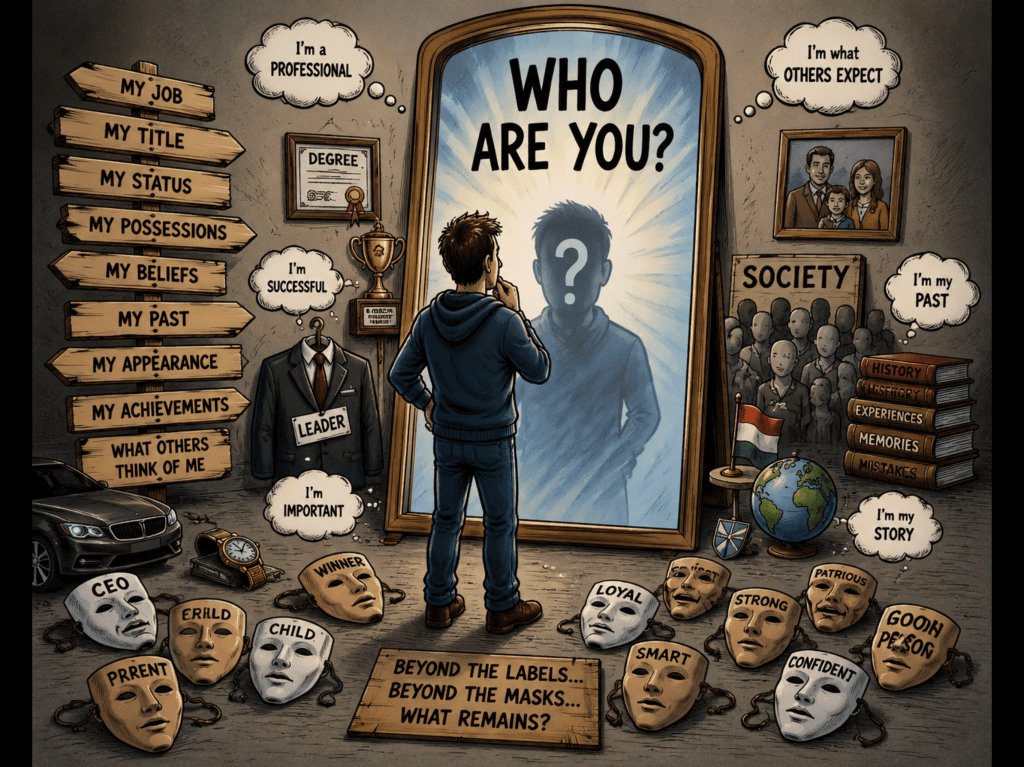
🪞🧠Most of us can reel off the easy answers without breaking a sweat: What do you do? Where are you from? What do you believe? Job title, hometown, politics, football team, relationship status—identity neatly packed into little boxes.
But ask “Who are you?” without allowing any of those labels, and suddenly the mental loading wheel appears. 🔄
🎭Welcome to the Great Human Identity Costume Party
We spend years assembling ourselves out of nouns.
Manager. Parent. Brit. Homeowner. Graduate. Conservative. Socialist. Entrepreneur. Retiree. Vegan. Gym person. Person-who-definitely-doesn’t-care-what-anyone-thinks.
Then someone commits the social crime of asking what exists underneath all that.
Cue silence. 😶
Because perhaps we’ve become so good at describing our position in the world that we’ve forgotten how to describe the person actually standing there.
Strip away the salary, postcode, qualifications, possessions and carefully curated opinions, and what remains?
Your character when nobody is watching.
What frightens you.
What you forgive.
What you refuse to become.
How you treat people who can do absolutely nothing for you.
The things you secretly want but are embarrassed to admit.
The principles you keep when keeping them becomes inconvenient.
That version of identity cannot be squeezed onto LinkedIn. Which is probably why LinkedIn has wisely avoided adding a section called “Existential Core.” 💼💀
Perhaps the uncomfortable truth is that identity isn’t something we simply have. It is something we repeatedly construct through choices.
Lose a job and you discover whether the job was something you did—or something you thought you were. Lose status, money, popularity or certainty and the same question comes knocking again:
Now who are you?
🔥Challenges🔥
Try answering “Who am I?” without mentioning your job, nationality, family role, possessions, religion, politics, qualifications or social status.
Harder than it sounds, isn’t it? 🪞
What would be left in your answer—and would you actually like the person you described?
👇 Drop your answer in the blog comments, hit like, and share this with someone brave enough to attempt the question.
The best comments, insights and existential curveballs will be featured in the magazine. 🎯📝


Leave a comment