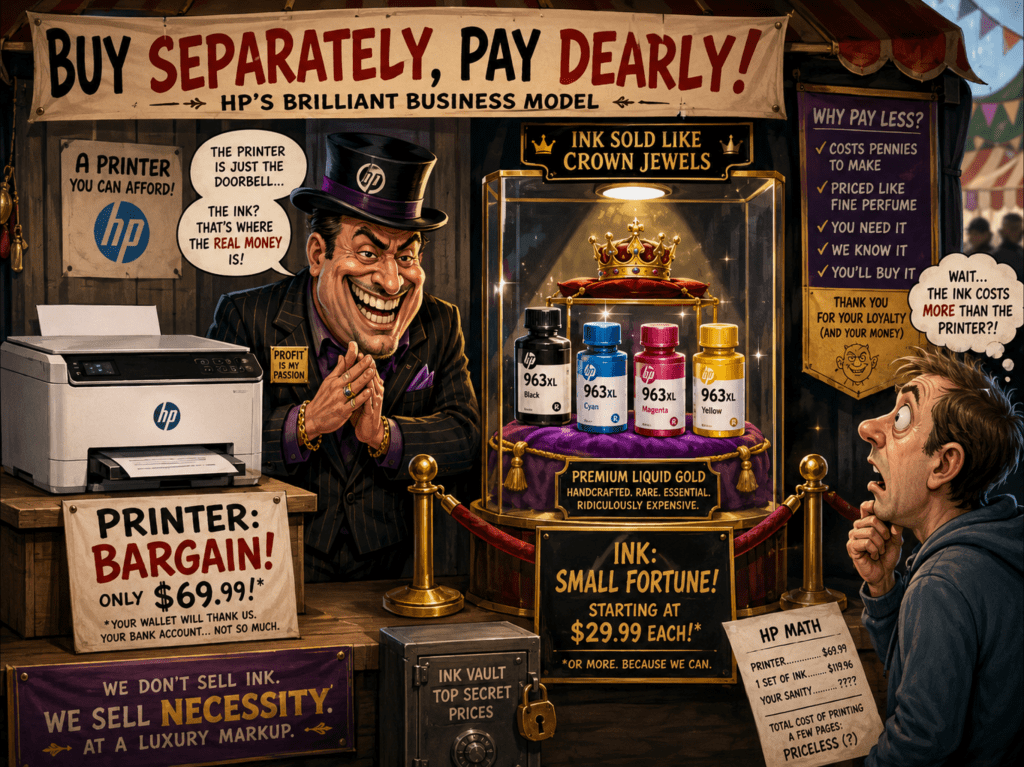
Sometimes a business idea appears because a product is being sold in a strange way.
Take the HP Smart Tank 7007.
Suppose you can buy the complete printer, including ink, for around £180.
At first glance, that is just a printer purchase. But look at the bundle differently and you may see two separate products:
- the printer itself;
- the genuine HP ink supplied with it.
That creates a simple question:
Could you buy the bundle, separate the components, and sell them individually for more than you paid?
Start with the numbers
A full set of genuine replacement ink is worth roughly £52 at normal retail prices.
So, very roughly:
£180 bundle price − £52 ink value = £128 printer value
That £128 figure is important.
If you wanted the ink for yourself and could sell the unused printer without ink for more than £128, you would effectively be getting your ink cheaper than buying it separately.
But what happens if you sell the ink as well?
Now you have a small trading business.
Imagine buying 10 printers:
10 × £180 = £1,800 invested
Suppose you sell each set of genuine ink for £45.
That produces:
10 × £45 = £450
You now only need to recover £1,350 from the printers to get all your original money back.
That means:
£1,350 ÷ 10 = £135 per printer
Anything above £135 per printer becomes gross profit.
For example:
Sell 10 ink sets at £45 = £450
Sell 10 printers at £150 = £1,500
Total sales = £1,950
Original purchase cost = £1,800
Gross profit = £150
That is £15 gross profit per printer bundle before fees, postage, returns and other costs.
Selling the ink separately may be even better
Instead of selling the ink as one complete set, you could potentially sell individual bottles.
Somebody who only needs cyan does not necessarily want to buy four bottles.
If HP sells a colour bottle for around £12.49 and you sell yours for £10 or £11, the customer saves money and you still extract reasonable value from the original printer package.
Black ink could be sold separately as well.
Suddenly, one £180 printer becomes several saleable products:
1 printer + several bottles of ink
That is the same principle used by dismantlers, wholesalers and parts businesses everywhere.
The value of the components can sometimes exceed the value of the complete product.
But don’t buy 100 printers tomorrow
This is where budding entrepreneurs often make their first expensive mistake.
The spreadsheet says it works, so they assume the market will cooperate.
It might not.
The crucial question is:
Will somebody really pay £140 or £150 for a brand-new printer that does not contain ink?
That needs testing.
There are also selling costs.
You need to consider:
- eBay or marketplace fees;
- payment-processing fees;
- postage;
- packaging;
- damaged parcels;
- returns;
- time spent listing products;
- customer questions;
- warranty implications;
- competition from discounted new printers.
A £15 theoretical profit can disappear remarkably quickly.
The sensible entrepreneur’s experiment
Do not start with ten.
Start with one additional printer.
Buy it for £180.
Remove the unopened ink.
List the printer accurately as:
New and unused — ink not included.
Sell the ink separately.
Then record exactly what happens.
For example:
Printer sells for £145.
Ink sells for £45.
Total recovered = £190
You have made £10 gross profit.
Not exciting, perhaps.
But you have proved something extremely valuable:
the market exists.
Now imagine the printer sells for £155 and the ink for £48.
Total recovered:
£203
Profit:
£23 per unit
Ten units could theoretically produce £230.
One hundred could produce £2,300.
At that point you start negotiating bulk purchase prices rather than paying normal retail.
And that is where the idea becomes more interesting.
The real business lesson
The most valuable part of this experiment is not necessarily printer ink.
It teaches an important business principle:
A bundled product can sometimes be worth more when separated into its components.
Businesses do this constantly.
Cars become spare parts.
Computers become processors, memory and screens.
Gift sets become individual products.
Wholesale packs become retail units.
And perhaps, occasionally, a heavily discounted printer becomes a printer plus several bottles of genuine ink.
The entrepreneur does not simply ask:
“What does this product cost?”
They ask:
“What are all the things inside this product worth?”
That small change in thinking is often where interesting businesses begin.


Leave a comment