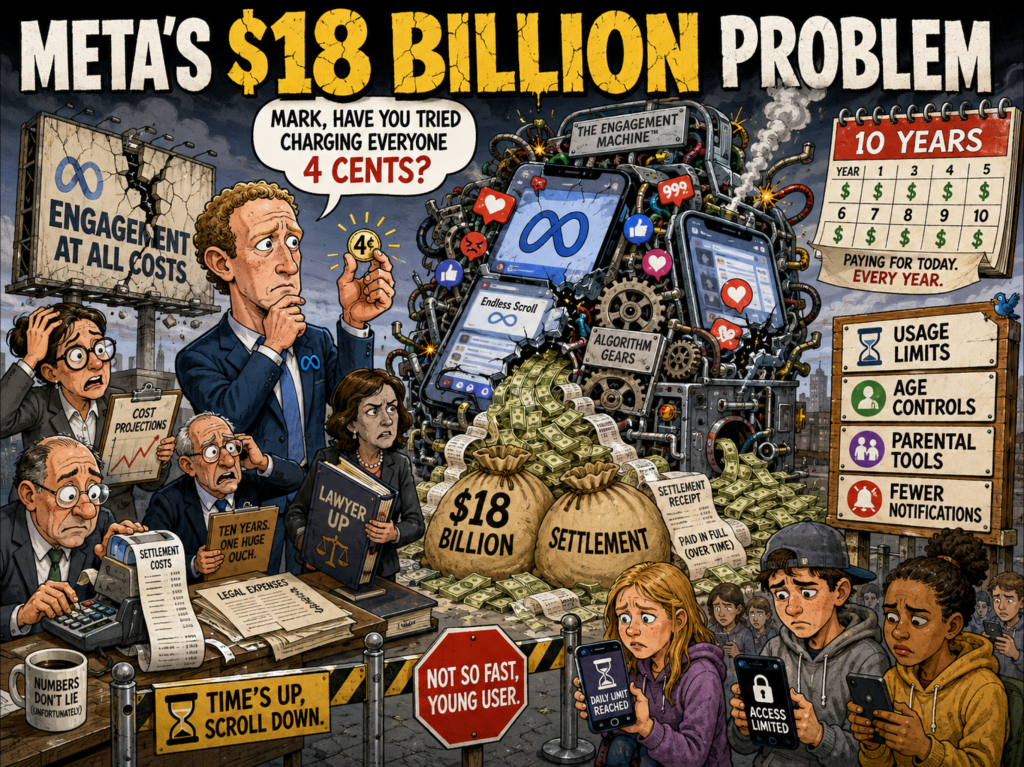
💰📱Meta has agreed to pay up to $18 billion over ten years to settle US claims concerning alleged harms to children from Facebook and Instagram. Meta denies wrongdoing, but the agreement also brings tighter restrictions for teenagers, including usage limits and stronger age controls. (reuters.com)
Eighteen billion dollars sounds catastrophic. Until you remember that Meta’s family of apps averaged around 3.60 billion daily active people in June 2026. (sec.gov)
Then somebody reaches for a calculator. Spread the full $18 billion across 3.6 billion active users over ten years and it works out at roughly: 50 cents per user, per year. Or approximately: 4 cents a month. 🤏💵
That’s it. Four cents. Somewhere in Silicon Valley an accountant has presumably just fallen out of a Herman Miller chair.
💸 Dear Meta: We May Have Found the World’s Smallest $18 Billion Repayment Plan
Suppose Meta didn’t even try to recover the money through advertising. Suppose it introduced something entirely different: A tiny verified-account charge.
Not $10 a month. Not $5. Not even the £1 we previously suggested. Perhaps 10p, 20p or 25p a month.
The purpose wouldn’t primarily be to raise money. The payment would create something social media has spent twenty years avoiding: friction. And, more importantly: accountability.
An adult opens an account. They verify that they are an adult through an approved identity or age-assurance process. They attach a genuine payment mechanism. They pay a nominal recurring amount. They can still use whatever public username they want.
Nobody needs to know that DragonSlayerBrexitMum72 is actually Susan from Basingstoke. 🐉🇬🇧 But Meta knows there is a verified adult behind the account. That’s the important bit.
Children Don’t Get Independent Accounts
A child or teenager who is permitted to use the platform doesn’t create an entirely independent digital identity simply by entering: Date of birth: 14 March 1987.
Very convincing, Kevin. You’re eleven. 🧒📲
Instead, the young person’s account sits underneath a verified parent or guardian account. The parent authorises it. The parent knows it exists. The platform knows which verified adult is responsible for it. Age controls can then be attached to an actual family relationship rather than the world’s most optimistic tick box.
Meta is already developing Teen Accounts, parental supervision and AI-powered age assurance. It has introduced systems designed to place suspected teenagers automatically into more restrictive experiences. (about.fb.com)
So most of the technological ingredients already exist. The radical ingredient is simply this: Make somebody accountable for opening the door.
And suddenly the $18 billion settlement gives Meta an extraordinary opportunity. Don’t merely write the cheque. Redesign the system that created the argument in the first place.
🪪 Keep Anonymity — Lose Unaccountability
This distinction matters enormously. Nobody is suggesting that your passport name should appear beside every Facebook argument about cyclists.
Public pseudonymity can remain. You could still be: AngryBadger1958, ChelseaDad666, or Patriot_FreeSpeech_NoSeriouslyThisTime47. 🇬🇧🦡
Wonderful. Democracy survives.
What changes is that Meta knows an accountable adult exists behind that identity.
One verified adult might be allowed several profiles. But those profiles ultimately lead back to one validated account relationship. That makes industrial quantities of disposable accounts harder to manufacture. It makes pretending to be an adult harder for children. And it potentially allows parental controls to stop being optional decorative furniture buried fourteen menus deep.
The settlement itself now requires stronger protections, including tighter age verification and restrictions on teenagers’ use. (reuters.com)
So here’s the delicious irony: Meta is about to spend billions dealing with the consequences of a problem that a tiny accountability mechanism might help reduce.
🤔 So Why Won’t Meta Do It?
Ah. Welcome to the awkward bit.
Because if this were obviously wonderful for Meta, Mark Zuckerberg would presumably already be launching Facebook Verified Human™ while standing in front of a suspiciously minimalist grey wall.
There are several reasons Meta might hate the idea.
First: friction is the enemy of growth. Social media became enormous partly because opening an account is incredibly easy. Every additional screen between “I fancy joining Instagram” and “Here is my breakfast” risks losing a user. A verification process plus payment—even a microscopic payment—turns instant registration into a transaction. Tech companies have spent decades removing precisely that kind of friction.
Second: free users are extremely valuable. Meta’s business isn’t primarily built around charging people to enter. It’s built around having enormous numbers of people enter, remain there and generate opportunities to sell advertising.
Meta reported $60.8 billion of revenue in just the second quarter of 2026, while ad impressions across its family of apps rose 14%. (sec.gov)
Why put a tollbooth in front of one of the largest advertising audiences ever constructed?
Third: requiring payment creates exclusion problems. Children aren’t the only people without conventional banking. Some adults don’t have credit cards. Some rely on prepaid cards. Some are financially vulnerable. Some live in countries where payment infrastructure works completely differently. Some have legitimate reasons not to connect their financial identity directly with their social-media activity.
Suddenly our beautiful 25p solution requires seventeen committees, 400 pages of exemptions and a consultant called Sebastian charging £2,300 a day. 📚💼
Fourth: payment doesn’t automatically prove identity. Someone can use somebody else’s card. Parents can hand credentials to children. Payment accounts can be shared. Fraud exists. So the financial transaction would need to accompany proper age or identity assurance—not replace it.
Fifth: Meta could inherit even more responsibility. This may be the biggest reason of all. Imagine Meta explicitly announces: “Every child account is linked to a verified responsible adult.”
Wonderful. Until something goes horribly wrong.
Then lawyers may ask: “You said you knew who the responsible adult was. You said this system verified ages. Why did this child get through?”
Suddenly a system designed to demonstrate responsibility could also create much clearer expectations about Meta’s own responsibility.
Corporate lawyers do occasionally regard such innovative ideas with the enthusiasm of a cat being introduced to a bath. 🐈🛁
Sixth: governments might rather regulate it themselves. Once platforms demonstrate that reliable adult verification is technically and commercially possible, politicians may ask an unpleasant follow-up: “Excellent. So why isn’t it compulsory?”
Meta could accidentally build the prototype for the regulation it has spent years arguing should remain proportionate. Whoops.
💥 But Here’s the Question Meta Now Has to Answer
Meta already has Teen Accounts. It already has parental supervision. It already uses age-assurance technology. It already knows how to take payments. It already operates verified subscription products. And it has now agreed to a settlement worth up to $18 billion over allegations concerning children’s use of its platforms. (reuters.com)
So perhaps the interesting question isn’t: “Could Meta do this?”
Clearly, the components exist.
The question is:
“Why hasn’t Meta joined them together?”
Verified adult. Nominal recurring charge. Public pseudonymity protected. Children attached to verified guardians. Multiple profiles permitted but ultimately accountable. Platforms still responsible for doing their part. And a tiny financial barrier discouraging the production of disposable accounts by the thousand.
Maybe it should cost £1. Maybe 25p. Maybe 10p. Perhaps merely one penny.
The exact figure is almost irrelevant. Because the product being purchased isn’t Facebook.
It’s accountability.
🔥 Challenges: Would You Pay Pennies for a More Accountable Internet?🔥
Here’s the challenge. Would you pay 10p or 25p a month if it meant knowing every adult social-media account ultimately belonged to a verified adult—even though their real name remained private?
Would you allow your teenager’s account to sit beneath yours?
And here’s the bigger question: Would Meta ever introduce a system that might make social media safer if the price was making account creation slightly harder? 👀
That’s the question worth putting to Mark Zuckerberg.
👇 Hit the blog comments and tell us what we’ve missed.
Is this an elegant solution to online accountability—or the beginning of an identity system nobody should want?
Comment. Like. Share. Argue. Improve it. Tear it apart. 💬🔥📲
The best comments—and the most convincing objections—will be included in the magazine. 📰🎯


Leave a Reply