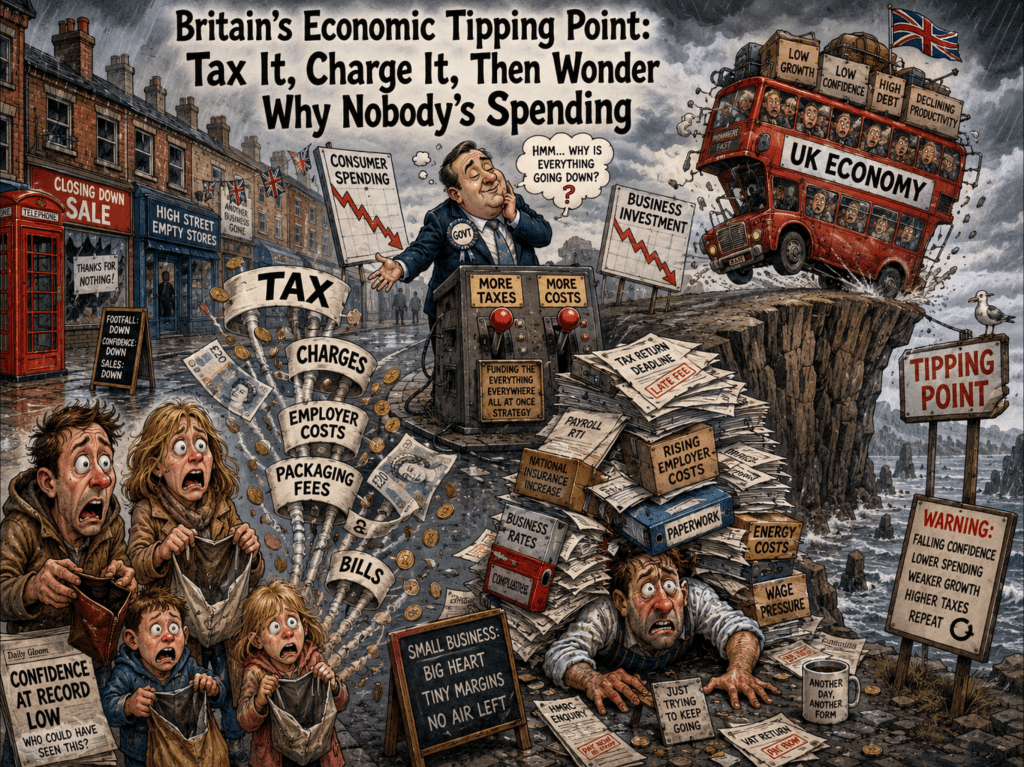
Asda executive chairman Allan Leighton’s warning is brutally simple: make it more expensive to employ people, add costs to businesses, squeeze consumers, and eventually spending and investment fall.
He believes Britain may be nearing a “tipping point” where that pressure becomes self-reinforcing. Higher business costs lead to higher prices, weaker investment and cautious hiring. Households then have less money to spend, confidence declines and demand softens — leaving politicians staring at disappointing growth figures as if the missing growth has gone into hiding. 📉🤔
Leighton has criticised Labour’s economic approach since taking office in 2024, arguing that taxation and additional business charges have “inhibited growth.” Employer taxes and packaging-related costs may be imposed on companies, but consumers ultimately feel the impact through prices, employment decisions and reduced investment.
🎓 Apparently Britain Needed Harvard to Discover That People Spend Less When They Have Less Money
Leighton put it plainly:
“When that happens, consumers spend less, their confidence goes down, and businesses invest less. You don’t have to go to Harvard to work that out.”
Quite.
The formula is not complicated:
Tax the employer.
Raise business costs.
Increase prices or cut investment.
Leave households with less money.
Then announce that “growth remains the Government’s priority.” 🚀
Priority, perhaps.
Policy? Less convincing.
Leighton says the forthcoming Budget has three broad choices: continue adding measures that inhibit growth, stop adding them, or introduce policies designed to stimulate the economy.
The most revealing possibility is that Britain may now regard not imposing another burden as economic progress.
That is not a boom.
That is the Treasury taking its foot off the accelerator and calling it a recovery. 🏎️💨
Governments, of course, need revenue. Public services and infrastructure cost money, and balancing the national budget is harder than balancing the household spreadsheet after cancelling Netflix.
But Leighton’s argument concerns the cumulative effect. At what point does raising more money from businesses and consumers begin to weaken the economic activity needed to generate future tax revenue?
If every attempt to fill the Treasury’s bucket creates another hole in the bottom, the answer may not be a bigger bucket.
It may be a plumber. 🪣💷
🔥 Challenges 🔥
The Budget must answer one central question: has the cure for weak public finances started creating a weaker economy?
Leighton believes Britain is close to that tipping point.


Leave a Reply